
Schedule Appointment

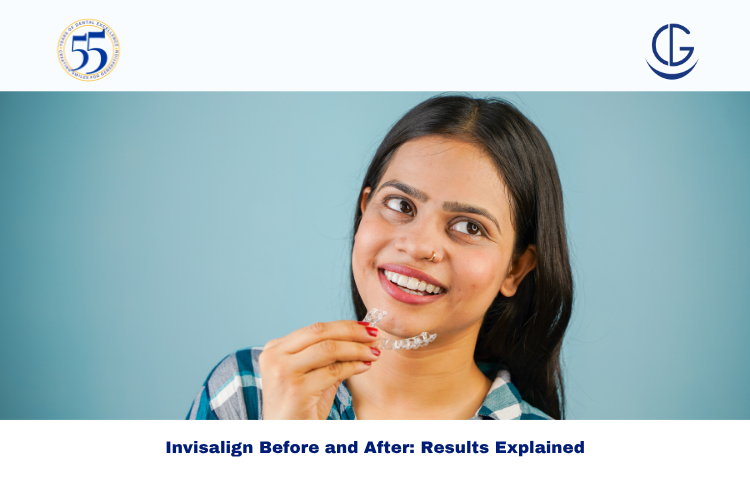
Invisalign before and after photographs are among the most powerful tools for helping patients understand what clear aligner treatment can realistically achieve — and they are also among the most misunderstood. Social media feeds are full of dramatic Invisalign smile transformations, and while many of these are genuine, they represent carefully selected best-case outcomes, not the average patient experience. At Dr Gowds Dental Hospitals, we prefer a different approach: showing patients exactly what Invisalign before and after results look like across the full spectrum of orthodontic presentations — mild, moderate, complex, and the cases that push the boundaries of what clear aligners can manage. Invisalign does work extraordinarily well for the right conditions. But informed expectations lead to better patient experiences, better compliance, and better outcomes than inflated promises ever do.
| Medically Reviewed by: Prof. Dr. Snigdha Gowd, MDS (Orthodontics & Dentofacial Orthopaedics) |
| 📞 Call: 08065295050 | 📅 Book an Appointment Today |
Before presenting condition-by-condition expectations, it is important to understand the variables that most influence the gap between your Invisalign before and after starting point and the final outcome. These factors apply regardless of the specific orthodontic problem being treated:
Invisalign — like any orthodontic appliance — moves teeth through bone. The biology of bone remodelling sets absolute limits on what any aligner system can achieve in a given timeframe. Complex rotations of round-rooted teeth, significant vertical movements (extrusion), and severe skeletal discrepancies all represent areas where the Invisalign before and after gap between desired and achieved result can be narrower than patients hope. This is not a failure of the system — it is the biology of orthodontics, and it applies equally to fixed braces.
The single variable is most within patient control. Invisalign aligners must be worn for 20–22 hours per day to track as planned. Patients who consistently wear their aligners achieve the Invisalign before and after results seen in their ClinCheck simulation. Patients who remove them for extended periods — meals, social engagements, discomfort — introduce tracking errors that compound over time, often requiring refinement trays and extending treatment duration.
Invisalign attachments — the small tooth-coloured composite handles bonded to specific teeth — are what allow the aligner to exert precise directional forces on individual teeth. The quality of attachment placement by the treating clinician, and the precision of the aligner fit maintained throughout treatment, directly influences how closely the final Invisalign before and after photographs match the ClinCheck prediction.
Virtually all comprehensive Invisalign treatments include at least one refinement — an additional set of aligners prescribed mid-treatment to fine-tune tooth positions that have not tracked perfectly. The Invisalign before and after results our patients see at Dr Gowd’s reflect a completion standard: we do not discharge patients with outstanding tooth position corrections. Refinements are part of the treatment, not a sign that something went wrong.
The following condition cards summarise what Invisalign before and after looks like for each major orthodontic presentation. Each card documents the typical starting picture, the achievable outcome, the realistic treatment timeframe, and the ideal patient profile for that condition.
| Condition 1: Mild to Moderate Dental Crowding The most common Invisalign indication — and where before and after results are most consistently excellent | |
| BEFORE — Common Presentation | AFTER — Realistic Outcome |
| • Overlapping anterior teeth (1–6mm crowding) • Rotated premolars or lateral incisors • Lower anterior crowding with lingual tipping • Aesthetic concern and hygiene compromise • Plaque trapping between overlapping contacts | • Fully aligned, non-overlapping anterior teeth • Improved arch form and symmetry • Corrected rotations (within aligner range) • Improved interdental cleanability • Natural, balanced smile line |
| Typical Timeframe6–14 months for mild-moderate cases | Best Candidate ProfileCompliant adult or teen; dental crowding ≤8mm; no major skeletal component |
| Condition 2: Gaps and Spacing (Including Diastema) Invisalign before and after results for spacing are highly predictable and often among the most visually dramatic | |
| BEFORE — Common Presentation | AFTER — Realistic Outcome |
| • Single gap between upper central incisors (diastema) • Generalised spacing across upper or lower arch • Multiple small gaps distributed along arch • Self-consciousness when smiling • Food packing between spaced teeth | • Complete diastema closure in most cases • Even spacing distribution or full closure • Harmonious contact points between teeth • Improved gum health from better contact • Confident, closed-gap smile |
| Typical Timeframe4–12 months depending on gap size | Best Candidate ProfileAdult or teen; gap of dental (not skeletal) origin; stable periodontal health |
| Condition 3: Overbite Correction Deep overbites respond well to Invisalign — what to realistically expect before and after treatment | |
| BEFORE — Common Presentation | AFTER — Realistic Outcome |
| • Upper front teeth cover ≥50% of lower front teeth on closure • Lower anterior teeth biting into palatal tissue • Worn palatal surfaces on upper incisors • TMJ discomfort from abnormal occlusal loading • Aesthetic concern about ‘gummy’ or short smile | • Reduced vertical overlap to normal range (2–3mm) • Relief of palatal tissue trauma • Improved enamel wear pattern • Reduced TMJ loading and discomfort • More balanced smile with appropriate tooth display |
| Typical Timeframe12–20 months; Class II elastics often required | Best Candidate ProfileDental deep bite component; compliant patient; Class II elastics worn as directed |
| Condition 4: Open Bite Anterior open bites can be corrected with Invisalign in carefully selected cases | |
| BEFORE — Common Presentation | AFTER — Realistic Outcome |
| • Upper and lower front teeth do not meet when back teeth close • Speech difficulties (lisping, air escape) • Difficulty biting into food • Tongue thrust habit often contributing • Aesthetic concern about visible gap when smiling | • Anterior tooth contact established in most dental open bite cases • Improved speech clarity • Normal biting function restored • More aesthetically balanced smile line • Note: tongue thrust habit must be addressed separately for stable result |
| Typical Timeframe12–18 months; depends on severity and cause | Best Candidate ProfileDental (not skeletal) open bite; no significant tongue thrust; adult patient with bone density appropriate for extrusion |
| Condition 5: Mild Crossbite Posterior and anterior crossbites treatable with Invisalign — with realistic expectations | |
| BEFORE — Common Presentation | AFTER — Realistic Outcome |
| • One or more upper teeth biting inside lower teeth• Jaw deviation on closure • Uneven enamel wear on crossbite teeth • Gingival recession on labially displaced teeth • Occasional TMJ symptoms from mandibular deviation | • Corrected tooth positions — upper teeth outside lower • Elimination of closure deviation • Reduced asymmetric enamel wear • Improved periodontal architecture around corrected teeth • Skeletal crossbites may require surgical support |
| Typical Timeframe8–16 months for dental crossbites | Best Candidate ProfileDental (not skeletal) crossbite; compliant patient; attachments used for precision force direction |
| Condition 6: Complex Multi-Issue Cases (Worst Case Scenarios) What Invisalign before and after looks like in the most challenging presentations | |
| BEFORE — Common Presentation | AFTER — Realistic Outcome |
| • Combination of significant crowding + bite correction needed • Multiple rotations of difficult teeth types • Previous orthodontic relapse with root resorption history • Adults with pre-existing restorations limiting attachment placement • Cases approaching the limits of dental aligner capability | • Significant improvement achieved — rarely 100% perfection • Refinement trays extended to optimise final positions • Supplementary fixed appliances occasionally required for final detailing • Honest clinical counselling throughout — no inflated promises • Functional improvement even when cosmetic perfection is not achievable |
| Typical Timeframe18–24+ months; refinements expected | Best Candidate ProfilePatients who understand the complexity and commit to full treatment duration; willing to accept supplementary appliances if required |
Invisalign before and after transformations happen every day at Dr Gowds Dental Hospitals — for straightforward cases and complex ones alike. What makes the difference between a good outcome and a great one is almost always the same combination: the right case selection, a well-planned ClinCheck simulation, excellent compliance from the patient, and thorough clinical monitoring from the treating team. If you are considering Invisalign treatment and want to understand exactly what your specific teeth can achieve — with honest, evidence-based expectations rather than social media promises — we invite you to book a consultation.
| Book Your Invisalign Consultation at Dr Gowds Dental Hospitals. See Your Before and After Preview Today. Our Hyderabad branches: Gachibowli, Madhapur, Koti, Nanakramguda |
Most patients notice visible changes within the first 6–8 weeks of Invisalign treatment — particularly for spacing cases where gaps begin closing early in the tray series. More complex movements like rotation correction and bite adjustment become visible in the 3–6 month range. The full Invisalign before and after transformation is typically evident by the final tray, with minor refinements occasionally adding 2–4 months to the total.
Some are; many are curated to show the best possible outcomes. Social media Invisalign before and after images rarely indicate how complex the case was, how long treatment took, whether refinements were required, or whether the patient had supplementary treatment. They should be used as inspiration, not as a benchmark for your own expected outcome. Your ClinCheck simulation at Dr Gowd’s is a far more relevant predictor — it is based on your actual teeth.
A minor discrepancy between the ClinCheck projection and your final tooth positions is entirely normal — no digital simulation predicts biology perfectly. Significant deviations from the planned outcome are addressed through refinement trays, which are a standard part of comprehensive Invisalign treatment at Dr Gowd’s. We do not consider treatment complete until we are satisfied with the clinical result.
Dental overbites — where the discrepancy is caused by tooth position rather than jaw size — respond very well to Invisalign, particularly when Class II elastics are used appropriately. Skeletal overbites involving significant jaw size mismatch may require orthognathic surgery for complete correction. Your assessment at Dr Gowd’s will determine which category applies to your case.
Invisalign can manage many cases that would be described as moderately severe by traditional orthodontic standards. Truly severe skeletal malocclusions are better managed with fixed appliances or combined orthodontic-surgical treatment. The key determination is made at your clinical assessment — and if Invisalign is not the right tool for your specific severity, we will tell you that honestly rather than take you through a treatment course that cannot deliver the result you are seeking.
Comprehensive Invisalign before and after documentation at Dr Gowd’s includes front, right side, left side, upper arch, and lower arch photographs, plus an overjet and overbite measurement record. This full set allows objective comparison of tooth positions, arch form, midline alignment, and bite relationship — giving both patient and clinician a complete picture of the treatment outcome.
 Gachibowli Branch