

Schedule Appointment


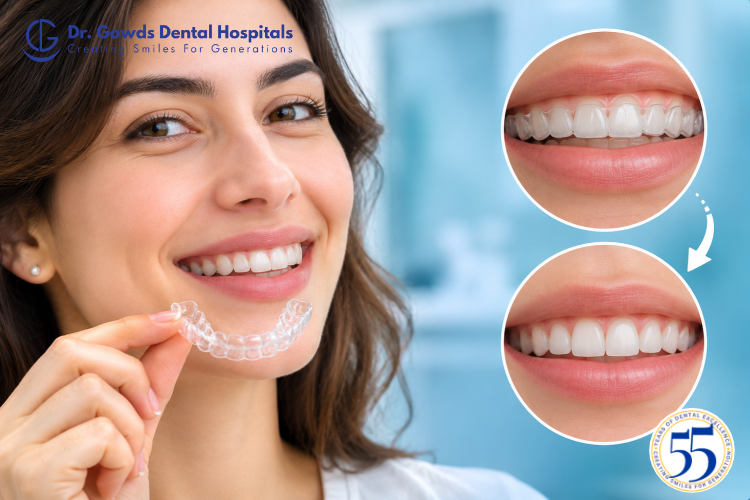
If you are considering clear aligners, one question is likely to come up before starting treatment: Are invisible braces permanent?
The short answer is no. Invisible braces, commonly referring to clear aligners, are designed to be used during a planned treatment period. They are not permanent appliances. More importantly, the alignment achieved through treatment needs to be maintained after the active treatment phase.
Understanding what happens before, during and after invisible braces treatment can help you make a more informed decision. At Dr Gowds Dental Hospitals, patients in Hyderabad can discuss their alignment concerns and treatment options with a dental professional before deciding what approach is suitable for them.
Thinking about invisible braces in Hyderabad?
The term “invisible braces” is commonly used to describe clear aligners. Instead of traditional brackets and wires, clear aligners are transparent, removable trays designed to guide teeth through a planned sequence.
Each set of aligners is used according to the treatment plan, with subsequent sets gradually continuing the planned alignment process.
Because the trays are transparent, many people choose them when they want an orthodontic option that is less noticeable than conventional braces.
However, “invisible” does not mean permanent.
The aligners themselves are part of the active treatment process. Once that phase is complete, another stage becomes important: maintaining the alignment.
No, invisible braces are not permanent appliances.
Clear aligners are normally used for a specific stage of treatment and are replaced according to the planned sequence. They are not intended to remain on the teeth permanently.
There is another important distinction to understand:
The aligners are temporary, while maintaining the alignment is an ongoing consideration.
After active alignment treatment, patients may be advised about retainers. Retainers are designed to help maintain the position achieved during treatment.
This is why asking only “Are invisible braces permanent?” does not tell the whole story. A better question is:
“How can I maintain my teeth alignment after invisible braces treatment?”
The answer depends on what happens after the active treatment phase.
Teeth are not fixed in one position forever. Their position can change over time, which is why retention is an important part of the conversation around orthodontic treatment.
A person may complete their clear aligner plan successfully, but that does not mean they can simply forget about maintaining the result.
The post-treatment plan may include retainers and instructions about how they should be used. The specific approach can vary from person to person.
This means invisible braces should be viewed as a treatment process rather than a one-time permanent change.
Completing the final aligner is not necessarily the end of the overall process.
The planned series of clear aligners comes to an end once the treatment plan reaches its intended stage.
At this point, the dental professional can assess the alignment and discuss the next step.
Retainers may be recommended after active alignment treatment. Their purpose is different from that of the active aligners.
Clear aligners are used to work towards the planned alignment.
Retainers are used to help maintain that alignment.
How and when retainers should be used depends on the individual treatment plan. Patients should follow the instructions provided by their dental professional rather than assuming that one retention routine applies to everyone.
This is one of the most important questions to ask before starting clear aligner treatment.
In many treatment plans, retention is discussed as part of maintaining the alignment after active treatment.
Without following the recommended retention plan, the alignment achieved during treatment may not remain unchanged over time.
That is why patients should ask about both parts of treatment:
Understanding both can give you a clearer picture of what to expect from invisible braces treatment.
The position of teeth can change over time, which is why post-treatment retention matters.
This does not mean that invisible braces have “stopped working” or that the treatment was necessarily unsuccessful. Rather, active alignment and long-term maintenance are two different parts of the overall process.
If you notice a change in your alignment after completing treatment, it is better to discuss it with your dental professional rather than making changes to your retainer routine on your own.
There are actually two different questions hidden in this search query.
Treatment duration varies according to the individual’s alignment needs, treatment plan and other factors. There is no single timeline that applies to every patient.
The number of aligners and the sequence in which they are used are planned according to the case.
Clear aligners are intended to be used as part of a specific treatment sequence. They are not designed to function as permanent appliances.
If you are comparing clear aligners, ask your dental professional how the treatment sequence will work and how often your aligners are expected to change.
Several practical factors can influence how well someone maintains their post-treatment alignment.
These may include:
The key point is simple: completing the active treatment is only one part of the process.
A common misconception is that traditional braces produce a permanent result while invisible braces do not.
The bigger distinction is between the type of appliance and the maintenance of the alignment.
Invisible braces use clear aligners, while traditional braces use brackets and wires. Both approaches involve an active treatment phase and may involve a retention stage afterwards.
So, if you are choosing between invisible braces and traditional braces, the question should not simply be which one is “permanent.”
Instead, consider:
If you are considering clear aligners, having the right questions ready can make your consultation more useful.
Consider asking:
A consultation is also an opportunity to understand whether invisible braces are appropriate for your specific needs rather than choosing them based only on appearance.
Considering clear aligners? Talk to Dr Gowds Dental Hospitals in Hyderabad to discuss your concerns, treatment options and what to expect after treatment.
We provide dental care across branches in Nanakramguda, Gachibowli, Madhapur, koti.
For people looking for a less noticeable approach to teeth alignment, clear aligners may be an option worth discussing with a dental professional.
However, the decision should not be based only on the fact that the aligners are transparent or removable.
Think about the complete treatment journey:
Assessment → Treatment Plan → Clear Aligners → Progress Monitoring → Completion → Retention
Understanding this entire journey gives you a better idea of what invisible braces involve.
The most important takeaway is that invisible braces themselves are not permanent. The active aligners are part of a planned treatment process, while retention is considered afterwards to help maintain the alignment.
No. Invisible braces, commonly referring to clear aligners, are temporary appliances used during an active treatment phase. A separate retention plan may be recommended after treatment.
No. Clear aligners are used as part of a planned treatment sequence and are not designed to remain on the teeth permanently.
Retainers may be recommended after active clear aligner treatment to help maintain the alignment achieved. The recommended retainer routine can vary between individuals.
Teeth can change position over time, which is why post-treatment retention is an important part of the overall treatment discussion.
After the active aligner phase is completed, the alignment can be reviewed and a retention plan may be discussed. Patients should follow the instructions provided by their dental professional.
This can refer either to the length of treatment or the lifespan of individual aligners. Treatment duration varies, while individual aligners are used according to the planned treatment sequence.
“Clear aligners” and “invisible braces” are often used interchangeably when discussing transparent, removable aligner treatment. The exact terminology can vary between providers.
Patients should not make changes to their retention routine without discussing them with their dental professional. The recommended approach depends on the individual treatment plan.

 Gachibowli Branch