

Schedule Appointment

Choosing the best toothpaste isn’t as simple as picking a brand you’ve seen in ads. With so many varieties—whitening, herbal, anti-cavity, and sensitivity formulas—it’s easy to get overwhelmed. According to the experts at Dr Gowds Dental Hospital in Hyderabad, understanding your dental needs and selecting the right toothpaste can make a world of difference to your oral health.
Medically Reviewed by: Prof. Dr. Snigdha Gowd, MDS (Orthodontics & Dentofacial Orthopaedics)
Unsure which toothpaste suits your teeth?
In this guide, we’ll break down what makes the best toothpaste, how to read ingredient labels, which types suit specific dental issues, and when it’s time to consult a dentist for professional guidance.
The best toothpaste is one that matches your oral health needs, contains fluoride, and helps prevent cavities, sensitivity, stains, or gum problems.
The toothpaste you use every day plays a major role in maintaining strong teeth and healthy gums. A good formula doesn’t just freshen breath—it helps fight plaque, cavities, enamel erosion, and even gum disease.
The best toothpaste is one that addresses your individual oral care needs. For example:
The step most Indians skip: Don’t rinse your mouth immediately after brushing. Spit out the excess toothpaste but leave the residue on your teeth for at least 30 minutes. Fluoride needs contact time to remineralize enamel — rinsing immediately cancels out a large portion of the benefit. This single change can measurably reduce your cavity rate over 6–12 months.
Other technique points your dentist wants you to know:
Different oral issues require different toothpaste formulas. Here’s what to look for depending on your concern:
Cavities form when acid-producing bacteria erode enamel faster than your mouth can repair it — so the single most important thing a cavity-fighting toothpaste needs is fluoride, which helps enamel remineralize and actively resists that acid attack. Most dentist-recommended options contain 1000–1450 ppm of fluoride; anything lower won’t give meaningful cavity protection for adults.
What to look for:
For cavity repair specifically: once early decay has started (visible as a white or brown spot, not yet a hole), a fluoride toothpaste used consistently — paired with cutting back on frequent snacking — can sometimes remineralize the spot before it becomes a true cavity. Once a cavity has actually formed a hole, toothpaste can only prevent it from progressing further; it cannot repair or fill the cavity itself. That needs a dentist.
Colgate Total and Oral-B Pro Health both sit comfortably in the recommended fluoride range and are what we most often recommend for cavity-prone patients.
Tooth sensitivity happens when the dentin layer underneath your enamel gets exposed — usually from enamel erosion, gum recession, or aggressive brushing — allowing hot, cold, or sweet triggers to reach the nerve. The right toothpaste treats this directly rather than just easing symptoms.
Two ingredients actually work, in different ways:
For most patients, Sensodyne Repair & Protect (with NovaMin® technology) or Sensodyne ProNamel are the most consistent performers — we typically see patients report noticeable relief within 2 weeks.
One thing that makes sensitivity worse: brushing too hard or using a hard-bristled brush wears down enamel further and can undo the benefit of a sensitivity toothpaste. Pair sensitivity toothpaste with a soft-bristled brush and gentle technique for it to actually work.
When it’s not just toothpaste: if sensitivity is sudden, severe, or limited to one specific tooth (rather than general sensitivity across many teeth), that’s often a sign of a cracked tooth, deep cavity, or exposed root — not something a desensitizing toothpaste will fix. That needs an exam.
If you’re looking for the best whitening toothpaste, go for one that gently removes surface stains using mild abrasives or ingredients like hydrogen peroxide. Avoid harsh formulas that can wear down enamel.
Choose a toothpaste that includes zinc citrate or triclosan alternatives. These help fight bacteria responsible for gingivitis and bad breath.
Children’s toothpaste should have lower fluoride content and a mild flavor. Always ensure your child spits it out and doesn’t swallow.
Persistent bad breath (halitosis) that toothpaste alone should fix is usually bacterial, not just about fresh scent. Look for a toothpaste with zinc citrate or chlorine dioxide, which neutralize the sulfur compounds bacteria produce — mint flavoring only masks the smell temporarily. Antibacterial formulas like Colgate Total or Oral-B Pro Health also help here, since bad breath is frequently linked to the same bacteria that cause gum disease.
If bad breath persists despite consistent brushing, flossing, and an antibacterial toothpaste for 2–3 weeks, it’s often coming from the tongue (bacteria coating) or, less commonly, a source unrelated to oral hygiene — worth a dental check to rule out.
Choosing toothpaste becomes easier when you match the formula to your specific oral health need. Different ingredients are designed for different concerns such as sensitivity, stains, cavity prevention, or gum care. Use the table below as a simple guide to understand what to look for—and what to avoid—when selecting the right toothpaste for your daily routine.
| Concern | What to Look For | Avoid |
|---|---|---|
| Sensitivity | Potassium nitrate | Very abrasive pastes |
| Whitening | Mild silica, peroxide | Daily harsh charcoal use |
| Cavities | Fluoride | Fluoride-free if cavity-prone |
| Gums | Antibacterial actives | Ignoring bleeding gums |
Here’s a quick breakdown of what you’ll commonly find in toothpaste—and what it means:
| Ingredient | What It Does | Should You Want It? |
|---|---|---|
| Sodium Fluoride / Stannous Fluoride | Remineralizes enamel, prevents cavities | Yes — the single most important ingredient |
| Potassium Nitrate | Desensitizes nerve endings | Yes, if you have sensitivity |
| Xylitol | Starves cavity-causing bacteria | Bonus benefit — look for it as 2nd-3rd ingredient |
| Hydroxyapatite (n-HA) | Remineralization alternative to fluoride | Good option for fluoride-sensitive patients |
| SLS (Sodium Lauryl Sulfate) | Creates foam | Skip if you get mouth ulcers or canker sores frequently |
| Activated Charcoal | Mild abrasive | Limit use — abrasive, no proven whitening benefit beyond mechanical |
| Triclosan | Antibacterial | Avoid — removed from most formulas due to FDA concerns |
| Carrageenan | Thickening agent | Neutral — no proven harm at toothpaste concentrations |
Knowing what each ingredient does helps you choose the best toothpaste for your unique needs.
Children (3–7 years): low-fluoride formula, 500ppm maximum, pea-size amount
Children (8–12): standard fluoride, 1000ppm
Teenagers with braces: fluoride + remineralizing formula, avoid whitening
Adults (general): fluoride-based, condition-specific
Adults 50+: sensitivity protection + enamel strengthening become priorities
Pregnant women: standard fluoride is safe; avoid charcoal formulas
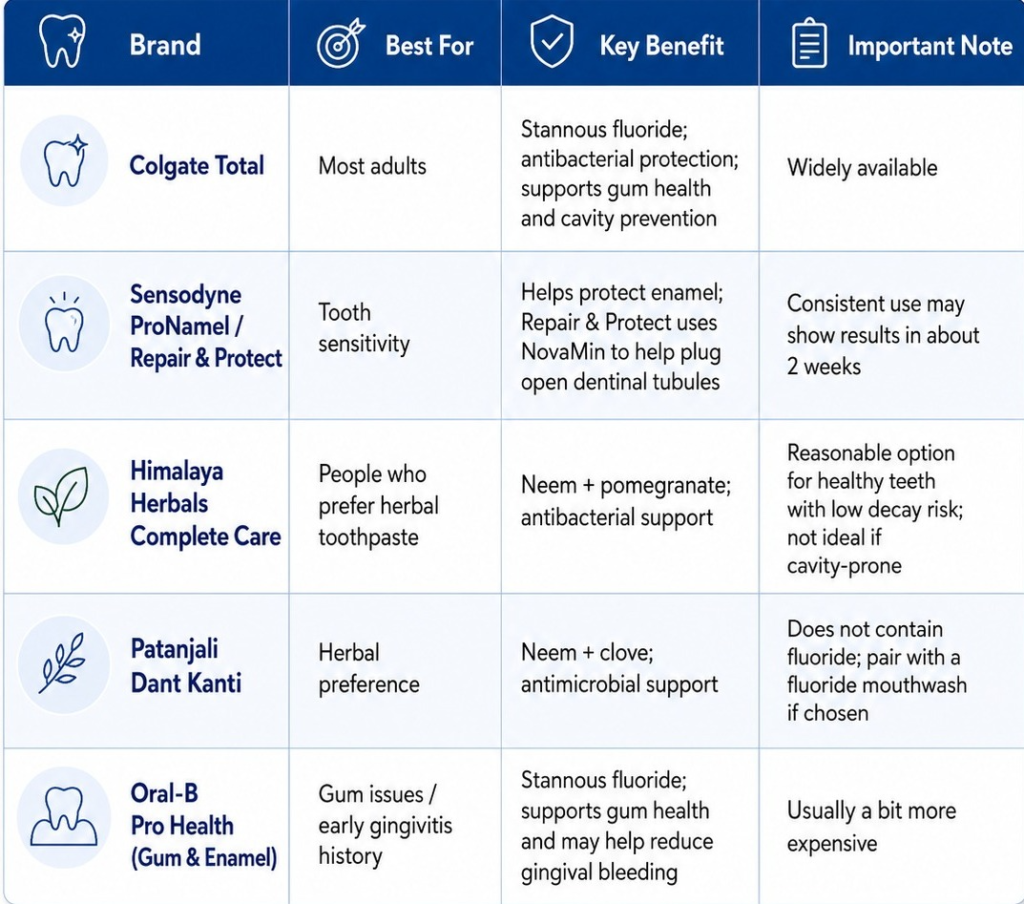
At Dr. Gowds Dental Hospital in Hyderabad, we see patients with a wide range of concerns — from heavy pan staining to enamel erosion from acidic foods. Here’s what we actually recommend:
Colgate Total (Stannous Fluoride) — Our go-to recommendation for most adults. The stannous fluoride formula provides 12-hour antibacterial protection and addresses gum health alongside cavity prevention. Widely available at every pharmacy across India.
Sensodyne ProNamel / Sensodyne Repair & Protect — For patients with sensitivity, this is non-negotiable. The NovaMin® technology in Repair & Protect is the only OTC formula clinically proven to physically plug open dentinal tubules. We see measurable results within 2 weeks of consistent use.
Himalaya Herbals Complete Care — For patients who strongly prefer herbal formulations. It combines pomegranate and neem with clinically tested antibacterial action. Not a replacement for fluoride toothpaste if you’re cavity-prone, but a reasonable daily option for patients with healthy teeth and low decay risk.
Patanjali Dant Kanti — Popular with many of our patients. The neem and clove base does have real antimicrobial properties, but it lacks fluoride. We recommend pairing it with a fluoride mouthwash if you choose this brand.
Oral-B Pro Health (Gum & Enamel) — Best for patients with gingivitis or early gum disease history. The stannous fluoride formula reduces gingival bleeding in clinical studies. Slightly more expensive but worth it if gum health is a priority.
Whitening toothpastes work by removing surface stains — not by bleaching the tooth structure itself. The key distinction is the abrasive level, measured as RDA (Relative Dentin Abrasivity). For safe daily use, stay under RDA 70. Most mainstream whitening pastes (Colgate Optic White, Closeup Charcoal) sit in the 70–100 range — fine for twice-weekly use, not ideal for every single brush.
If you want whitening without the abrasion risk, look for low-RDA options with hydrogen peroxide in the formula — Colgate Optic White Advanced (1% hydrogen peroxide) is a good middle ground. For stubborn staining from tea, coffee, or tobacco that doesn’t respond to over-the-counter products, in-office whitening at our clinic gives results in a single 45-minute session that whitening toothpaste cannot replicate.
Even the best toothpaste can’t fix severe dental issues. If you experience persistent tooth pain, gum bleeding, or sensitivity that doesn’t improve after a few weeks of use, consult a dentist immediately.
A professional evaluation can identify problems like cavities, gum disease, or enamel damage that may require in-office treatment.
If you’re in Telangana, Dr Gowds Dental Hospital in Hyderabad offers comprehensive dental care—ranging from preventive check-ups to advanced cosmetic treatments.
The best toothpaste is the one that fits your dental health goals—whether it’s preventing cavities, reducing sensitivity, or achieving a whiter smile. Always check for fluoride, avoid overly abrasive formulas, and seek professional guidance if symptoms persist.
If you’re unsure which toothpaste is right for you, schedule a consultation with the experts at Dr Gowds Dental Hospital in Hyderabad. Their experienced dentists can recommend personalized solutions to keep your smile healthy and confident.
The best toothpaste for daily use contains fluoride to protect against cavities and mild abrasives for cleaning. Popular options include Colgate Total and Sensodyne Daily Protection.
The best whitening toothpaste typically includes hydrogen peroxide or baking soda to lift surface stains. However, professional whitening treatments provide faster, safer results.
Yes, using toothpaste with potassium nitrate or stannous fluoride can relieve sensitivity over time. If pain continues, see a dentist for an examination.
You can switch toothpastes every few months to try new formulations, but always ensure it contains fluoride and suits your dental needs.
Yes. Dentists at Dr Gowds Dental Hospital in Hyderabad recommend fluoride-based and sensitivity-protection toothpaste depending on your oral condition. They often suggest personalized options after examination.
Only in the very earliest stage, before a cavity has actually formed a hole — a fluoride toothpaste can help remineralize an early white-spot lesion. Once true decay has formed, toothpaste can slow it down but can’t repair or fill it; that requires a dentist.

 Gachibowli Branch