

Schedule Appointment


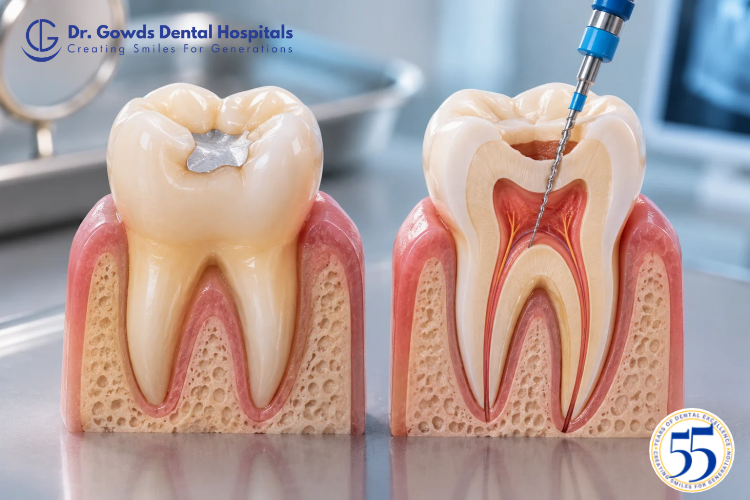
A cavity does not always mean you need a root canal. In some cases, a dental filling may be suitable, while deeper decay may require a different approach. The important question is not simply how large the visible hole looks, but how far the decay has progressed inside the tooth.
Understanding the difference between a filling vs root canal can help you have a more informed conversation with your dentist. Dr Gowds Dental Hospitals in Hyderabad can assess the affected tooth and explain which treatment options may be appropriate based on the condition of the tooth.
A filling and a root canal address different levels of tooth damage.
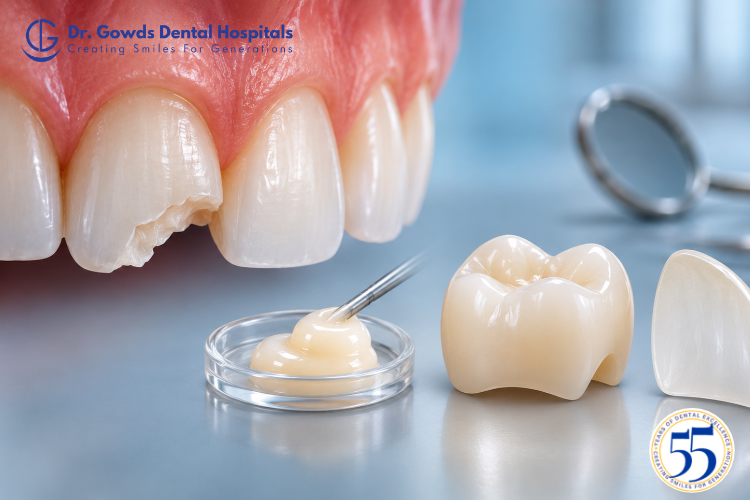
A dental filling is generally used when the damaged portion of the tooth can be restored without removing the tissue inside the tooth.
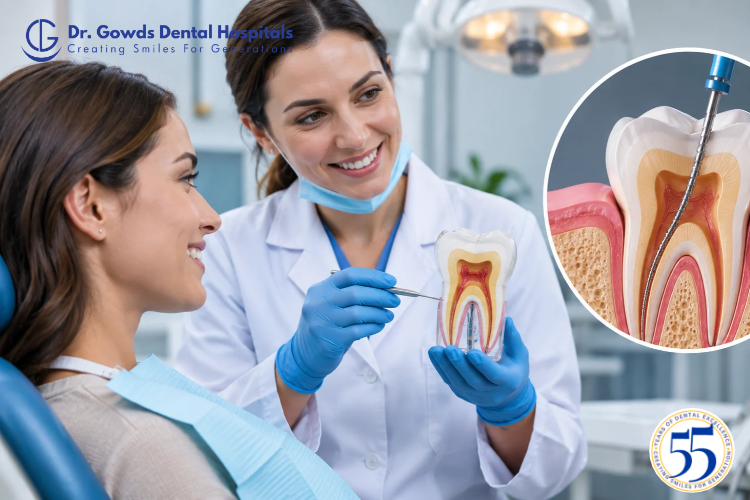
A root canal treatment involves addressing the inside portion of the tooth when the dental pulp is involved or needs to be treated.
The decision between a filling and root canal is therefore based on the condition of the tooth rather than simply the presence of a cavity.
A filling may be considered when:
Root canal treatment may be considered when:
The exact treatment cannot always be determined simply by looking at the tooth.
One of the most common questions patients ask is, “How deep is my cavity?”
The visible part of a cavity does not necessarily show the full extent of the affected area. A small-looking cavity may require closer examination, while a larger visible area does not automatically mean that a root canal is required.
Dentists generally consider several factors when assessing the depth of decay.
The dentist first examines the tooth for visible changes, damaged areas, discoloration, and other signs that may indicate decay.
However, a visual examination alone may not provide all the information needed to determine how far decay has progressed.
Depending on the situation, a dental X-ray may help the dentist evaluate areas that cannot be fully seen during a routine examination.
It can provide additional information about the location and extent of decay in relation to the deeper structures of the tooth.
Your symptoms can also form part of the assessment.
You may be asked about:
Symptoms can provide useful information, but they do not always determine the depth of decay on their own.
A tooth has several layers, and decay can progress from the outer surface toward the deeper structures.
Enamel is the hard outer layer of the tooth. Early damage may not look like a large cavity from the outside.
Under the enamel is dentin. When decay extends into this layer, the affected area may become more noticeable during examination.
The pulp is the inner part of the tooth containing nerves and blood vessels. When decay progresses toward or into this area, the treatment decision can be different from that for a more superficial cavity.
This is why the question “filling or root canal?” cannot be answered accurately based only on the size of the visible hole.
Certain symptoms can make a dentist look more closely at the possibility of deeper tooth involvement.
These may include:
These symptoms do not automatically mean that you need a root canal.
The same symptom can have different causes, which is why an examination is important before choosing treatment.
This is one of the most important points to understand.
A cavity being described as “deep” does not automatically mean that a root canal is required.
The dentist needs to evaluate how close the decay is to the pulp and assess the condition of the tooth. The amount of healthy tooth structure remaining, the symptoms, examination findings, and imaging may all be relevant to the treatment decision.
For this reason, two teeth that appear to have similarly sized cavities may receive different treatment recommendations.
| Factor | Dental Filling | Root Canal Treatment |
| Main purpose | Restore a tooth affected by decay or damage | Treat the inner portion of a tooth when indicated |
| Depth of concern | Usually less extensive decay | Deeper involvement may be present |
| Inner pulp | Does not require root canal treatment | Pulp is involved or requires treatment |
| Assessment | Examination and, when appropriate, imaging | Examination, symptoms, and imaging when appropriate |
| Final decision | Based on the condition of the tooth | Based on the condition of the tooth |
The table provides a general comparison. Your dentist’s assessment is needed to determine which option is suitable for a specific tooth.
Some people assume that severe pain automatically means a root canal, while little or no pain means a filling.
That is not a reliable way to determine the depth of decay.
A tooth can require careful evaluation even when symptoms are limited. Similarly, tooth discomfort can have several possible causes that are not necessarily related to the depth of a cavity.
The better question is not simply “Does it hurt?” but “What is happening inside the tooth?”
A dental examination can help answer that question.
If you visit a dentist for a suspected cavity, the assessment may involve several steps.
The dentist may ask when the problem started, what triggers the discomfort, and whether it has changed over time.
The tooth and surrounding area are examined to identify visible signs of decay or structural damage.
When necessary, additional dental evaluation or imaging may be used to understand the extent of the problem.
Once the condition of the tooth has been assessed, the dentist can explain whether a filling, root canal, or another treatment approach should be considered.
This approach is more useful than choosing treatment based on symptoms or the visible appearance of a cavity alone.
If you notice a cavity, sensitivity, discomfort, or a damaged tooth, avoid delaying an evaluation simply because the problem does not seem severe.
A useful approach is to:
Being informed can make the treatment discussion easier and help you understand why a particular approach has been suggested.
The difference between a filling and a root canal mainly comes down to how far the damage has progressed and what part of the tooth is involved.
A visible cavity does not tell the whole story. The dentist may need to combine a clinical examination, your dental history, symptoms, and imaging where appropriate to determine the condition of the tooth.
If you are searching for filling vs root canal treatment in Hyderabad, Dr Gowds Dental Hospitals provides dental consultations across its Nanakramguda, Gachibowli, Madhapur, koti branches.
Have a cavity or are you unsure whether you need a filling or root canal? Book a dental consultation at Dr Gowds Dental Hospitals in Hyderabad to have the tooth examined and understand your treatment options.
A filling is used to restore a tooth when the damaged portion can be treated without root canal treatment. A root canal addresses the inner portion of a tooth when the pulp is involved or requires treatment.
The visible size of a cavity does not always show how deep the decay is. A dentist may use a clinical examination and, when appropriate, dental imaging to assess the affected tooth.
Not necessarily. The decision depends on the condition of the tooth and whether the deeper structures, including the pulp, are involved. A dentist needs to assess the tooth before recommending a treatment.
A dentist can assess the tooth using an examination, your symptoms and dental history, and imaging when appropriate. These findings help determine whether a filling, root canal, or another treatment option should be considered.
Tooth pain does not automatically determine whether a filling or root canal is appropriate. The cause and condition of the tooth need to be assessed before choosing treatment.
Not necessarily. The visible appearance of a tooth may not show the complete extent of an affected area. A dental examination can provide more information about the tooth.
You can ask how deep the decay is, whether the pulp is involved, what the examination shows, why a particular treatment is being suggested, and what other treatment options may be appropriate.

 Gachibowli Branch