

Schedule Appointment

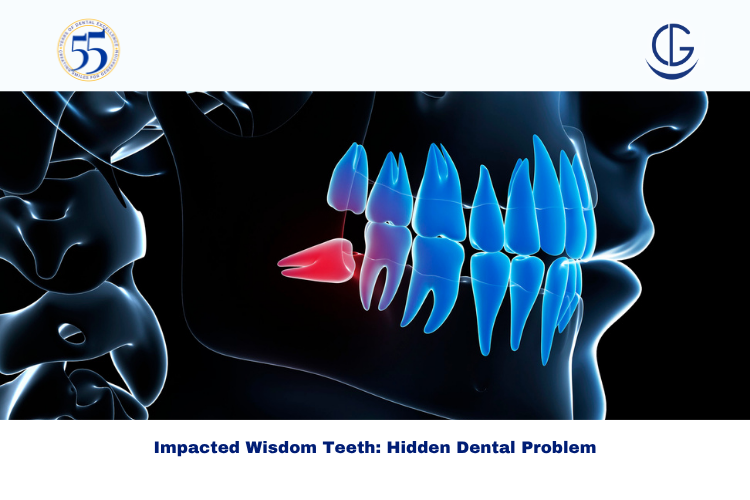
Impacted wisdom teeth sounds alarming — but understanding what it actually means transforms it from a source of anxiety into a manageable clinical situation. Impacted wisdom teeth are simply third molars that have failed to emerge into their correct position in the mouth, either because of insufficient space, an unfavourable angle, or obstruction by surrounding bone and tissue. At Dr Gowd’s Dental Hospitals, impacted wisdom teeth represent one of the most common reasons patients visit our oral surgery team — and with good reason. Left unaddressed, impacted wisdom teeth can cause pain, infection, crowding, and even damage to adjacent teeth. But with early identification and the right surgical approach, they are very treatable.
Medically Reviewed by: Prof. Dr. Snigdha Gowd, MDS (Orthodontics & Dentofacial Orthopaedics)
📞 Call: 08065295050 | 🌐 Book an appointment today.
Impacted wisdom teeth are teeth that are blocked from fully erupting through the gum line. The impacted tooth meaning is essentially this: the tooth is stuck. It may be angled sideways, tilted forward toward the second molar, tilted backward, or trapped entirely within the jawbone. The degree to which the tooth is submerged and the angle of its orientation define the type and complexity of the impaction.
Dental surgeons classify impacted wisdom teeth based on their angle of orientation in the jaw. This classification — developed using X-ray assessment — directly influences the surgical approach:
The most common type, where the wisdom tooth is angled forward (mesially) toward the second molar. The crown of the impacted tooth leans into the root of the tooth in front of it. This angle makes extraction relatively accessible compared to other types, though precision is still required to avoid damaging the neighbouring molar.
Here, the impacted wisdom tooth angles backward, away from the second molar and toward the back of the jaw. Distoangular impacted wisdom teeth are among the more challenging to remove because the angle directs the tooth deeper into the bone as it is delivered.
The tooth is correctly oriented — pointing straight up — but simply cannot erupt because there is not enough space. Vertically impacted wisdom teeth are sometimes the easiest to manage surgically since no rotation or angulation correction is needed.
The tooth lies completely on its side, pointing directly at the root of the second molar. A horizontally impacted wisdom tooth places significant pressure on the adjacent tooth and is associated with the highest rates of root resorption — where the root of the second molar is literally dissolved by the pressure. Surgical removal of a horizontally impacted wisdom tooth typically involves sectioning (cutting the tooth into pieces) for safe extraction.
An OPG (orthopantomogram) — the panoramic dental X-ray that captures all teeth in a single image — is the standard first step in evaluating impacted wisdom teeth. At Dr Gowd’s, our digital OPG suite produces high-resolution images that allow our surgeons to assess:
• The exact angle and depth of the impacted wisdom tooth
• Proximity of the tooth roots to the inferior alveolar nerve (critical in lower jaw extractions)
• Relationship to the maxillary sinus for upper impacted wisdom teeth
• Root morphology — whether roots are curved, fused, or unusually formed
• Evidence of cyst formation around the impacted tooth crown
In complex cases — particularly where the wisdom tooth roots appear very close to the nerve on OPG — our team may recommend a cone beam CT (CBCT) scan for three-dimensional assessment before surgery.
| Concerned about an impacted wisdom tooth? Request an OPG assessment at Dr Gowd’s Dental Hospitals — our surgical team will evaluate your specific impaction and discuss your options. |
Not all impacted wisdom teeth are immediately symptomatic — some are discovered only on routine X-rays. However, impacted wisdom teeth symptoms commonly include:
• Persistent or recurrent pain at the back of the jaw
• Swelling and tenderness of the gum overlying the impacted tooth
• Bad breath or an unpleasant taste (suggesting bacterial colonisation around the impacted tooth)
• Difficulty opening the mouth fully
• Occasional headaches or earaches via referred pain pathways
• Pain in the adjacent second molar — which may indicate root damage from the impacted wisdom teeth
[See: Wisdom Tooth Pain: Causes, Symptoms & When to See a Dentist ]
For impacted wisdom teeth that are fully enclosed in bone, showing no signs of cyst formation, causing no symptoms, and not threatening adjacent teeth, conservative monitoring with annual X-rays is an acceptable management strategy. This is particularly relevant for older patients where surgical risks increase.
Surgical extraction is the definitive treatment for problematic impacted wisdom teeth. At Dr Gowd’s, our oral and maxillofacial surgery team performs impacted wisdom tooth extraction under local anaesthesia as a day procedure. The steps generally involve making a small incision in the gum, removing a small portion of bone if necessary, sectioning the tooth, extracting each piece, and closing the wound with dissolvable sutures.
In rare situations where the wisdom tooth roots are extremely close to or wrapped around the inferior alveolar nerve, a coronectomy may be considered — removing only the crown of the tooth while leaving the roots in place to reduce the risk of nerve injury. This is a specialist decision made strictly on a case-by-case basis and is not a routine procedure.
Impacted wisdom teeth are not a sentence to suffering — they are a clinical finding that, when identified early and managed properly, can be resolved safely and predictably. At Dr Gowd’s Dental Hospitals, our oral surgery team brings extensive experience in all four types of impacted wisdom tooth extraction, using state-of-the-art digital imaging and surgical equipment to deliver the best possible outcomes for every patient. If you have been told you have impacted wisdom teeth — or suspect you might — the most important thing you can do right now is seek an informed, expert opinion.
| Book Your Impacted Wisdom Teeth Assessment at Dr Gowd’s Dental Hospitals — Expert Surgical Care, Compassionate Recovery Support. You can visit any of our Hyderabad branches: Gachibowli, Madhapur, Koti, Nanakramguda |
No. Asymptomatic, deeply buried impacted wisdom teeth in older patients with no evidence of cyst formation or adjacent tooth damage may be safely monitored rather than removed. The decision is always individualised. [See: Is It Necessary to Remove Wisdom Teeth? — Blog B12]
Most patients are comfortable within 3–5 days after simple impacted extractions. Full bony impactions — particularly horizontal ones — may require 7–10 days of recovery. Soft diet, careful oral hygiene, and following post-operative instructions are the key to smooth healing.
The procedure itself is performed under effective local anaesthesia — you should feel pressure and movement, but not pain. Post-operative discomfort is managed with prescribed analgesics and typically peaks in the first 48 hours before steadily improving.
Yes — this is one of the principal reasons surgical removal is recommended for mesioangular and horizontal impacted wisdom teeth. Pressure from an impacted wisdom tooth can cause root resorption of the second molar, a form of irreversible root damage that may ultimately compromise that tooth.
Potential consequences include recurrent infection (pericoronitis), dentigerous cyst formation, damage to the neighbouring second molar, and — very rarely — tumour development within the cyst lining. These risks underscore the value of early professional assessment.



 Gachibowli Branch