

Schedule Appointment

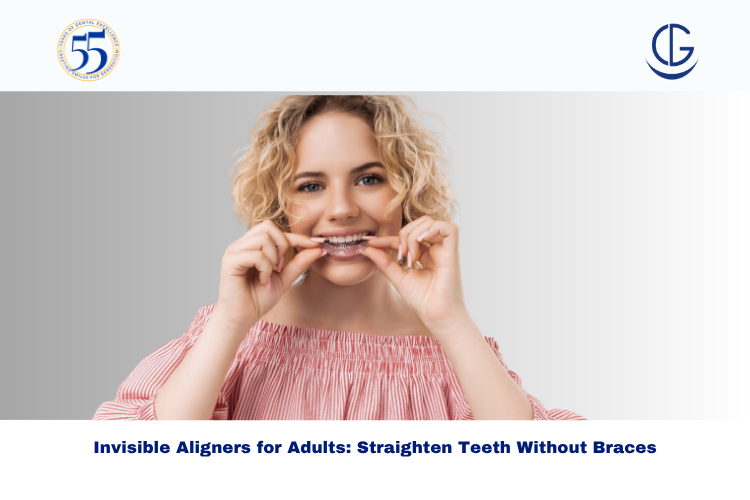
Invisible aligners were once considered primarily a teenager’s treatment — something you did before you had a career, a mortgage, or a professional reputation to protect. That perception has changed fundamentally. At Dr Gowds Dental Hospitals, the majority of patients who now enquire about clear aligner therapy are adults between the ages of 25 and 50, and the reasons are entirely understandable. Crooked teeth, gaps, and misalignment do not correct themselves in adulthood, and the consequences of leaving them untreated — from accelerated enamel wear to gum disease and jaw pain — become more significant with every passing year. Invisible aligners have made it possible for adults to address these issues discreetly, comfortably, and on a timeline that fits around professional and family life. This guide is written specifically for adult patients who are considering invisible aligners and want to understand exactly what is involved — clinically, practically, and financially.
| Medically Reviewed by: Prof. Dr. Snigdha Gowd, MDS (Orthodontics & Dentofacial Orthopaedics |
| 📞 Call: 08065295050 | 📅 Book an Appointment Today |
The adult orthodontic market in India has grown significantly over the past decade, driven by two converging forces: rising awareness of the health consequences of untreated misalignment, and the availability of invisible aligners that make treatment socially and professionally viable for adults in a way that traditional metal braces simply are not.
Many of today’s adult invisible aligner patients had orthodontic treatment recommended to them as teenagers but could not access it, or had treatment as teenagers but experienced relapse — teeth that shifted back after retainer wear lapsed. Others have never had treatment at all and simply reached a point in their lives where the discomfort, aesthetic concern, or functional impact of misaligned teeth became significant enough to act.
Whatever brings an adult patient to the consultation chair, invisible aligners offer a genuinely practical pathway: no visible brackets, no dietary restrictions, removable for professional commitments, and — when treatment is planned by an experienced provider — clinically effective for a wide range of adult orthodontic presentations. [See: Invisible Teeth Braces: Treating Gaps, Crowding and Spacing — Blog I25]
Treating an adult with invisible aligners is not the same as treating a teenager. There are meaningful biological and clinical differences that every adult patient should understand before beginning treatment — not to discourage, but to ensure that their treatment plan is properly adapted to their actual clinical picture.
Adult bone is denser and less metabolically active than adolescent bone. Tooth movement through adult bone is slower and requires more careful force management. This means invisible aligners for adults typically move teeth in smaller increments per tray, and treatment plans may include more total trays than an equivalent teenage case. The clinical outcome is just as achievable — but the timeline is more measured. Your Dr Gowd’s orthodontist accounts for this from the first ClinCheck planning session.
Adults frequently present with fillings, crowns, veneers, bridges, and sometimes dental implants. Each of these creates specific challenges for invisible aligner planning. Attachments cannot be bonded to porcelain crowns or veneers. Implants cannot be moved. Bridges connect teeth that may need to move independently. None of these factors make invisible aligners impossible — but they do require a more sophisticated treatment plan and, in some cases, coordination with restorative dentistry.
A proportion of adult patients present with some degree of gum recession or underlying periodontal bone loss — particularly those who have had crowded teeth for years. Tooth movement through compromised periodontal bone requires careful force control and active periodontal monitoring throughout treatment. All adult patients at Dr Gowd’s undergo a periodontal assessment before invisible aligner treatment is initiated.
Adults with a history of clenching or bruxism — often worsened by misalignment itself — may present with significant enamel wear on tooth surfaces. Invisible aligners can provide some protection against further attrition during treatment (functioning similarly to a thin night guard), but the underlying bruxism needs to be addressed as part of the comprehensive treatment plan.
Adult patients tend to be highly motivated and compliant with invisible aligner wear requirements — a genuine clinical advantage over treating teenagers. However, adults also have more complex schedules, more frequent social and professional commitments, and a more deliberate relationship with the cost and time investment of treatment. These factors are discussed openly at Dr Gowd’s during the consultation to ensure invisible aligner treatment is realistically planned around each patient’s life.
Invisible aligners are effective for a wide range of adult orthodontic presentations. Here is a clinical summary of the most common issues we treat with invisible aligners at Dr Gowd’s Dental Hospitals:
| Orthodontic Issue | Suitable for Invisible Aligners? | Notes for Adult Patients |
| Mild to moderate crowding | Yes — excellent results | IPR may be required; arch expansion possible in select cases |
| Generalised spacing | Yes — very predictable | Anchorage control critical; frenum assessment for front gaps |
| Diastema (single front gap) | Yes — highly effective | Frenectomy may be advised to prevent relapse |
| Mild to moderate overbite | Yes — with bite ramps | Mandibular advancement features available in Invisalign |
| Open bite (anterior) | Yes — in select cases | Vertical extrusion movements; requires careful monitoring |
| Mild crossbite | Yes — with attachments | Posterior crossbites require precise force direction |
| Relapse from previous treatment | Yes — excellent indication | Often shorter treatment than the original course |
| Moderate underbite (dental) | Possible — case dependent | Skeletal underbites require surgical correction |
| Severe crowding / complex bites | Sometimes — with adjuncts | May need supplementary fixed appliances or surgery |
The most important message here is that case selection matters enormously in adult invisible aligner treatment. At Dr Gowds, no patient is offered invisible aligners without a thorough clinical assessment — including radiographs, photographs, and a digital ClinCheck simulation — that confirms the treatment plan is appropriate for their specific anatomy and presenting condition.
| Wondering whether invisible aligners will work for your specific adult orthodontic situation? Book a full clinical assessment at Dr Gowds Dental Hospitals — and see your outcome before committing to treatment. |
Your invisible aligners journey at Dr Gowd’s begins with a comprehensive consultation that is quite different from what most adult patients expect. Rather than simply examining your teeth and sending you away with a quote, our team uses an iTero digital intraoral scanner to capture a precise 3D model of your dentition in minutes — with no messy impressions. This model forms the basis of a ClinCheck treatment simulation that shows you, on screen, exactly how your teeth will move over the course of treatment and what the final result will look like. For adult patients who are investing significant time and money in treatment, seeing a clinically validated digital preview before they commit is enormously reassuring.
Invisible aligners are delivered in sets of trays — typically 10–14 at a time. Each tray is worn for 20–22 hours per day for one to two weeks before progressing to the next. Adults consistently report that the 20–22 hour requirement is manageable with normal lifestyle discipline. The aligners are removed for eating, drinking anything other than water, and for significant professional commitments where speech clarity is critical. Most adults adapt to the minor lisp that can occur in the first day or two of each new tray within hours.
Adult invisible aligner patients attend Dr Gowd’s for a progress review approximately every 6–8 weeks. These appointments are brief — typically 20–30 minutes — and allow our team to assess tooth movement against the ClinCheck plan, check periodontal health, and deliver the next set of trays. If refinements are needed mid-treatment (additional tray sets to fine-tune movements), these are identified at monitoring visits and planned into the treatment without additional clinical assessment fees.
This is the phase many adults underestimate — and the phase that determines whether your result lasts. After the final invisible aligner tray, a retention protocol is established that typically includes nightly removable retainers and, in some cases, a fixed lingual wire bonded behind the front teeth. Adult bone has a strong tendency to revert to its original configuration if retention is not maintained. At Dr Gowd’s, we spend as much time on retention planning as we do on the active treatment phase, because a beautifully aligned smile that shifts within two years is not a successful outcome.
Invisible aligners have removed every practical objection that once made orthodontic treatment feel impossible for adults: the visibility, the dietary restrictions, the professional awkwardness, the endless adjustment appointments. What remains is a clinically rigorous, aesthetically invisible treatment system that delivers straight teeth — and all the health and confidence benefits that come with them — without disrupting adult life. At Dr Gowd’s Dental Hospitals, our adult orthodontic patients are some of the most motivated and gratified patients we treat. They come in with years of lived-with misalignment and leave, months later, with the smile they stopped believing was available to them. If that sounds like your story, we would very much like to help you write the next chapter.
| Book Your Adult Invisible Aligners Consultation at Dr Gowds Dental Hospitals — Digital Smile Preview Included at Your First Visit. Our Hyderabad branches: Gachibowli, Madhapur, Koti, Nanakramguda |
No. Invisible aligners can be used at any age in adulthood provided the patient has healthy teeth and gums, adequate bone support, and a clinical presentation within the treatable range. We regularly treat patients in their forties and fifties with excellent outcomes. The key pre-requisite is good periodontal health — not a specific age ceiling.
Yes — with the important caveat that adult treatment requires a properly adapted clinical approach. Slower bone remodelling is accounted for in the tray design. Pre-existing restorations are mapped and managed. Periodontal status is monitored. When these factors are properly addressed, adult invisible aligner outcomes are clinically equivalent to teenage outcomes for appropriate cases.
Invisalign cost for adults typically ranges from ₹45,000 for simple relapse cases to ₹3,50,000+ for complex full-arch treatments with Invisalign. At Dr Gowds, cost is provided as a complete written treatment plan — never as a vague estimate — after your clinical assessment and digital simulation.
Minimal impact is the consistent report from our adult patients. A brief lisp may occur in the first 24–48 hours of each new tray — this resolves rapidly as the tongue adapts. For presentations or important speaking engagements, the trays can be temporarily removed. The near-invisibility of the aligners means most colleagues and clients never notice them at all.
Yes — within a defined clinical range. Overbites, mild open bites, and certain crossbites can all be addressed with invisible aligners in adult patients. Severe skeletal discrepancies may require orthognathic surgery regardless of appliance choice. Your clinical assessment at Dr Gowd’s will clearly define what is achievable for your specific bite presentation.
This is a common adult clinical scenario and is entirely manageable with careful sequencing. Restorations are sometimes completed before treatment begins; in other cases, provisional restorations are placed and final restorations done after alignment is complete. Implant placement, if planned, is timed around aligner treatment to ensure the implant site is not within an active movement zone.
 Gachibowli Branch