

Schedule Appointment

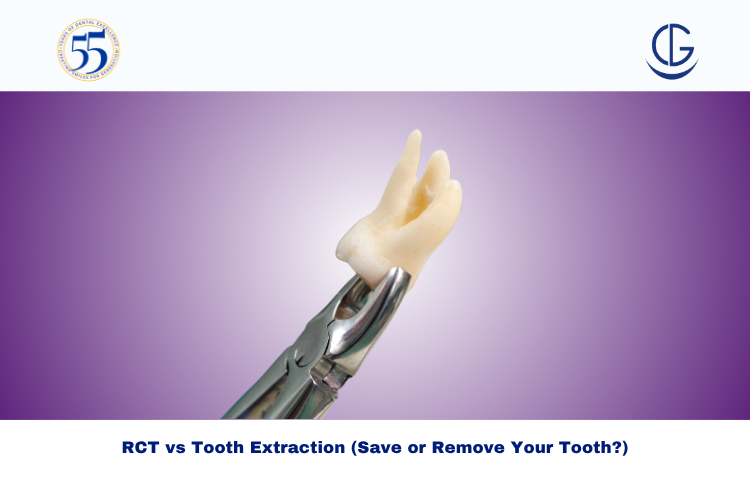
RCT vs tooth extraction — this is the conversation that happens in dental clinics every single day, and it is one of the most consequential decisions a patient can make about their long-term dental health. A dentist has just told you that a tooth needs either a root canal treatment (RCT) or extraction. You are in pain, possibly anxious, and you have a head full of things you have heard from friends and read online: that root canals are terrifying, that extraction is simpler and cheaper, that the tooth is ‘just going to fail anyway.’ At Dr Gowds Dental Hospitals, we make this decision with patients — never for them — and we always begin by ensuring they have accurate, complete, clinically honest information. This guide explains exactly what each option involves, when each is the appropriate choice, what the long-term consequences of each decision look like, and the clinical framework our specialists use to guide the RCT vs tooth extraction decision for every individual patient.
| Medically Reviewed by: Prof. Dr. Snigdha Gowd, MDS (Orthodontics & Dentofacial Orthopaedics) |
| 📞 Call: 08065295050 | 📅 Book an Appointment Today |
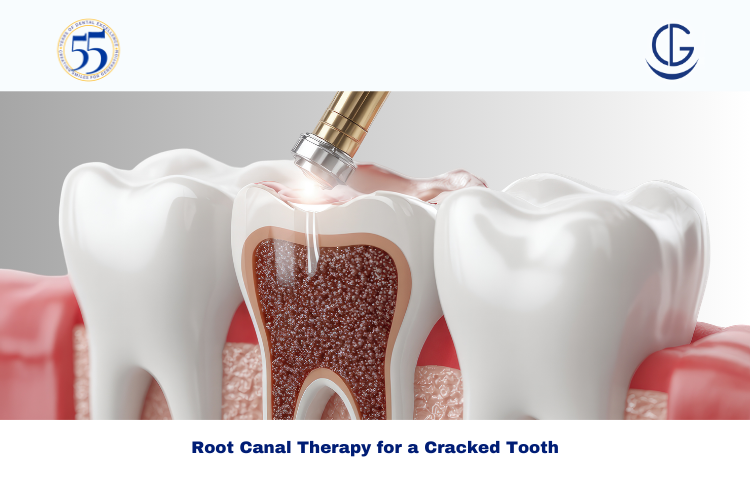
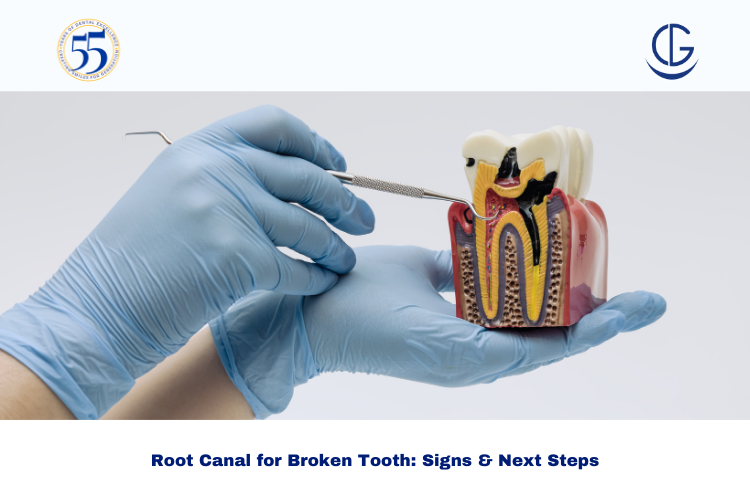
Root canal treatment — commonly called RCT — is a dental procedure that removes infected, inflamed, or dead pulp tissue from inside a tooth, cleans and shapes the root canals, and seals them permanently to prevent reinfection. The pulp — the soft tissue at the centre of the tooth containing the nerve, blood vessels, and connective tissue — becomes infected or dies when deep decay, a cracked tooth, or repeated dental procedures allow bacteria to reach the pulp chamber.
The common perception that root canal treatment is extremely painful is significantly outdated. Modern RCT performed under effective local anaesthesia is comparable in discomfort to having a filling placed. At Dr Gowds Dental Hospitals, we offer Single Sitting Root Canal Treatment using rotary endodontic instruments, apex locators, and digital X-ray guidance — allowing most straightforward RCTs to be completed in a single appointment of approximately 45–90 minutes.
Following successful root canal treatment, the tooth is restored with a crown to protect it from fracture — since a non-vital tooth becomes more brittle over time. A properly root canal treated and crowned tooth can last decades, often as long as a natural untreated tooth.
Tooth extraction is the removal of a tooth from its socket in the jawbone. Simple extractions involve teeth that are visible and accessible; surgical extractions involve teeth that are impacted, fractured at the gumline, or require bone removal for access. Following extraction, the socket heals over several weeks, leaving a gap where the tooth was.
Extraction is faster and, in the short term, less expensive than root canal treatment followed by a crown. However, extraction is not the end of the story — it is the beginning of a separate set of decisions about how to manage the resulting gap. A missing tooth rarely stays ‘just a gap’ without consequence.
| Dimension | Root Canal Treatment (RCT) | Tooth Extraction |
| Preserves natural tooth | ✅ Yes — tooth remains in place | ❌ No — tooth is permanently lost |
| Procedure duration | 45–90 mins (single sitting at Dr Gowds) | 15–45 mins for simple extraction |
| Pain during procedure | Minimal under local anaesthesia | Minimal under local anaesthesia |
| Post-procedure discomfort | Mild soreness 2–5 days | Moderate soreness 3–7 days; longer for surgical |
| Recovery time | 24–48 hours for most patients | 5–10 days; longer for surgical extraction |
| Short-term cost | Higher — RCT + crown required | Lower — extraction alone |
| Long-term cost | Lower — no replacement needed if successful | Higher — implant, bridge, or denture required |
| Bone preservation | ✅ Tooth root maintains jawbone density | ❌ Bone resorption begins within weeks of extraction |
| Effect on adjacent teeth | None — no movement of surrounding teeth | ⚠️ Adjacent and opposing teeth shift into gap over time |
| Chewing function | Fully restored after crown placement | Reduced until replacement completed; may remain reduced |
| Aesthetic outcome | Natural tooth preserved — no visible gap | Gap visible unless replacement completed |
| Success rate | 85–97% over 10 years with proper restoration | Extraction itself has high success; replacement outcomes vary |
| Future flexibility | Crown can be replaced if needed | Implant / bridge requires healthy adjacent teeth or bone |
The single most underappreciated consequence of tooth extraction — and the factor that most changes the long-term calculus of the RCT vs tooth extraction decision — is bone resorption.
Your jawbone exists, in biological terms, to support and anchor your teeth. The mechanical stimulation transmitted through the tooth root to the surrounding bone during chewing is what signals the bone to maintain its density and volume. When a tooth is extracted and that stimulation disappears, the body initiates a process of bone resorption — it begins reabsorbing the bone that no longer has a function to perform.
This resorption is not trivial. Studies document an average loss of 25% of bone width in the extraction site within the first year, and up to 40–60% of bone height over subsequent years. This progressive bone loss has three serious consequences:
• Adjacent teeth lose bone support and may become mobile over time
• The facial profile changes — particularly visible in the lower jaw — contributing to an aged, sunken appearance
• Dental implant placement — the gold-standard tooth replacement — becomes more difficult, more expensive, and sometimes impossible without bone grafting as resorption progresses
Root canal treatment, by preserving the natural tooth root in the jawbone, completely eliminates this resorption. This is one of the most compelling clinical arguments for RCT vs tooth extraction in any case where RCT is technically feasible.
Root canal treatment is the appropriate choice — and the clinically preferable option in the RCT vs tooth extraction decision — when:
• The tooth has sufficient healthy structure remaining to support a crown after treatment
• The infection or inflammation is confined to the pulp and root canals — not spread to significant surrounding bone
• The tooth has strategic importance in the arch: a first molar, a canine, a front tooth where aesthetics and function are critical
• The patient has adequate bone support and healthy adjacent teeth — making implant replacement genuinely complex
• The patient’s overall dental health and systemic health supports endodontic treatment
• The patient values tooth preservation and is willing to complete the full treatment including crown placement
At Dr Gowds Dental Hospitals, our Single Sitting Root Canal Treatment service allows most RCT cases to be completed in one appointment using advanced rotary instruments, electronic apex locators, and digital radiography — significantly reducing the time burden that was historically a deterrent to choosing RCT over extraction.
There are clinical situations where extraction is not only appropriate but genuinely the better option in the RCT vs tooth extraction decision. Extraction is indicated when:
• The tooth is so severely decayed or fractured that insufficient tooth structure remains to support a crown — making RCT futile even if technically successful
• There is extensive bone loss around the tooth root from severe periodontal disease — making the tooth non-restorable regardless of pulp status
• The tooth has a vertical root fracture — a crack running along the length of the root — which cannot be successfully treated with RCT and leads to inevitable failure
• The infection has caused a significant abscess with extensive bone involvement that requires surgical management combined with extraction
• The tooth is a wisdom tooth causing recurrent infection, impaction, or damage to adjacent teeth — where preservation offers limited functional value
• The patient’s systemic health (uncontrolled diabetes, bleeding disorders, bisphosphonate therapy) makes extended endodontic treatment higher-risk
• The patient cannot afford or access the full RCT + crown treatment sequence — a partially completed RCT without a crown has a very high failure rate
RCT vs tooth extraction is not a question with a universal answer — but it does have a universal clinical principle: save the natural tooth whenever it is technically and financially feasible to do so. Nothing in dentistry fully replaces a natural tooth — not an implant, not a bridge, not a denture. Your natural tooth root maintains your jawbone, transmits biting forces naturally, and — when properly restored — can serve you for decades. Root canal treatment has been transformed by modern instrumentation, anaesthesia, and single-sitting techniques from the procedure people feared into one of the most routine and comfortable in modern dentistry. At Dr Gowds Dental Hospitals, our endodontic team will give you an honest assessment of whether your tooth is worth saving, what the RCT vs tooth extraction trade-offs are for your specific case, and the full treatment plan — including costs — before any decision is made. Come in for a consultation. Let us look at the tooth together and make the right decision for your long-term oral health.
| Book Your RCT vs Tooth Extraction Consultation at Dr Gowds Dental Hospitals — Same-Day Assessment, Clear Recommendation, Honest Pricing. Our Hyderabad branches: Gachibowli, Madhapur, Koti, Nanakramguda |
Under modern local anaesthesia, neither procedure should be painful during the appointment itself. Both may produce mild-to-moderate soreness for 2–5 days afterward. The pain associated with RCT is predominantly the pain of the infection that makes it necessary — not the procedure itself. At Dr Gowds, patients consistently report that single-sitting RCT under effective anaesthesia is far more comfortable than their pre-procedure anxiety suggested.
This is a persistent myth. Root canal treatment has an 85–97% success rate over 10 years when followed by appropriate crown restoration. The caveat — appropriate crown restoration — is critical. An RCT without a crown fails at a significantly higher rate because the unprotected tooth fractures. When the full treatment sequence (RCT plus crown) is completed, root canal treatment is one of the most predictably successful procedures in dentistry.
The consequences accumulate over time: the adjacent teeth on either side gradually drift into the gap; the opposing tooth over-erupts (moves downward into the space); bone resorption at the extraction site begins within weeks and progresses for years; chewing efficiency decreases; and if an implant is eventually desired, bone grafting becomes necessary because of the resorption that occurred. Extraction without a replacement plan is a short-term decision with significant long-term costs.
Most straightforward single-sitting RCT cases at Dr Gowds Dental Hospitals are completed in 45–90 minutes in one appointment. More complex cases — teeth with unusual canal anatomy, curved roots, or severe infection requiring additional antibiotic management before instrumentation — may require two appointments. Your endodontist will give you an accurate time estimate after reviewing your X-rays at the consultation.
This is a comparison of two entirely different things: a dental implant replaces an extracted tooth; root canal treatment saves a natural tooth. The question of which is ‘better’ should be: is saving this tooth with RCT better than extracting it and replacing it with an implant? In most cases where RCT is technically viable, preserving the natural tooth is the superior long-term option — natural teeth outperform implants in sensitivity to biting forces, proprioception, and longevity when the underlying structure is sound. Implants are excellent replacements when natural tooth preservation is not possible.
A tooth is beyond saving with RCT when: there is a vertical root fracture; tooth decay has destroyed so much structure that a crown cannot be supported; there is severe bone loss from periodontal disease extending to the root apex; or the root canal system is so calcified that instrumentation is not clinically achievable. Your endodontist at Dr Gowds will assess these factors using clinical examination, periapical X-rays, and CBCT imaging where indicated, and give you an honest assessment of whether your specific tooth is a viable RCT candidate.
 Gachibowli Branch