

Schedule Appointment

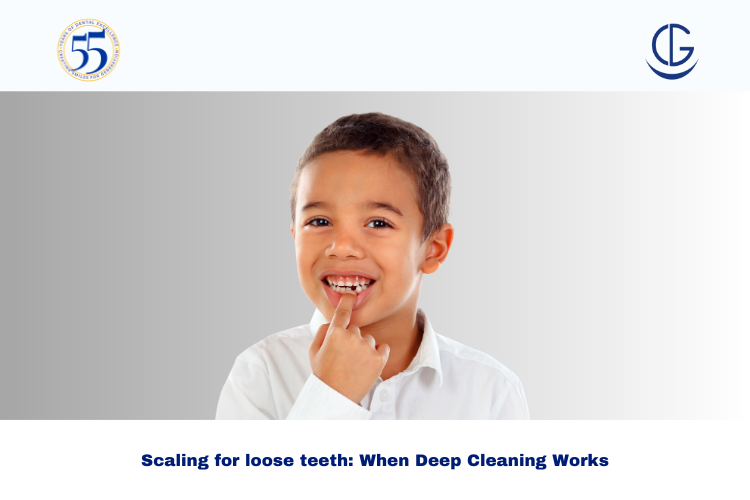
Loose teeth can feel alarming—especially when you notice movement while chewing, brushing, or even when you touch the tooth with your tongue. Many people immediately assume the tooth will need to be removed. In reality, scaling for loose teeth is often one of the first and most effective clinical steps when gum infection and buildup are the root cause.
At Dr Gowds Dental Hospitals, our dentists see many Hyderabad patients who delay care because the symptoms feel “manageable” at first—mild bleeding, occasional bad breath, or gum tenderness. But these are early warning signs. Timely deep cleaning can slow or stop further damage and, in many cases, help stabilize the teeth by treating the underlying gum disease.
If you’re noticing tooth mobility, gum bleeding, or persistent bad breath, don’t wait. Book a consultation at Dr Gowds Dental Hospitals to get a periodontal evaluation, understand what’s causing the looseness, and start the right treatment early. Visit your nearest branch in Hyderabad and speak with a specialist.
Loose teeth in adults are most commonly linked to gum disease, not “weak teeth.” Teeth are supported by bone and gum tissue. When gums are infected and the bone starts shrinking, the tooth loses its foundation.
Deep cleaning is not the same as routine cleaning. It usually refers to:
This is why scaling for loose teeth is frequently recommended when looseness is linked to gum infection and buildup.
Normal cleaning focuses on visible surfaces. Deep cleaning targets:
Yes—scaling for loose teeth can help, but the result depends on why the tooth is loose and how advanced the gum disease is.
Deep cleaning works best when:
Patients often report:
Deep cleaning may not fully stabilize teeth if:
In such cases, deep cleaning is still important—but it may be combined with:
Many patients worry that deep cleaning will be painful or complicated. The experience is usually comfortable with proper anesthesia and technique.
It can be:
You won’t feel “tight teeth” immediately in all cases. Healing takes time because the gums need to reduce inflammation and reattach.
Teeth looseness caused by active inflammation often improves faster than looseness caused by significant bone loss.
If you notice any of these, it’s time to visit a dentist:
Sometimes deep cleaning gum disease treatment needs support therapies for long-term stability.
Even if your primary concern is gum health, aligning teeth can reduce trauma on vulnerable teeth—so in some cases, it helps to talk to an orthodontist and explore options like aligners.
Deep cleaning helps, but home care keeps the results stable.
Seek urgent dental evaluation if you have:
Loose teeth can often be managed—if you act early.
Yes, deep cleaning can absolutely help—especially when gum infection and tartar are the main causes. Scaling for loose teeth reduces bacteria, improves gum health, and can slow the bone loss process. In many cases, it improves stability and prevents the problem from escalating.
If you’re worried about loose teeth, gum bleeding, or gum infection, take action early. Book a consultation with Dr Gowds Dental Hospitals to get a clear diagnosis and a treatment plan tailored to you. Visit your nearest branch(Gachibowli, Madhapur, Koti, Nanakramguda) in Hyderabad, talk to an orthodontist if bite correction is needed, and explore aligner treatment options if alignment is contributing to mobility.
Scaling is usually comfortable because local anesthesia can be used. You may feel mild soreness afterward, but it typically settles in a few days.
A dentist checks gum pocket depth, mobility grade, and bone support on X-rays. If looseness is mainly from inflammation, the tooth often stabilizes after deep cleaning and follow-ups.
Mild cases may need one visit. Moderate to severe cases may require two or more sessions (quadrant-wise), plus follow-up reviews for healing.
Because gum disease needs structured diagnosis, careful cleaning below the gums, and follow-ups. A multi-specialty dental setup also helps if you need orthodontic or restorative coordination.
In selected cases, yes. If misalignment and bite pressure are worsening mobility, orthodontic correction or aligners can reduce stress on affected teeth. This must be planned carefully after gum inflammation is controlled.

 Gachibowli Branch