

Schedule Appointment

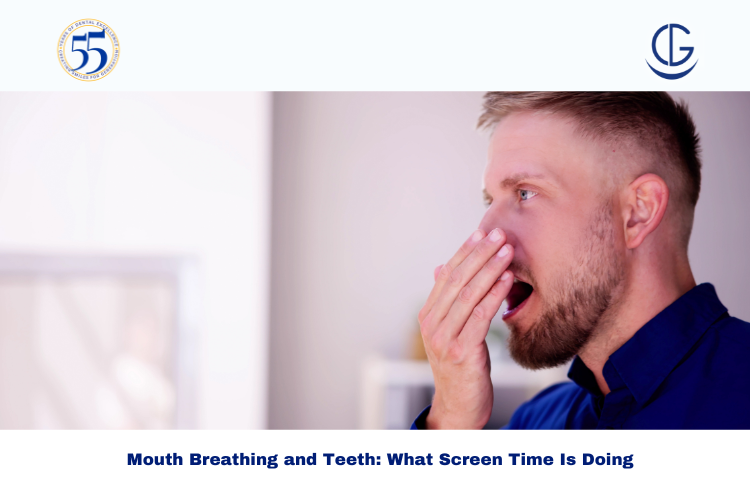
Mouth breathing and teeth misalignment are becoming increasingly common — especially among children and adults who spend long hours on phones, laptops, and tablets. At Dr Gowds Dental Hospitals, one of the Best Dental Hospital in Hyderabad, our orthodontists consistently see teens and adults with crowding, overbite changes, and narrow arches linked to prolonged mouth-open posture during screen time.
If you suspect that screen-related habits are affecting your breathing or smile, this guide explains why it happens and what you can do.
Book an orthodontic check-up at Dr Gowds Dental Hospitals and prevent long-term teeth shifting.
Most people assume screen time only strains the eyes — but it also changes your posture and airway patterns. When the head tilts forward and the chin drops (a common device-using posture), the nose airflow becomes restricted, causing a natural shift to mouth breathing.
This pattern leads to several mouth breathing effects, especially in children whose facial structures are still growing.
Prolonged mouth breathing — even a few hours daily during screen time — can significantly alter dental and facial development.
When the mouth stays open, the tongue doesn’t rest on the palate. Without tongue support, the upper arch becomes narrow, leading to:
These are some of the most common crooked teeth causes we see at our Hyderabad branches.
Open mouth posture disrupts the natural alignment of the jaw. Over time, it contributes to:
Common in children with chronic mouth breathing:
Mouth breathing dries out protective saliva, increasing the risk of:
Visit Dr Gowds Dental Hospitals (Gachibowli, Madhapur, Koti, Nanakramguda) for early mouth breathing assessment.
Parents across Hyderabad are noticing that children spending long hours on online classes, mobile games, and cartoons develop:
Children aged 5–14 are especially vulnerable because their facial bones grow rapidly during this period.
Yes. It is one of the strongest and most overlooked teeth shifting causes.
Teeth naturally stabilize when:
Mouth breathing disrupts all three.
This is why many orthodontic cases at Dr Gowds begin with identifying airway issues before braces or aligners.
At Dr Gowds Dental Hospitals, treatment is customized based on age, severity, and breathing habits.
Instead of only straightening teeth, airway orthodontics improves:
Depending on the severity of misalignment:
Includes:
Prevention is easier and more cost-effective than treatment.
Yes. Early intervention, orthodontics, and breathing therapy can restore correct nasal breathing.
Look for signs like open lips, snoring, dry mouth, long face growth, or difficulty closing the lips.
Not always. Treatment depends on severity. Our orthodontists first correct breathing issues before planning braces or aligners.
Screen time doesn’t directly move teeth, but it encourages mouth-open posture that leads to tongue dropping, airway collapse, and long-term dental shifts.
 Gachibowli Branch