

Schedule Appointment


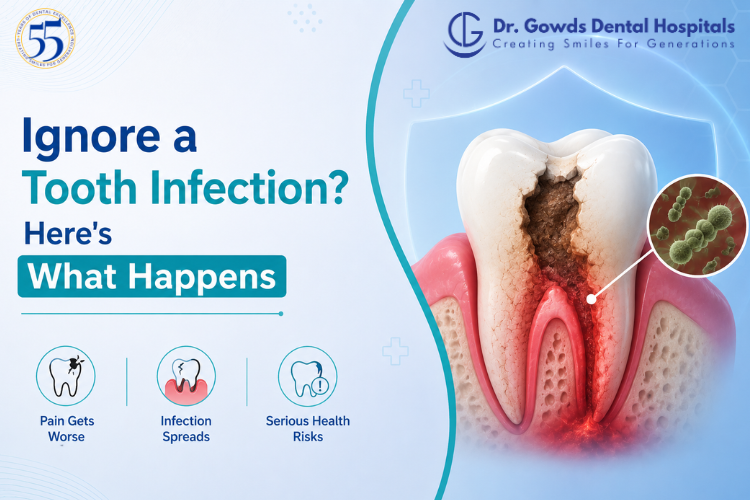
Ignoring a tooth infection can allow bacteria to spread from the tooth into the surrounding gums, jawbone, facial tissues, and, in severe cases, other parts of the body. What may begin as mild tooth pain can progress into a dental abscess, tooth loss, bone damage, or even a life-threatening medical emergency if left untreated.
At Dr. Gowds Dental Hospitals, dentists emphasize treating tooth infections as early as possible because prompt care can often save the tooth and prevent serious complications.
Many people delay treatment because:
Unfortunately, the infection often continues spreading even when the pain decreases.
Pain disappearing does not necessarily mean the infection is gone—it may indicate that the tooth’s nerve has died.
During the earliest stage, bacteria invade the pulp and begin causing inflammation.
At this stage, treatment is usually simpler and has a high chance of saving the tooth.
As bacteria multiply, inflammation increases inside the tooth.
Pressure builds because the pulp is enclosed within hard tooth structure.
Pain often becomes more intense during this stage.
If the infection reaches the root tip, pus begins collecting.
This creates a dental abscess.
An abscess requires immediate dental treatment.
Without treatment, bacteria begin affecting the surrounding jawbone.
Bone destruction may gradually occur around the infected tooth.
At this stage, saving the tooth becomes more difficult.
The infection may spread into facial soft tissues.
This condition is called cellulitis.
Medical treatment becomes increasingly urgent.
In rare but serious situations, bacteria may spread beyond the face.
Possible complications include:
Although uncommon, untreated dental infections can become life-threatening.
This is why prompt dental care should never be delayed.
No. A tooth infection rarely resolves without professional treatment.
Even if:
The bacteria often remain inside the tooth or surrounding tissues.
Without removing the source of infection, complications can continue developing.
Yes.
As infection progresses, it can destroy:
In advanced cases, the tooth may become too damaged to save.
Early treatment offers the best opportunity to preserve the natural tooth.
If you’re wondering what happens if you ignore a tooth infection, the answer is simple: the infection usually gets worse, not better.
What starts as mild tooth pain can progress to a dental abscess, bone damage, facial swelling, tooth loss, and, in rare cases, serious systemic infection. The earlier a tooth infection is treated, the greater the chance of saving the tooth and avoiding complex procedures.
If you notice persistent tooth pain, swelling, or signs of infection, don’t wait for the symptoms to become severe. Seeking prompt care at Dr. Gowds Dental Hospitals can help protect your oral health and prevent potentially serious complications.
Visit us at-
Dr gowds dental hospital Nanakramguda
Dr gowds dental hospital Gachibowli
Dr gowds dental hospital madhapur
There is no safe timeline. Some infections worsen within days, while others progress over weeks or months. Early treatment is always recommended.
Yes. In severe cases, bacteria can spread to surrounding tissues, the jawbone, bloodstream, or other parts of the body, leading to serious health complications.
No. Antibiotics may help control the spread of infection, but the source usually requires dental treatment such as a root canal or tooth extraction.
Yes. Facial swelling, fever, difficulty swallowing, or trouble breathing are signs of a dental emergency that require immediate medical attention.
In many cases, yes. If diagnosed early, root canal treatment can eliminate the infection while preserving the natural tooth. Delaying treatment reduces the chances of saving it.
 Gachibowli Branch