

Schedule Appointment


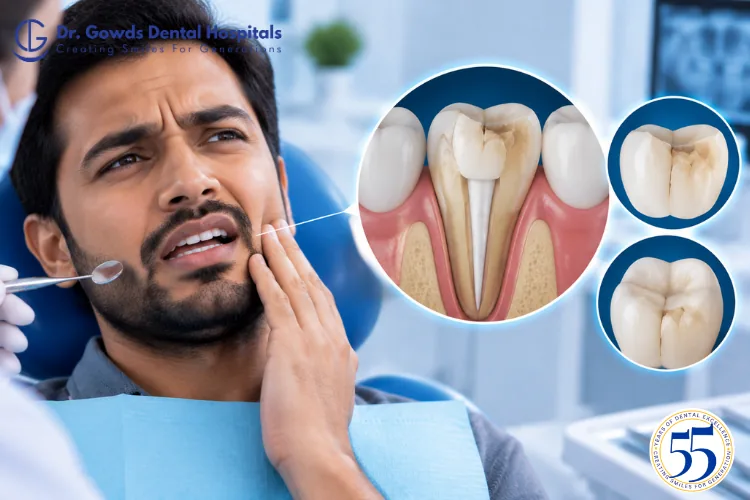
A tooth that was successfully treated with a root canal can remain functional for many years. However, some people notice that a previously treated tooth becomes weaker, develops cracks, or breaks long after the procedure.
If you are concerned about a tooth becoming brittle years after a root canal, the problem is not necessarily that the root canal itself has failed. Several factors can contribute to the structural weakening or fracture of a tooth over time.
At Dr Gowds Dental Hospitals, dentists evaluate the remaining tooth structure, the restoration, the bite, and the condition around the tooth before deciding how it should be treated.
Understanding why a root canal-treated tooth may become fragile can help you recognize warning signs and seek treatment before a small crack develops into a more serious fracture.
A root canal removes infected or inflamed pulp tissue from inside the tooth. The procedure allows the tooth to remain in the mouth rather than requiring extraction.
However, the tooth may already have lost substantial structure before treatment because of:
The amount of remaining natural tooth structure has a major influence on how well the tooth withstands chewing forces.
Therefore, a root canal-treated tooth does not simply become brittle because it has been “deprived of nerves.” The loss of structural tissue and the forces placed on the remaining tooth are important factors.
A tooth may function normally for years before developing a problem.
Several changes can occur over time.
Teeth experience repeated chewing forces every day.
Over many years, a heavily restored tooth may experience additional wear or stress, particularly if it has already lost significant natural structure.
A tooth that required a root canal may also have a large filling or other restoration.
If much of the original tooth structure has been removed by decay or previous treatment, there may be less natural tooth material surrounding the restoration.
This can make the tooth more vulnerable to fracture.
Normal chewing places forces on the teeth every day.
Additional stress may occur in people who:
Over time, these forces can contribute to cracks or fractures in a weakened tooth.
A root canal treats the internal infection, but restoring the tooth afterward is a separate part of treatment.
Depending on the tooth and how much structure remains, a dentist may recommend a restoration designed to protect the remaining tooth.
For some heavily damaged back teeth, a crown may be recommended because molars and premolars experience substantial chewing forces.
However, not every root canal-treated tooth automatically requires the same restoration.
A brittle tooth does not always cause symptoms in the beginning.
Watch for changes such as:
You may notice a visible line on the tooth, particularly if the tooth has been heavily restored.
Not every visible crack is dangerous, but a dentist should evaluate a new or changing crack.
A small piece of the tooth or restoration may break away while eating.
Pain when biting down or releasing the bite can sometimes occur with a cracked tooth.
Although a properly root canal-treated tooth should no longer have an inflamed pulp, discomfort can still arise from tissues around the tooth, a crack, the restoration, or other dental problems.
A filling, crown, or other restoration may become worn, loose, or damaged over time.
Repeated food trapping around a tooth can sometimes occur when the tooth or restoration has changed shape.
This is a common misconception.
The root canal procedure itself is not the only factor determining whether a tooth will fracture.
A tooth requiring root canal treatment often has already experienced substantial structural damage from decay, cracks, large restorations, or trauma.
Removing infected pulp is necessary to treat the internal problem, but the remaining tooth still has to withstand normal chewing forces.
The long-term strength of the tooth therefore depends heavily on how much healthy tooth structure remains and how the tooth is restored.
Back teeth can be particularly vulnerable because they absorb significant chewing forces.
Molars and premolars may have:
Front teeth experience different forces and may require different restoration strategies.
The appropriate restoration depends on the individual tooth rather than simply whether it has undergone a root canal.
The treatment depends on where the crack is located and how deeply it extends.
If the tooth has a small area of damage but remains structurally sound, the dentist may be able to restore it.
Treatment could involve a suitable filling or other restoration.
A crack that extends through part of the tooth may require a protective restoration.
The dentist will determine whether the tooth can still be predictably restored.
If a fracture extends deeply into the root or separates important parts of the tooth, saving the tooth may become more difficult.
In some cases, extraction may be necessary.
This is why evaluation is important when a root canal-treated tooth starts breaking.
Sometimes, yes.
The possibility of saving the tooth depends on factors such as:
A dentist may use clinical examination and dental imaging to assess the tooth.
A crack that is limited to the crown can have a very different outlook from a fracture extending into the root.
Treatment is individualized according to the structural condition of the tooth.
A filling may be appropriate when only a limited amount of tooth structure has been damaged and sufficient healthy structure remains.
It is not suitable for every fractured root canal-treated tooth.
A crown covers and protects the remaining tooth structure.
For a heavily restored posterior tooth, a crown may be considered when appropriate to help protect it from further damage.
The dentist will first assess whether enough healthy tooth structure remains to support the restoration.
Some teeth may benefit from a restoration that covers vulnerable areas without completely covering the tooth.
The choice depends on the amount and location of remaining tooth structure.
A brittle tooth does not automatically need another root canal.
Retreatment may be considered when there is evidence that the original root canal treatment has failed or the tooth has developed a new endodontic problem.
A fracture and a failed root canal are different problems and need to be distinguished.
If the tooth has a fracture that cannot be predictably restored, extraction may be recommended.
Replacement options can then be discussed based on the patient’s oral health and individual circumstances.
A well-designed restoration can help protect remaining tooth structure, but no restoration can guarantee that a tooth will never fracture.
The benefit of a crown depends on factors including:
A dentist should assess the tooth before deciding whether a crown or another restoration is appropriate.
This can happen.
A root canal-treated tooth may not respond to temperature in the same way as a tooth with healthy pulp. As a result, structural damage may not always produce the typical sensitivity associated with a living tooth.
A crack can therefore develop without significant pain initially.
If you notice a chip, visible crack, change in the bite, or damaged restoration, it is worth having the tooth examined even if it does not hurt.
If a piece of the tooth breaks:
If there is significant swelling, severe pain, facial swelling, or fever, seek urgent dental care.
Good oral care can help preserve a treated tooth and the restoration around it.
Brush twice daily with fluoride toothpaste and clean between the teeth regularly.
Routine examinations allow dentists to identify worn restorations, cracks, decay, or changes around the treated tooth.
Do not use teeth to open packages, cut materials, or bite hard non-food objects.
If you grind or clench your teeth, discuss it with your dentist. A suitable night guard may be considered in some situations.
A damaged or loose crown or filling should be assessed rather than ignored.
Arrange a dental examination if a root canal-treated tooth develops:
Prompt assessment can help determine whether the tooth can be restored and whether additional treatment is required.
At Dr Gowds Dental Hospitals, root canal-treated teeth can be evaluated for both their internal condition and their remaining structural support.
When a previously treated tooth becomes damaged years later, the goal is to determine whether the issue involves a restoration, a crack, recurrent infection, or another dental problem.
The appropriate treatment can then be planned based on the condition of the tooth rather than assuming that every brittle root canal tooth needs the same procedure.
Visit us at-
Dr gowds dental hospital Nanakramguda
Dr gowds dental hospital Gachibowli
Dr gowds dental hospital madhapur
A tooth becoming brittle years after a root canal does not necessarily mean that the root canal treatment has failed.
A tooth may become vulnerable because of extensive structural loss from the original decay or damage, large restorations, repeated chewing forces, grinding, cracks, or deterioration of a restoration over time.
If a root canal-treated tooth develops a crack, chip, pain when biting, or a damaged crown or filling, do not wait for the problem to become severe. A dental examination can determine the cause and whether the tooth can still be protected and restored.
With appropriate restoration and regular dental care, many root canal-treated teeth can continue functioning for years.
Yes. A root canal-treated tooth can become vulnerable to cracking or fracture over time, particularly when substantial tooth structure was lost from decay, previous restorations, or trauma.
A previously treated tooth may break because of remaining structural weakness, repeated chewing forces, a large restoration, tooth grinding, an existing crack, or damage to the restoration.
The need for root canal treatment is often associated with significant loss of tooth structure. The structural condition of the remaining tooth and how it is restored are important factors in its long-term fracture resistance.
Some cracked teeth can be restored, depending on the location and depth of the crack and how much healthy tooth structure remains. A fracture extending deeply into the root may be more difficult or impossible to restore predictably.
No. The appropriate restoration depends on the tooth, the amount of remaining structure, its location, and the forces placed on it. Some teeth may require a crown, while others may be suitable for different restorations.
Yes. A root canal-treated tooth may not produce the same sensations as a tooth with healthy pulp. Structural damage can therefore sometimes occur with little or no pain initially.
Avoid chewing on that side, keep the area clean, and arrange a dental examination. Do not attempt to repair or glue the broken tooth yourself.
A properly planned restoration can provide protection to remaining tooth structure, but it cannot guarantee that a tooth will never fracture. The condition of the tooth and the patient’s bite and habits also matter.
No. Extraction is generally considered when the tooth has damage that cannot be predictably restored. If sufficient healthy structure remains, restorative treatment may be possible.
Possibly, but brittleness alone does not mean retreatment is required. Retreatment is considered when there is evidence of persistent or recurrent infection or another endodontic problem.
 Gachibowli Branch