

Schedule Appointment

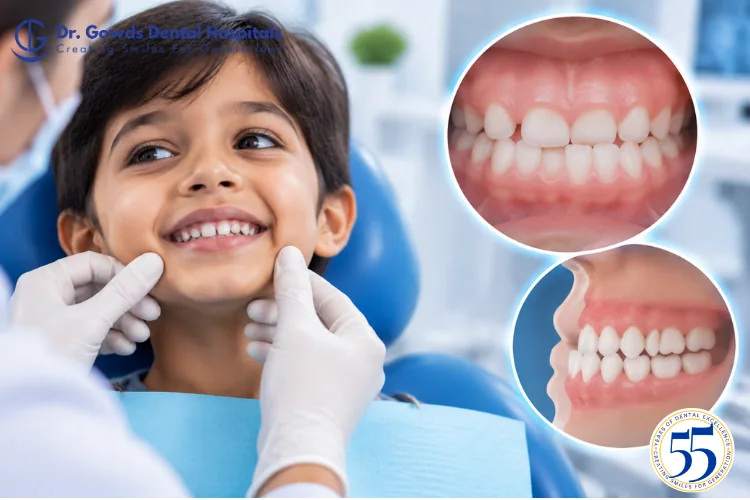
A child’s teeth and jaws change rapidly during the growing years, which makes childhood an important time to notice developing bite problems. One condition parents may observe is a reverse bite in children, where some of the lower teeth bite in front of the upper teeth instead of behind them.
A reverse bite may involve only one or a few front teeth, or it can affect a larger part of the bite. In some children, it may be related mainly to the position of the teeth, while in others, jaw growth can contribute to the problem.
At Dr Gowds Dental Hospitals, children can be evaluated for developing bite problems so that concerns can be identified while the teeth and jaws are still developing.
Recognizing the early signs does not necessarily mean that a child needs immediate treatment. However, an orthodontic or dental evaluation can help determine whether the bite should be monitored or treated.
A reverse bite is a bite relationship in which one or more lower teeth are positioned in front of the corresponding upper teeth when the child closes their mouth.
For the front teeth, this can appear as the lower incisors sitting ahead of the upper incisors. This is commonly referred to as an anterior crossbite.
A reverse bite can vary considerably from child to child.
It may involve:
The appearance of the bite alone does not always reveal the underlying cause. A dentist or orthodontist needs to examine the teeth, jaw relationship, facial growth, and how the child closes and moves their jaw.
Parents may notice certain changes when their child smiles, speaks, eats, or closes their mouth.
One of the clearest signs is that one or more lower front teeth appear to sit in front of the upper teeth when the child bites down.
The difference may be subtle, particularly when only one tooth is affected.
A child may have an upper front tooth that sits behind a lower tooth instead of overlapping it normally.
Parents sometimes notice this when looking closely at the child’s teeth during brushing.
A single tooth that appears out of position can sometimes be an early indication of an anterior crossbite.
Some children with a developing bite problem may move their lower jaw forward or to one side to bring their teeth together.
Parents may notice that the jaw does not close in the same position in which it rests.
This is particularly important to have evaluated because a dentist needs to determine whether the shift is caused by the way the teeth contact each other or by an underlying jaw relationship.
The teeth may not meet evenly when the child bites down.
For example, some teeth may contact earlier than others, while certain teeth may appear to have little or no contact.
An uneven bite does not automatically mean that a child has a reverse bite, but it can be a reason to schedule an evaluation.
Some children with bite problems may find it difficult to use their front teeth to bite foods comfortably.
Parents may notice changes such as:
These signs can have many causes, so they should not be used to diagnose a reverse bite on their own.
When teeth do not meet in their expected positions, certain areas may receive unusual biting forces.
Over time, this can contribute to uneven wear on affected teeth.
A dentist can determine whether the wear is related to the child’s bite or another dental issue.
Children’s teeth naturally change as permanent teeth erupt.
However, parents may notice that the child’s bite has gradually become more uneven or that a lower tooth has started appearing in front of an upper tooth.
Changes during the mixed-dentition stage deserve attention because this is a period when both baby and permanent teeth may be present.
A reverse bite can develop for different reasons. It is not always caused by a single factor.
Sometimes the jaw relationship is relatively normal, but one or more teeth erupt in an unfavorable position.
For example, a permanent upper front tooth may erupt behind the lower front teeth.
This type of problem may be primarily dental rather than skeletal.
In some children, the relationship between the upper and lower jaws contributes to the reverse bite.
A difference in jaw position or growth can make the lower teeth appear ahead of the upper teeth.
This is why an early examination is useful. A dentist or orthodontist can assess whether the issue is primarily related to tooth position, jaw development, or both.
Jaw shape and facial growth patterns can have a hereditary component.
A child with close family members who have certain bite or jaw relationships may have an increased likelihood of developing a similar pattern.
However, family history alone does not determine whether a child will develop a reverse bite.
Insufficient space can affect the eruption path of permanent teeth.
If an upper front tooth does not have enough room to erupt normally, it may emerge behind the lower teeth.
Not every reverse bite requires immediate correction, but early assessment can help identify the type and severity of the problem.
A growing child is still undergoing changes in tooth position and jaw development. Depending on the child’s age and the cause of the bite, treatment options can differ considerably.
An early evaluation may help the dental team:
Early assessment is particularly useful when the bite appears to be changing or becoming more pronounced.
A reverse bite can sometimes be associated with an abnormal functional movement of the lower jaw.
When a child repeatedly shifts the jaw to achieve tooth contact, the bite may need closer evaluation.
However, the presence of a reverse bite does not automatically mean that the child’s jaw will develop abnormally.
The potential effect depends on factors such as:
This is why individualized assessment is more useful than judging the bite from photographs alone.
A dental examination usually begins with a visual assessment of the child’s teeth and bite.
The dentist or orthodontist may evaluate:
The position of individual teeth is examined to determine which teeth are involved.
The way the upper and lower teeth meet is assessed when the child closes naturally.
The clinician may observe whether the lower jaw shifts when the child closes their mouth.
The relationship between the upper and lower jaws and overall facial development may be considered.
When necessary, dental imaging can provide additional information about developing permanent teeth, roots, and jaw structures.
Not every child requires the same type of imaging. The examination should determine what is appropriate.
The terms can sometimes be used interchangeably in everyday conversations, but they do not always describe exactly the same situation.
A crossbite refers to an abnormal relationship between specific upper and lower teeth.
An underbite is commonly used to describe a situation where the lower teeth or jaw extend in front of the upper teeth.
A child can have a small anterior crossbite involving only one tooth without having the broader jaw relationship commonly associated with an underbite.
An orthodontic examination can distinguish between these patterns.
Treatment depends on the cause, the child’s age, the teeth involved, and the stage of dental and jaw development.
If the bite is mild and does not currently require intervention, the dentist may recommend regular monitoring.
This allows changes in tooth eruption and jaw growth to be observed over time.
When a developing crossbite is suitable for early correction, an orthodontist may recommend interceptive treatment.
Depending on the case, treatment may involve appliances designed to guide teeth into a more favorable position.
The exact appliance should be selected based on the child’s individual bite rather than simply their age.
If the problem is mainly related to the position of one or more teeth, orthodontic treatment may be used to reposition them.
The approach varies depending on the available space, tooth eruption, and surrounding structures.
When jaw development contributes significantly to the bite, treatment may require a different approach.
In growing children, the timing of treatment can be an important consideration because the jaws are still developing.
Parents should avoid trying to correct a child’s reverse bite without professional guidance.
Do not:
These approaches can injure teeth and surrounding tissues.
If you notice a developing bite problem, professional assessment is safer and more appropriate.
Consider scheduling a dental or orthodontic evaluation if you notice:
Parents do not need to wait until all permanent teeth have erupted before discussing a bite concern.
Parents can support their child’s oral health by establishing consistent dental habits.
Children should brush their teeth regularly using age-appropriate fluoride toothpaste.
Pay attention to changes as baby teeth are replaced by permanent teeth.
Routine examinations allow dental professionals to monitor tooth development and identify problems early.
If a child’s bite suddenly changes or a permanent tooth erupts in an unusual position, discussing it with a dentist can clarify whether monitoring or treatment is appropriate.
At Dr Gowds Dental Hospitals, children’s dental concerns can be evaluated with attention to tooth development, bite relationships, and individual treatment needs.
A developing reverse bite may look minor when only one tooth is involved, but determining the underlying cause is important before deciding whether treatment is necessary.
Depending on the child’s needs, dental and orthodontic evaluation can help monitor tooth eruption and identify appropriate treatment options during the growing years.
A reverse bite in children can sometimes be noticed when a lower tooth sits in front of an upper tooth, but the appearance of the bite does not tell the whole story.
The condition may be related to tooth position, jaw development, eruption patterns, or a combination of factors. Some cases may require treatment, while others may simply need monitoring.
The most important step for parents is to recognize changes early and have the child’s bite evaluated when something looks unusual. Timely assessment allows the dental team to understand how the teeth and jaws are developing and determine whether intervention is appropriate.
Regular dental visits, good oral hygiene, and attention to changes in tooth eruption can help support healthy dental development throughout childhood.
Visit us at-
Dr gowds dental hospital Nanakramguda
Dr gowds dental hospital Gachibowli
Dr gowds dental hospital madhapur
A reverse bite occurs when one or more lower teeth bite in front of the corresponding upper teeth. When it affects the front teeth, it is commonly described as an anterior crossbite.
Common signs include lower front teeth appearing ahead of the upper teeth, an upper tooth sitting behind a lower tooth, uneven tooth contact, or the jaw shifting when the child bites down.
Some dental bite irregularities may change as teeth erupt, but it is not possible to determine whether a reverse bite will correct itself without an appropriate dental evaluation.
Not necessarily. A reverse bite may involve only one or a few teeth, whereas an underbite is commonly used to describe a broader relationship involving the lower teeth or jaw.
A reverse bite can be evaluated as soon as a parent or dentist notices it. The appropriate timing for treatment depends on the child’s dental development and the underlying cause.
A developing crossbite can influence how affected teeth contact and wear against each other. An examination can determine whether the permanent teeth require monitoring or treatment.
No. Treatment depends on the cause and severity of the bite. Some children may need orthodontic appliances, while others may only require observation.
No. Parents should not attempt to move teeth or alter a child’s bite manually. Professional evaluation is recommended to avoid injury and determine the appropriate approach.
In some cases, yes. Treatment timing depends on the child’s age, dental development, jaw relationship, and the nature of the bite problem.
Consider an orthodontic evaluation if you notice lower teeth biting ahead of upper teeth, a jaw shift, an unusual eruption pattern, or a bite that appears to be becoming more pronounced.
 Gachibowli Branch