

Schedule Appointment


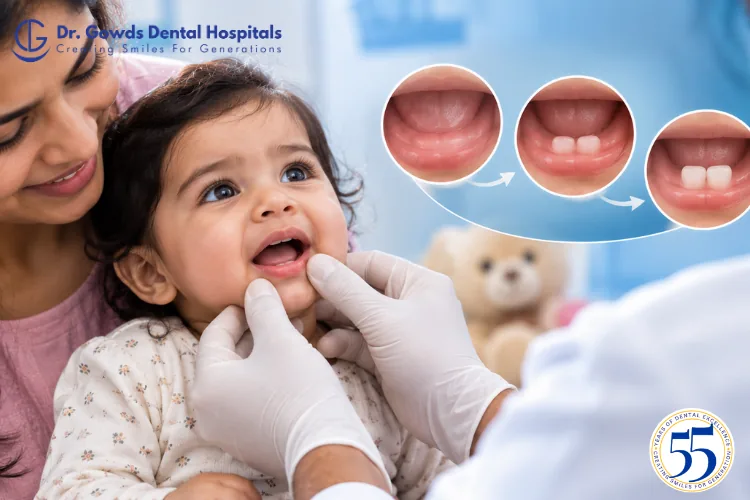
Parents often expect their baby’s first tooth to appear during a particular period. When months pass without seeing a tooth, it is understandable to wonder whether the delay is normal.
Tooth eruption varies from child to child. Some babies get their first tooth relatively early, while others may not have a visible tooth until later. The order in which teeth appear can also vary.
At Dr Gowds Dental Hospitals, parents can have their child’s oral development evaluated if they are concerned about delayed eruption, an unusual eruption pattern, or other symptoms.
A baby teeth coming in late does not automatically indicate a dental problem. However, understanding normal eruption patterns and knowing when to seek professional advice can help parents recognize situations that may need further evaluation.
Most children begin developing their primary teeth during infancy. The lower central incisors, or lower front teeth, commonly appear first, followed by other primary teeth over the following months.
By approximately 2½ to 3 years of age, most children have their complete set of 20 primary teeth.
However, there is considerable variation in the timing of individual teeth. The sequence may also differ slightly between children.
Factors that can influence dental development and eruption include:
Therefore, a child who gets teeth later than a sibling or another baby is not necessarily experiencing abnormal development.
Delayed tooth eruption means that a tooth has not erupted within the expected developmental period.
There is no single age at which every late-erupting tooth should be considered an emergency. Dentists assess the child’s overall development and eruption pattern rather than relying on age alone.
During an evaluation, a dentist may consider:
This broader assessment helps distinguish normal variation from a pattern that may require further investigation.
There are several possible reasons for delayed baby teeth eruption. In many cases, the timing simply reflects normal variation.
Genetics can influence the timing of tooth eruption.
If parents or siblings experienced later-than-average eruption, a child may have a similar pattern. A family history of delayed teething can therefore be useful information when discussing a child’s dental development with a dentist.
Children born prematurely may have differences in developmental timing, including the timing of dental development and eruption.
When assessing a child with delayed eruption, the dentist may consider the child’s birth history along with their growth and overall development.
Prematurity alone does not mean that a child will necessarily have delayed teeth.
Adequate nutrition is important for normal growth and development, including the development of teeth.
Significant nutritional deficiencies or inadequate nutritional intake may affect development in some children.
However, parents should not give vitamins, minerals, or other supplements specifically to make teeth erupt faster unless recommended by a pediatrician or dentist.
Some medical or developmental conditions can affect growth and tooth development.
If delayed eruption occurs together with poor growth, unusual fatigue, other developmental concerns, or persistent health symptoms, the child may benefit from a broader medical assessment.
A dental examination can help determine whether the eruption delay appears isolated or whether there are dental findings that warrant further evaluation.
Occasionally, an individual tooth may not develop normally.
Developmental abnormalities can affect the presence, size, shape, or position of a tooth. In some cases, a tooth may be absent or may not follow the expected eruption path.
A dentist may recommend dental imaging if there is concern that a tooth is missing, developing abnormally, or unable to erupt normally.
Sometimes a tooth has developed beneath the gum but has not yet emerged through the gum tissue.
Parents may assume that a missing visible tooth means the tooth is not present. A dental examination can provide useful information, and an X-ray may be considered when clinically appropriate.
Imaging can help the dentist determine whether an unerupted tooth is present and assess its position and development.
No.
Children do not all follow exactly the same tooth eruption schedule. A baby may simply develop teeth at a different pace from another child of the same age.
The overall pattern is more important than comparing one child with another.
For example, a child who has fewer erupted teeth than expected may still have normal development if the teeth are developing appropriately and there are no other concerns.
On the other hand, a significant delay combined with swelling, pain, unusual tooth development, or other developmental concerns may warrant a dental evaluation.
Parents should therefore avoid comparing their child’s eruption schedule too closely with that of friends, siblings, or children seen online.
Consider arranging a dental evaluation if:
The appropriate timing for evaluation depends on the child’s individual circumstances.
Delayed eruption itself does not necessarily cause dental disease.
However, the reason behind delayed eruption may sometimes require attention. For example, a tooth that is not developing normally or is unable to follow its expected eruption path may need monitoring.
Early assessment can help determine whether the tooth is developing appropriately and whether observation is sufficient.
In many cases, the outcome of an examination may simply be reassurance that the child’s eruption pattern is within an acceptable range.
No.
Parents should not press, cut, scratch, or otherwise manipulate the gums to encourage a tooth to erupt. Doing so can injure the gum tissue and potentially introduce infection.
Parents should also be cautious about using teething gels or other products. Not every product is appropriate for every age, and some may not be recommended for infants.
If a tooth appears close to the surface but does not erupt, allow a dentist to determine whether anything needs to be done.
A dental appointment for delayed eruption usually begins with understanding the child’s development and examining the mouth.
Treatment is not automatically required simply because a tooth has appeared later than expected.
The dentist may:
The dentist may ask about:
The dentist examines the gums, erupted teeth, jaw development, and overall oral health.
They may also look for signs that an unerupted tooth is developing beneath the gum or whether there are abnormalities affecting the eruption path.
The dentist considers which teeth have erupted, the order in which they have appeared, and whether the pattern is appropriate for the child’s developmental stage.
An X-ray may be recommended when the dentist needs additional information about an unerupted tooth.
Imaging can help determine whether a tooth is present, where it is positioned, and whether there may be an obstacle affecting eruption.
An X-ray is not automatically required for every child with late teething. The decision depends on the clinical examination and the child’s individual circumstances.
Not necessarily.
A delay in the eruption of primary teeth does not automatically mean that permanent teeth will also erupt late.
Primary and permanent teeth develop through different stages, and individual differences in eruption timing are common.
However, significant developmental abnormalities involving the primary teeth or jaws may warrant continued monitoring of future dental development.
Regular dental visits allow the dentist to observe how the child’s teeth and jaws develop over time.
Parents cannot control the exact date when a baby’s first tooth will appear, but they can support healthy oral development.
Before teeth erupt:
Once teeth begin to appear:
Good oral care should begin even before the first tooth appears.
Parents do not need to wait until all the baby teeth have erupted before taking their child to a dentist.
An early dental visit provides an opportunity to discuss:
Early dental visits also help establish a dental home where your child’s oral health and eruption pattern can be monitored as they grow.
At Dr Gowds Dental Hospitals, children’s dental concerns can be assessed according to their individual stage of oral development.
When parents are worried that their baby’s teeth are coming in late, a dental examination can help determine whether the eruption pattern represents normal variation or whether further evaluation may be appropriate.
The goal is not to make every child follow exactly the same eruption timetable. Instead, the focus is on monitoring healthy development, identifying unusual patterns, and addressing genuine dental concerns when necessary.
Baby teeth do not always appear according to a strict timetable. Some children get their first tooth earlier, while others take longer, and normal variation is common.
If your baby’s teeth are coming in late, there is no need to assume that something is wrong based solely on age. However, significant delays, unusual eruption patterns, persistent swelling or pain, or other developmental concerns should be discussed with a dentist.
A timely pediatric dental assessment can help determine whether your child simply needs more time or whether the eruption pattern requires monitoring or further investigation.
The most important approach is to avoid comparing your child with other babies and instead focus on their individual growth, development, and oral health.
Visit us at-
Dr gowds dental hospital Nanakramguda
Dr gowds dental hospital Gachibowli
Dr gowds dental hospital madhapur
The first baby tooth commonly appears during infancy, but the timing can vary considerably between children. Some babies develop their first tooth earlier, while others may take longer.
It can be normal for a baby to have no visible teeth later than another child. If you are concerned about a significant delay or your child has other symptoms, a pediatric dental examination can provide reassurance and identify potential concerns.
Late eruption may be associated with normal individual variation, family patterns, birth history, nutritional or developmental factors, certain medical conditions, or problems affecting tooth development.
Not necessarily. Delayed eruption does not automatically indicate a problem. However, significant delays, unusual eruption patterns, persistent swelling, pain, or other developmental concerns should be evaluated by a dentist.
A dental examination may provide clues that an unerupted tooth is present beneath the gums. When appropriate, dental imaging can provide additional information about the tooth’s presence, position, and development.
Nutrition supports normal growth and dental development. Significant nutritional problems may affect development in some children, but parents should not give supplements specifically to speed up tooth eruption without professional advice.
No. Parents should not try to force a tooth through the gums. Manipulating the gums can cause injury or irritation. If eruption appears unusually delayed, have the area examined by a dentist.
Not necessarily. A delay involving primary teeth does not automatically predict delayed eruption of permanent teeth. A dentist can monitor your child’s dental development as they grow.
If you are concerned about delayed eruption, unusual gum changes, persistent pain or swelling, or other developmental concerns, discuss them with a pediatric dentist rather than trying to encourage eruption at home.
Keep your baby’s gums clean with a clean, soft cloth and establish healthy feeding and oral-care habits. Once the first tooth appears, begin appropriate toothbrushing with fluoride toothpaste according to professional guidance.

 Gachibowli Branch