

Schedule Appointment


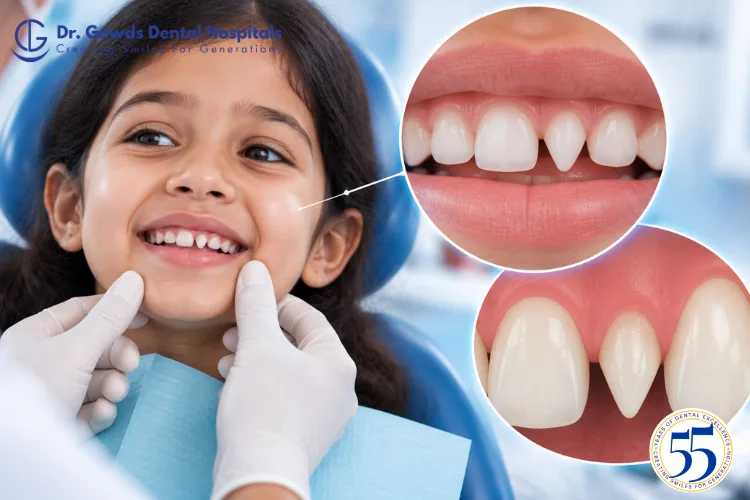
Teeth can vary naturally in size, shape, and proportion. However, some teeth develop noticeably smaller crowns with a narrow, tapered, or pointed appearance. These are commonly called Peg Shaped Teeth.
The term is most often used for unusually small lateral incisors, the teeth located beside the upper front central incisors. Because these teeth are visible when smiling, their unusual shape can sometimes make the teeth appear uneven or create noticeable spaces.
At Dr Gowds Dental Hospitals, a dental examination can help determine whether a small or pointed tooth represents a normal variation, a developmental condition, or a problem that requires treatment.
Peg-shaped teeth are usually not a dental emergency. Treatment is often considered when the tooth affects appearance, spacing, function, or the patient’s confidence.
A typical tooth has a relatively broad crown that gradually transitions toward the root.
A peg-shaped tooth has a noticeably different crown shape. It may appear:
The difference can be subtle in some people and very obvious in others.
Peg-shaped teeth can also create spaces between adjacent teeth because the smaller crown does not occupy the same amount of space as a normally shaped tooth.
The upper lateral incisors are the teeth most commonly associated with peg-shaped appearance.
These teeth sit immediately beside the two upper front central incisors.
Because lateral incisors are highly visible, even a relatively small difference in tooth size can affect the overall appearance of the smile.
However, unusual tooth shape can occur in other teeth as well. A dentist needs to examine the individual tooth to determine whether it is truly peg-shaped or simply smaller than the surrounding teeth.
Peg-shaped teeth are generally associated with disturbances in tooth development.
The exact reason can vary from person to person.
Tooth formation involves multiple stages, including the development of the crown and its shape.
If development occurs differently, a tooth may form with a smaller or tapered crown.
In some individuals, the cause cannot be identified even after a detailed dental examination.
Tooth size and shape can have a hereditary component.
If unusual tooth shapes or smaller teeth occur in a family, a child may also develop similar characteristics.
Genetics can influence the size, proportions, and morphology of teeth without necessarily indicating an underlying disease.
Peg-shaped teeth may be associated with microdontia, a condition in which teeth are smaller than expected.
Microdontia can involve:
Peg-shaped lateral incisors are one of the more recognizable forms of localized microdontia.
Importantly, not every small-looking tooth should automatically be diagnosed as microdontia. A dentist evaluates the tooth’s proportions and overall dental development.
In some cases, a peg-shaped lateral incisor may occur alongside other developmental differences.
For this reason, a dental examination can be useful when a child or teenager has an unusually small permanent tooth, particularly if other teeth are missing or have unusual shapes.
Usually, no.
The shape of a tooth does not necessarily indicate poor oral hygiene or inadequate dental care.
A person can have excellent brushing and flossing habits and still have peg-shaped teeth because the shape developed during tooth formation.
However, the smaller or unusual shape can sometimes create spaces or areas that are more difficult to clean, so maintaining good oral hygiene remains important.
Peg-shaped teeth are often primarily an aesthetic concern, but they can sometimes have functional or orthodontic implications.
Because the tooth is smaller than expected, a visible space may remain between the lateral incisor and neighboring teeth.
A small lateral incisor can make the adjacent central incisors appear disproportionately large.
If the unusual tooth size affects spacing and alignment, orthodontic treatment may sometimes be considered.
Patients may feel that the teeth do not look symmetrical, particularly in photographs or when smiling.
Not everyone with peg-shaped teeth needs treatment.
Diagnosis usually begins with a clinical examination.
The dentist may assess:
Dental X-rays may be recommended when the dentist needs to assess the tooth root, surrounding structures, or underlying dental development.
The goal is to understand whether the tooth is simply small and tapered or whether another developmental issue is involved.
Not always.
If the tooth is healthy and does not cause functional or aesthetic concerns, treatment may not be necessary.
Some people choose treatment because they want their smile to look more symmetrical. Others may need treatment because the unusual tooth shape is associated with spacing or orthodontic concerns.
Treatment decisions depend on:
Several approaches can improve the appearance of a peg-shaped tooth.
Composite bonding is often considered for reshaping a small tooth.
The dentist applies tooth-colored composite material to increase the apparent width or length of the crown.
The composite can be carefully sculpted to create proportions that blend with neighboring teeth.
A veneer can cover the visible front surface of a tooth and alter its apparent size and shape.
Veneers may be considered when a patient wants a more comprehensive cosmetic change and the tooth is suitable for the procedure.
Depending on the type of veneer and treatment plan, preparation requirements vary.
A dentist must evaluate the tooth and surrounding tissues before recommending veneers.
In selected cases, a crown may be used to restore the size and shape of a significantly abnormal or structurally compromised tooth.
However, a healthy peg-shaped tooth does not automatically require a crown.
Because crowns involve greater tooth preparation than some conservative cosmetic approaches, the dentist should determine whether the tooth actually needs full-coverage restoration.
If peg-shaped teeth are accompanied by spacing or alignment problems, orthodontic treatment may be included in the overall plan.
Braces or clear aligners can move teeth into more appropriate positions.
Sometimes orthodontic treatment is performed before reshaping the peg-shaped tooth so that the final tooth proportions and spacing can be planned more accurately.
Some patients may benefit from combining orthodontic treatment with cosmetic reshaping.
For example, orthodontic treatment may first improve the position of the teeth and spaces, followed by composite bonding or another restorative procedure to modify the shape of the peg-shaped tooth.
This approach can be useful when both tooth position and tooth size contribute to the appearance of the smile.
In many cases, their appearance can be significantly improved.
Composite bonding, veneers, or other restorative treatments can increase the apparent size of the tooth and create more balanced proportions.
The objective is not simply to make the tooth larger.
The dentist also considers:
Careful planning is important because making a tooth too wide or too long can create a different imbalance.
A gap should not automatically be closed by adding material to the tooth.
The dentist first determines why the space exists.
Possible factors include:
If the gap is mainly related to the small crown, composite bonding may sometimes be enough.
If several teeth are incorrectly positioned, orthodontic treatment may be more appropriate.
Yes.
Peg-shaped teeth are most often discussed in relation to permanent teeth, particularly the upper lateral incisors.
If parents notice that a newly erupted permanent tooth looks unusually small or pointed, a dental examination can help determine whether its shape is within normal variation or represents a developmental difference.
Early evaluation can also identify whether other teeth are developing normally.
Treatment does not usually need to be rushed simply because a tooth looks small.
For children and teenagers, the dentist may consider whether the surrounding permanent teeth have fully erupted and whether the bite and jaw development are still changing.
In some situations, monitoring is appropriate before definitive cosmetic treatment.
The timing should therefore be based on dental development rather than appearance alone.
Even when a tooth has an unusual shape, it still needs routine preventive care.
Use fluoride toothpaste and clean around the gum line carefully.
Floss or use an appropriate interdental cleaning method to remove plaque around spaces.
Regular examinations allow the dentist to monitor tooth development and identify cavities or changes early.
Small or reshaped teeth can still be damaged by biting hard objects.
If a peg-shaped tooth develops decay, early treatment can help preserve as much healthy tooth structure as possible.
Consider arranging an examination if:
A dentist can determine whether monitoring, orthodontics, restorative treatment, or no treatment is appropriate.
At Dr Gowds Dental Hospitals, treatment planning for unusual tooth shapes begins with assessing the tooth, surrounding teeth, bite, spacing, and overall smile.
For patients concerned about peg-shaped lateral incisors, the treatment approach can be tailored to the amount of tooth structure available and the desired cosmetic result.
Depending on the individual case, treatment may involve restorative reshaping, orthodontic alignment, or a combination of approaches.
The goal is to create a natural-looking result while preserving healthy tooth structure whenever possible.
Visit us at-
Dr gowds dental hospital Nanakramguda
Dr gowds dental hospital Gachibowli
Dr gowds dental hospital madhapur
Peg-shaped teeth are unusually small, narrow, or tapered teeth that are most commonly seen in the upper lateral incisors. They usually develop because of differences during tooth formation and are not necessarily related to poor oral hygiene.
For some people, the unusual shape is barely noticeable. For others, it can create visible gaps or affect the balance of the smile.
Treatment is not automatically required. When cosmetic or functional concerns exist, options such as composite bonding, veneers, orthodontic treatment, or selected restorative procedures may help improve tooth proportions and spacing.
If you notice a small or pointed permanent tooth, a dental examination can clarify what is causing its appearance and whether any treatment is appropriate.
Peg-shaped teeth are unusually small teeth with a narrow, tapered, or pointed crown. They most commonly affect the upper lateral incisors.
Peg-shaped teeth generally result from differences during tooth development. Genetic factors and localized developmental variations may contribute, although a specific cause is not always identifiable.
Peg-shaped teeth can be a form of localized microdontia, where a tooth is smaller than expected. However, a dentist should evaluate the tooth before making a diagnosis.
Yes. Depending on the tooth and the patient’s needs, options such as composite bonding, veneers, orthodontic treatment, or other restorative procedures may improve the tooth’s appearance.
Composite bonding can be a conservative option for reshaping certain peg-shaped teeth. The dentist can add tooth-colored material to increase the apparent width or length of the crown.
Usually, an unusually small tooth does not need to be removed simply because of its shape. Treatment depends on the tooth’s health, position, development, and functional or cosmetic concerns.
Braces or clear aligners can correct tooth position and spacing, but they do not change the actual shape of a peg-shaped tooth. Orthodontics may sometimes be combined with cosmetic reshaping.
Yes. Peg-shaped permanent teeth can become noticeable when they erupt. A dental examination can help assess tooth development and determine whether monitoring or future treatment is needed.
Peg-shaped teeth are not necessarily harmful. They are often primarily a difference in tooth shape and size, although associated spacing or alignment problems may sometimes require attention.
Arrange a dental examination, particularly if the tooth is noticeably smaller than its neighbors or other teeth are developing unusually. The dentist can assess its development and determine whether further evaluation is needed.
 Gachibowli Branch