

Schedule Appointment


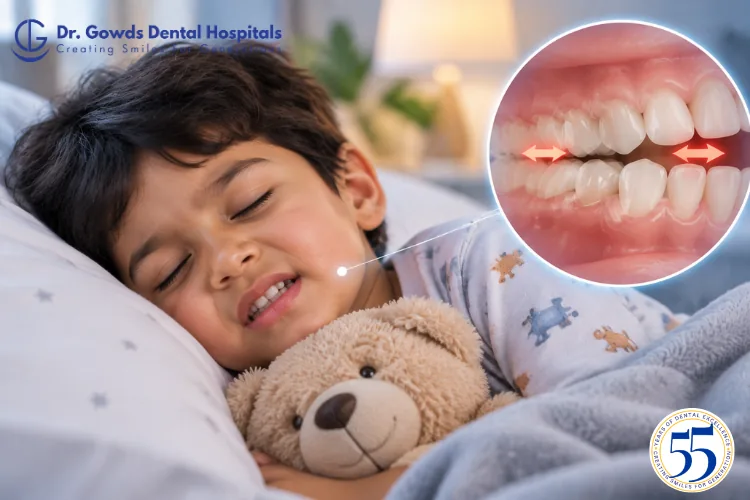
Hearing your child grind their teeth during a daytime nap can be unsettling, especially if you do not notice the same behavior at night. Child grinding teeth during naps can happen for several reasons, and the timing may provide useful clues about sleep patterns, habits, emotional changes, and oral health.
At Dr Gowds Dental Hospitals, children with unusual tooth-grinding patterns can be evaluated based on their age, dental development, symptoms, and overall pattern of bruxism.
Occasional grinding does not necessarily mean that a child has a serious dental problem. However, frequent or forceful grinding can place repeated stress on developing teeth and the muscles and joints involved in chewing.
Rather than focusing only on the sound of grinding, parents should consider when it happens, how often it occurs, and whether the child has other symptoms.
Teeth grinding is commonly called bruxism. It involves clenching, grinding, or rubbing the teeth together.
A child may:
Bruxism can occur during sleep or while a child is awake.
When grinding happens during a nap, parents may notice it more easily because they are nearby and the surrounding environment is quieter.
There is no single explanation for nap-time tooth grinding. Several factors may contribute, and sometimes a specific cause cannot be identified.
A nap is not necessarily identical to nighttime sleep. Children move through different stages of sleep and may experience brief changes between lighter and deeper sleep.
Jaw muscle activity can occur during sleep, and some children may grind or clench their teeth during particular sleep periods.
If grinding happens mainly during naps, the timing may reflect the child’s individual sleep pattern rather than a problem with the teeth themselves.
Children may respond to changes in their environment in ways that are not always easy for them to explain.
Possible factors include:
This does not mean that every child who grinds their teeth is experiencing stress.
However, if grinding began around the same time as a significant change in the child’s routine or emotional environment, it is worth mentioning to the dentist.
Changes in sleep routines may influence a child’s sleep behavior.
Factors such as:
can affect sleep patterns.
If your child grinds their teeth primarily during naps, you can observe whether it occurs more often after particularly tiring days or changes in their normal schedule.
Sleep-related breathing difficulties can sometimes occur alongside unusual sleep behaviors.
Parents may notice:
Teeth grinding alone does not establish that a child has a breathing disorder.
However, if grinding occurs together with significant snoring, breathing pauses, or other concerning sleep symptoms, discuss the pattern with your child’s pediatrician and dentist.
Children’s mouths are constantly developing.
As baby teeth erupt, become loose, or are replaced by permanent teeth, the relationship between the upper and lower teeth changes.
Some children may show temporary jaw movements or grinding during different stages of dental development.
This does not mean that an abnormal bite is necessarily responsible for the grinding. A dentist can assess the child’s teeth and bite to determine whether any dental issue requires attention.
Sometimes a child may grind or clench because something in the mouth feels uncomfortable.
Possible dental causes include:
Young children may not always be able to explain exactly what feels wrong.
This is one reason a dental examination can be useful when grinding becomes frequent, suddenly changes, or occurs alongside other dental symptoms.
The fact that your child appears to grind only during naps is useful information, but it does not necessarily point to one specific cause.
Your child may actually grind during nighttime sleep as well, but you may not hear it.
Alternatively, the grinding may be associated with a particular sleep period or transition.
Some children may also spend different amounts of time in lighter stages of sleep during naps, which could make certain movements easier for parents to notice.
Therefore, nap-only grinding does not automatically indicate a specific dental disorder.
The broader pattern matters more than the timing alone.
Occasional grinding may not cause noticeable dental damage.
Frequent or forceful bruxism, however, can place repeated pressure on the teeth and jaw.
Parents may eventually notice:
Some degree of natural wear can occur as children grow, particularly with baby teeth. A dentist can determine whether the amount and pattern of wear are appropriate for the child’s stage of development.
Parents should consider a dental evaluation if grinding is:
A sudden increase in grinding can also be worth discussing with a dental professional.
Not necessarily.
Bruxism describes clenching or grinding activity. It does not automatically mean that a child has a specific dental disease.
Some children grind their teeth without developing significant dental complications.
The important consideration is whether the grinding is associated with tooth damage, discomfort, sleep problems, or another underlying concern.
This is why treatment should not be based on the grinding sound alone.
Usually, there is no need to repeatedly wake a child simply because they are grinding their teeth.
Interrupting sleep every time grinding occurs can unnecessarily disturb the child’s rest.
Instead, parents can:
If the grinding is occasional and the child has no symptoms or visible dental changes, observation may be sufficient.
If emotional or environmental factors appear to coincide with the grinding, creating a calm and predictable routine may be helpful.
Parents can encourage:
These measures can support healthy sleep and emotional well-being, but they are not guaranteed to stop bruxism.
If grinding continues despite a healthy routine, the child should still be assessed when appropriate.
A dental evaluation may include an examination of several areas.
The dentist may look for:
The gums and other oral tissues can be examined for irritation, inflammation, injury, or other abnormalities.
The relationship between the upper and lower teeth can be assessed as part of the examination.
The dentist may ask about:
Parents may be asked whether the child:
This broader evaluation helps determine whether the grinding can simply be monitored or whether further investigation is appropriate.
No.
A mouthguard is not automatically required for every child who grinds their teeth.
Children’s teeth and jaws are still developing, so any oral appliance should be recommended and monitored by an appropriately qualified dental professional.
The decision may depend on factors such as:
Parents should avoid purchasing or using an ill-fitting appliance without professional advice.
Some childhood bruxism may reduce or disappear as a child grows.
However, it is not possible to predict exactly which children will continue grinding and which will stop.
If grinding is frequent or causing symptoms, it is better to monitor the child’s oral health rather than simply assuming they will outgrow it.
Regular dental visits allow changes in tooth wear and dental development to be monitored over time.
If your child grinds during naps, keeping a simple record can help the dentist understand the pattern.
Note:
If possible, a short audio or video recording of the grinding episode may also help a dentist understand what you are hearing.
Arrange a dental appointment if your child:
Prompt evaluation can help identify dental problems early and determine whether further assessment is appropriate.
Child grinding teeth during naps is not automatically a sign of a serious dental problem.
Children can grind or clench their teeth for different reasons, including sleep patterns, emotional changes, oral discomfort, and other factors.
The fact that grinding occurs during naps rather than at night does not, by itself, identify the cause. What matters is the frequency, force, duration, associated symptoms, and whether the child’s teeth are showing signs of excessive wear.
If your child occasionally grinds during a nap and has no symptoms or visible dental changes, observing the pattern may be reasonable. If grinding is frequent, forceful, or accompanied by tooth damage, jaw discomfort, snoring, or other concerns, a dental evaluation is a sensible next step.
The goal is not simply to stop the grinding sound, but to understand whether it is affecting your child’s teeth, jaw, sleep, or overall oral health.
Visit us at-
Dr gowds dental hospital Nanakramguda
Dr gowds dental hospital Gachibowli
Dr gowds dental hospital madhapur
Occasional teeth grinding can occur in children. Nap-time grinding does not automatically indicate a dental disorder, but frequent or forceful grinding should be monitored for symptoms and tooth wear.
Sleep-related teeth grinding can occur during different stages or transitions of sleep. The exact reason varies between children, and the timing alone does not identify the cause.
Emotional or environmental changes may contribute to teeth grinding in some children. However, stress is not the only possible factor.
Frequent or forceful grinding can contribute to tooth wear or damage. A dentist can determine whether the amount and pattern of wear are appropriate for the child’s stage of dental development.
Usually, repeatedly waking a child is not necessary. Instead, monitor the pattern and discuss frequent or concerning grinding with a dentist.
Teeth grinding is sometimes popularly associated with intestinal worms, but grinding by itself does not establish that a child has a parasitic infection. If you are concerned about your child’s health, consult their pediatrician.
Not every child who grinds needs a mouthguard. If an appliance is considered, it should be recommended and monitored by a dental professional based on the child’s age, dental development, symptoms, and tooth wear.
Seek dental advice if grinding is frequent, forceful, increasing, or associated with tooth wear, sensitivity, jaw pain, headaches, or other symptoms.
Some children may experience less grinding as they grow, but this varies. Regular dental examinations can help monitor tooth wear and oral development.
 Gachibowli Branch