

Schedule Appointment


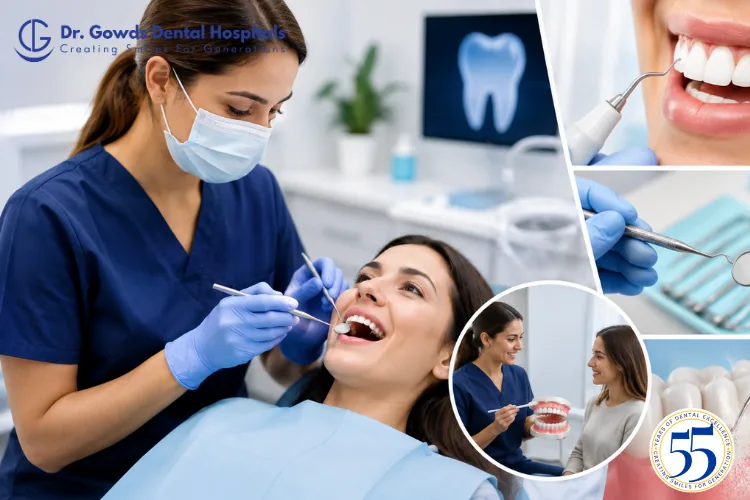
Brushing and flossing at home are essential for maintaining healthy teeth and gums, but they cannot always remove every deposit that accumulates around the teeth. Plaque can harden into tartar, particularly in areas that are difficult to clean effectively.
This is where a dental hygienist plays an important role.
A dental hygienist is a trained oral healthcare professional who focuses on preventive dental care, oral hygiene, plaque and tartar control, and maintaining healthy gums. Professional dental hygiene appointments can complement routine dental examinations and help identify oral health concerns that may require further attention.
At Dr Gowds Dental Hospitals, professional dental care can include preventive approaches designed to support long-term oral and gum health.
A dental hygienist is an oral healthcare professional who specializes in preventive dental hygiene and gum care.
Their work commonly focuses on controlling plaque and tartar, supporting gum health, providing oral hygiene guidance, and helping patients develop effective daily cleaning habits.
A dental hygienist does not replace a dentist.
Instead, hygienists and dentists can work as part of the broader dental care team.
While a dentist evaluates and treats a wide range of dental conditions, a hygienist’s work is often centered on prevention and maintaining oral cleanliness.
The exact duties can vary depending on the dental practice and the patient’s needs.
A dental hygienist may:
The focus is largely on preventing oral problems and helping patients maintain healthy habits between dental visits.
Plaque is a soft bacterial film that develops continuously on teeth.
If it is not removed effectively, it can harden into tartar or calculus.
Unlike soft plaque, hardened tartar cannot generally be removed effectively with ordinary brushing alone.
Tartar can accumulate around the gumline and contribute to gum inflammation.
Professional cleaning helps remove deposits that regular home care may not adequately eliminate.
The roles overlap in oral healthcare but are not identical.
A dentist diagnoses and treats dental conditions such as:
Dentists may also perform procedures such as fillings, root canal treatment, extractions, crowns, bridges, and other treatments depending on their training and practice.
A dental hygienist primarily focuses on:
If the hygienist identifies a concern requiring diagnosis or treatment, the patient may be referred to or evaluated by a dentist.
A professional hygiene appointment can vary depending on the patient’s oral health.
A typical appointment may include several steps.
The dental professional examines the teeth and gums to identify areas with plaque, tartar, inflammation, or other concerns.
Specialized instruments may be used to remove deposits from the teeth.
This is commonly called scaling.
After deposits are removed, the teeth may be polished to remove certain surface stains and leave the tooth surfaces smoother.
The hygienist may demonstrate techniques for:
The advice can be customized according to the patient’s oral condition.
Professional dental cleaning does not normally damage healthy tooth structure when appropriately performed.
Some patients may experience temporary:
These effects can be more noticeable when significant tartar or gum inflammation is present.
Patients sometimes mistake the sensation of smoother teeth or spaces that become visible after tartar removal for tooth damage. In reality, these changes may simply reveal the underlying tooth and gum structures that were previously covered by deposits.
Yes, professional oral hygiene can help when bad breath is associated with plaque, tartar, gum inflammation, or poor oral hygiene.
However, bad breath can have many possible causes.
Persistent halitosis may be associated with:
If bad breath continues despite good oral hygiene, a dental evaluation can help identify the cause.
These treatments have different purposes.
Focuses on:
Focuses primarily on lightening the color of teeth.
A professional cleaning may make teeth appear cleaner and brighter by removing deposits and surface stains, but it is not the same as bleaching or whitening treatment.
There is no single schedule that is appropriate for every person.
Some patients may benefit from routine preventive hygiene appointments, while others with gum disease, orthodontic appliances, extensive tartar buildup, or other risk factors may need more frequent professional care.
Your dentist or dental hygiene professional can recommend an appropriate schedule based on:
Regular home care remains important regardless of the frequency of professional cleaning.
A dental hygienist plays an important role in preventive oral healthcare.
Professional hygiene appointments can help remove plaque and tartar, manage surface deposits, support gum health, and teach patients practical ways to improve their daily oral hygiene.
However, professional cleaning should not be viewed as a replacement for brushing, interdental cleaning, or regular dental examinations.
Dentists and dental hygienists have complementary roles. While hygienists focus strongly on preventive care and oral hygiene maintenance, dentists diagnose and treat dental diseases and other oral conditions.
Maintaining healthy teeth and gums therefore requires a combination of daily home care, professional hygiene, regular dental examinations, and timely treatment when problems are identified.
Visit us at-
Dr gowds dental hospital Nanakramguda
Dr gowds dental hospital Gachibowli
Dr gowds dental hospital madhapur
A dental hygienist focuses on preventive oral care, including professional cleaning, plaque and tartar removal, gum maintenance, and oral hygiene education.
No. A dental hygienist primarily focuses on preventive oral hygiene, while a dentist diagnoses and treats dental diseases and performs various dental procedures.
Yes. Professional scaling is designed to remove hardened tartar that cannot be effectively removed through normal brushing.
Most professional cleanings are well tolerated. Some patients may experience temporary sensitivity or gum tenderness, particularly when there is significant tartar buildup or gum inflammation.
A dental hygienist can provide professional hygiene care and support periodontal maintenance, but the treatment required depends on the severity of gum disease and may require assessment and treatment by a dentist or periodontal specialist..
The appropriate frequency depends on your oral health, plaque and tartar buildup, gum condition, and individual risk factors. Your dental professional can recommend a suitable schedule.
Professional cleaning can help when bad breath is associated with plaque, tartar, or gum problems. Persistent bad breath may have other causes and should be evaluated.
If you have symptoms such as tooth pain, swelling, a broken tooth, or suspected decay, a dental examination is important. For preventive cleaning and oral hygiene maintenance, a dental hygiene appointment may be appropriate.


 Gachibowli Branch