

Schedule Appointment


A family dental clinic may hear a simple question from patients who notice something unusual about their smile: “Why do my front teeth have bumpy edges?” If you have noticed small ridges or rounded bumps along the biting edge of your front teeth, you may be looking at mamelons on teeth.
At Dr Gowds Dental Hospitals, we believe understanding the shape of your teeth makes dental conversations easier. This guide explains what mamelons are, why they appear, whether they change over time, and what to discuss with a dentist if you want a smoother-looking tooth edge.
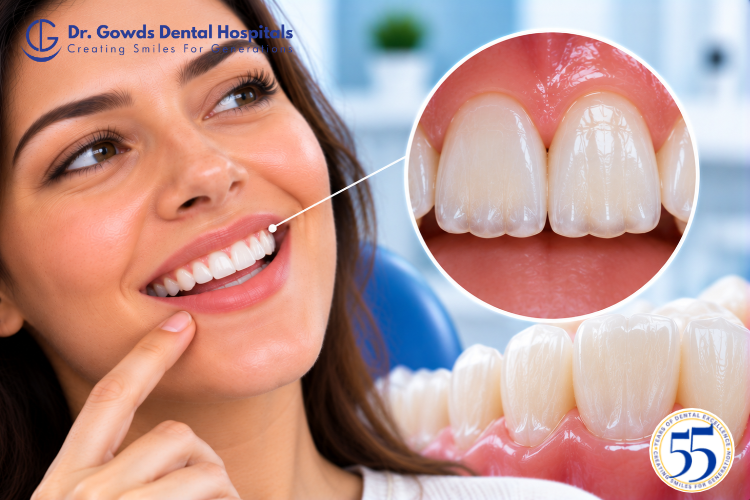
Mamelons are small, rounded projections along the biting edges of front teeth. They are most commonly noticed on permanent incisors when the teeth have recently appeared.
Instead of one straight edge, a tooth with visible mamelons can have a slightly scalloped or wavy outline. The bumps may be subtle or quite noticeable depending on the tooth’s shape and how much of the edge is visible.
“Mamelon” describes the shape of these projections. They are part of the visible contour of the tooth.
The appearance of mamelons is related to how front teeth develop. A developing tooth forms from separate areas that eventually join to create the visible crown.
The projections can therefore be visible when a front tooth first appears. As the tooth edge changes over time, the scalloped appearance may become less noticeable in some people.
This is why front teeth do not all have identical edges. Some people have clearly visible mamelons, while others have a smoother-looking edge.
If you are searching for “bumpy front teeth” or “ridges on front teeth”, mamelons on teeth may be what you are noticing.
They may appear as:
Not every uneven-looking tooth edge is a mamelon. Tooth shape can vary for different reasons, so an examination can help identify what you are seeing.
Mamelons are a natural feature of tooth shape that can be visible when front teeth emerge. Their presence does not automatically mean that anything needs to be changed.
For some people, the main concern is appearance. They may prefer a smoother, more uniform-looking smile, while others are happy with the natural shape of their teeth.
“Do mamelons go away?” is a common question after people notice bumpy edges on newly appearing front teeth.
Their appearance can become less noticeable as the biting edges change over time, but the amount of visible change varies from person to person. Some people may continue to notice them.
If you are unsure whether the bumps are mamelons, a dentist can examine the tooth and explain the visible shape.
If you are searching for “mamelon removal” or “how to get rid of bumpy front teeth”, first identify whether the bumps are actually mamelons and understand the tooth’s shape.
A dentist may discuss conservative tooth reshaping or contouring when someone wants a different appearance. The decision depends on the individual tooth and should follow an assessment rather than a photograph alone.
CTA: If you are considering tooth contouring for mamelons, speak with a dental professional at Dr Gowds Dental Hospitals to understand the options for your teeth.
It is easy to search for mamelons on front teeth after noticing an irregularity, but several appearances can make a front tooth look uneven.
Small rounded projections along the biting edge of front teeth, often noticed when permanent incisors first appear.
A chip can create an irregular edge that looks different from the repeated rounded pattern associated with mamelons.
Differences in tooth size, contour and alignment can also make front teeth look less uniform.
Changes in the visible edge of a tooth can affect its overall outline.
Because these appearances can overlap, it is better to have the tooth assessed rather than assuming every bump is a mamelon. Understanding mamelons on teeth also starts with identifying the actual shape of the tooth.
If you have noticed bumpy edges and want to understand them, you can raise the question during a dental visit.
It may also be useful to ask about them if:
A consultation lets you understand the appearance before deciding whether anything should be changed.
The dentist can assess the teeth you are concerned about, including:
The dentist can then explain whether the appearance is consistent with mamelons and discuss whether observation or cosmetic reshaping is worth considering.
Mamelons can be noticeable when you look closely at front teeth, particularly when the teeth have recently appeared.
Whether they make a smile look “uneven” is subjective. Some people like the natural character they add, while others prefer a more uniform edge.
Smile appearance also involves factors such as tooth proportions, alignment, spacing and edge contour. So the presence of mamelons is only one part of how front teeth look.
Mamelons are most often discussed in relation to permanent front teeth, especially incisors. They can be easier to notice when these teeth have recently appeared because the edge may have a distinct scalloped outline.
If you have noticed bumps on a child’s or teenager’s front teeth, you can ask a dentist about them during a regular dental visit. This allows the tooth shape to be viewed in context rather than judged from a photograph.
If your front teeth have small bumps or scalloped edges, those features may be mamelons on teeth. They are a distinctive part of tooth shape and can be more visible on newly appearing permanent front teeth.
The useful first step is to identify what you are actually seeing before considering any change. If you are curious about your front tooth shape or are considering cosmetic reshaping, a dental consultation can help you understand the available options.
Dr Gowds Dental Hospitals provides dental care across Hyderabad, with branches in Nanakramguda, Gachibowli, Madhapur, koti. If you have questions about mamelons, uneven front teeth or your smile’s appearance, book a consultation with a dental professional.
Mamelons are small, rounded projections along the biting edges of front teeth. They are especially noticeable on newly appearing permanent incisors and can give the edge a scalloped or bumpy appearance.
Bumpy edges on front teeth can be caused by mamelons or by other differences in tooth shape. A dentist can examine the edges and explain what is creating the appearance.
Mamelons can become less noticeable as the appearance of the tooth edge changes over time. The amount of change varies, so some people may continue to see them.
If the appearance bothers you, a dentist can assess the tooth and discuss whether conservative contouring or reshaping is appropriate. The decision should be based on the individual tooth.
Mamelons are most commonly discussed in relation to permanent front teeth, especially incisors. They are often easiest to notice when these teeth have recently appeared.
Not every bumpy tooth edge means the same thing. Mamelons are one possible explanation, while natural tooth shape or an altered edge can create a different appearance. An examination can clarify the cause.
You can discuss mamelons with a dentist if you are unsure what you are seeing, dislike the appearance of your front teeth, or are considering tooth reshaping.


 Gachibowli Branch