

Schedule Appointment


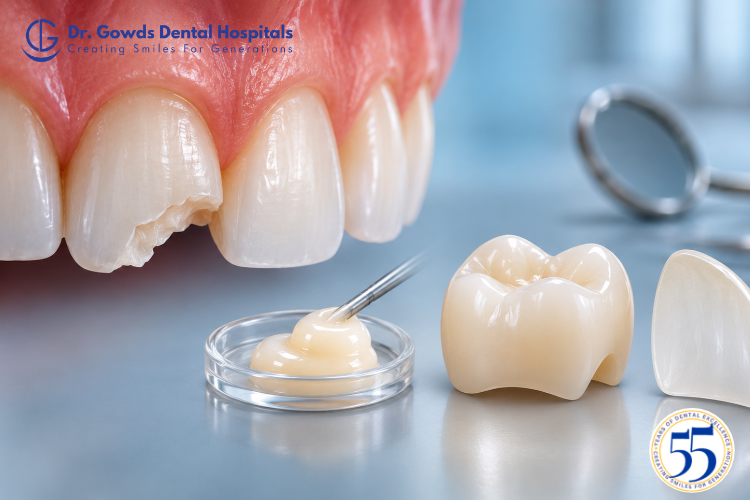
A broken or chipped tooth can leave you wondering what to do next. Should you choose dental bonding, a crown, or a veneer? The answer depends on factors such as how much of the tooth is damaged, where the damage is located, the condition of the remaining tooth structure, and the result you want.
Understanding your broken tooth treatment options can make a dental consultation easier and help you ask the right questions. Dr Gowds Dental Hospitals in Hyderabad can help you understand the differences between these restorative options and determine which approach is appropriate for your tooth.
If you are comparing bonding, crowns, and veneers for a broken tooth, this guide explains how each option differs, when it may be considered, and what factors can influence the decision.
Looking for a dental consultation for a broken or chipped tooth in Hyderabad?
Three commonly discussed options for repairing or improving the appearance of a damaged tooth are dental bonding, crowns, and veneers.
They are not interchangeable. Each one involves a different approach and is suited to different situations.
Dental bonding uses a tooth-coloured restorative material that is shaped and placed on the affected area of the tooth. The material can be used to rebuild the appearance of a chipped or partially broken area.
Bonding is generally discussed when the damaged area is relatively limited and there is enough suitable tooth structure for the restoration.
It can be particularly relevant when someone wants a conservative option for a small chip or minor change in tooth shape.
A dental crown is a restoration that covers the tooth rather than simply adding material to one small area.
When a tooth has a more substantial break, a crown may be considered depending on the remaining tooth structure and the overall condition of the tooth.
The decision is not based simply on how large the visible break looks. A dental professional also needs to assess the tooth itself before recommending a restoration.
A veneer is a thin restoration designed primarily for the visible surface of a tooth. Veneers are commonly discussed in cosmetic dentistry, particularly for front teeth where appearance is an important consideration.
For a broken tooth, a veneer may be considered when the damage and remaining tooth structure make this type of restoration appropriate.
A veneer is not automatically the right choice simply because the broken tooth is visible when you smile.
The easiest way to understand the difference is to compare what each option is designed to do.
Often considered for:
Main consideration: Bonding focuses on adding restorative material to the affected area rather than covering the entire tooth.
Often considered for:
Main consideration: A crown provides coverage around the tooth, so the assessment of the remaining tooth structure is important.
Often considered for:
Main consideration: Veneers are primarily associated with the visible surface of the tooth, so they are not suitable for every type of break.
There is no single restoration that is best for every broken tooth.
A dental professional may consider several factors before recommending bonding, a crown, or a veneer.
The size and location of the break can influence the available treatment options.
A small chip may be approached differently from a tooth that has lost a significant portion of its visible structure.
A front tooth and a back tooth have different functional and cosmetic considerations.
For front teeth, the appearance of the smile may be an important part of the discussion. For back teeth, the restoration needs to be considered in the context of the tooth’s role in everyday biting and chewing.
The amount and condition of the remaining tooth structure are important considerations.
A restoration needs an appropriate foundation. This is one reason why two people with similar-looking broken teeth may receive different treatment recommendations.
Some people are primarily concerned about restoring the shape of a chipped tooth. Others may be more focused on the overall appearance of their smile.
Your priorities can be discussed during the consultation so that the available options can be compared based on your individual situation.
Not every broken tooth is automatically suitable for bonding or veneers.
The tooth needs to be assessed before selecting a cosmetic restoration. Depending on what is found during the examination, a different restorative approach may be discussed.
Bonding and veneers can both be discussed when a person wants to improve the appearance of a damaged front tooth, but they are different types of restorations.
Bonding involves adding a tooth-coloured material directly to the tooth and shaping it to the desired form.
A veneer is a separate thin restoration designed to cover the visible surface of the tooth.
The choice can depend on the extent of damage, the condition of the tooth, the desired appearance, and the treatment approach recommended after examination.
A crown and veneer are also quite different.
A crown provides broader coverage of the tooth, while a veneer is focused on the visible surface.
If a tooth has significant structural damage, a veneer may not provide the type of coverage being considered. On the other hand, if the concern is mainly related to the visible appearance of a suitable front tooth, a veneer may be discussed.
The important point is that the visible size of the break alone does not determine the appropriate restoration.
A consultation is an opportunity to understand the condition of the tooth and compare possible restoration options.
The discussion may include:
Instead of choosing a restoration based only on photographs or general information online, it is better to have the individual tooth assessed before making a decision.
A broken front tooth may be considered for bonding, a veneer, or a crown depending on the extent and nature of the damage.
For example, a relatively small chip may be discussed in the context of bonding. A front tooth with more extensive structural damage may require a different restorative approach.
If appearance is your main concern, tell your dentist what you want the finished tooth to look like. This can help make the conversation about available options more specific to your needs.
CTA: Have a chipped or broken front tooth and unsure whether bonding, a veneer, or a crown is appropriate? Schedule a consultation with Dr Gowds Dental Hospitals in Hyderabad to discuss your options.
Before proceeding with a restoration, consider asking:
These questions can help you understand the reasoning behind the recommended treatment rather than choosing an option based only on its name or appearance.
The choice between bonding, a crown, and a veneer should be based on the individual tooth rather than a general rule.
Bonding may be discussed for smaller areas of damage where adding restorative material is appropriate.
A crown may be considered when broader coverage of a damaged tooth is appropriate.
A veneer may be considered for certain suitable front-tooth cosmetic situations where the visible surface is the primary focus.
The most suitable option depends on the tooth, the extent of damage, the remaining structure, your cosmetic goals, and the treatment plan discussed during your dental consultation.
If you are searching for broken tooth treatment in Hyderabad, Dr Gowds Dental Hospitals offers consultations across Nanakramguda, Gachibowli, Madhapur, koti.
A broken tooth does not automatically mean you need a crown, veneer, or bonding. Each restoration has a different purpose, and the right choice depends on the individual tooth and the result you are looking for.
Bonding can be considered for certain smaller chips or breaks, crowns provide broader tooth coverage, and veneers may be discussed for selected front-tooth cosmetic concerns. Comparing these differences with a dental professional can help you make a more informed decision.
Looking for broken tooth treatment in Hyderabad? Visit Dr Gowds Dental Hospitals to discuss whether bonding, a crown, a veneer, or another restoration may be appropriate for your tooth.
Not necessarily. Bonding and crowns serve different purposes. Bonding may be considered for certain smaller areas of damage, while a crown provides broader coverage. The appropriate option depends on the condition and remaining structure of the tooth.
A veneer may be considered for certain suitable front teeth where the visible surface is the main concern. It is not appropriate for every type of broken tooth, so the tooth should be assessed before selecting this option.
Bonding may be an option for certain chipped front teeth, particularly when the damaged area is limited and the remaining tooth structure is suitable for the restoration.
A crown provides broader coverage around the tooth, while a veneer is designed primarily for the visible surface. They are different restorations and are considered for different situations.
The choice depends on factors such as the extent and location of the break, remaining tooth structure, appearance, and your desired result. A dental consultation can help you compare the appropriate options.
In some situations, other restoration options may be considered instead of a crown. Whether bonding or a veneer is appropriate depends on the individual tooth and the extent of the damage.
Arrange a dental consultation so the broken tooth can be assessed and suitable restoration options can be discussed. Avoid choosing a treatment solely based on how the tooth looks from the outside.
 Gachibowli Branch