

Schedule Appointment

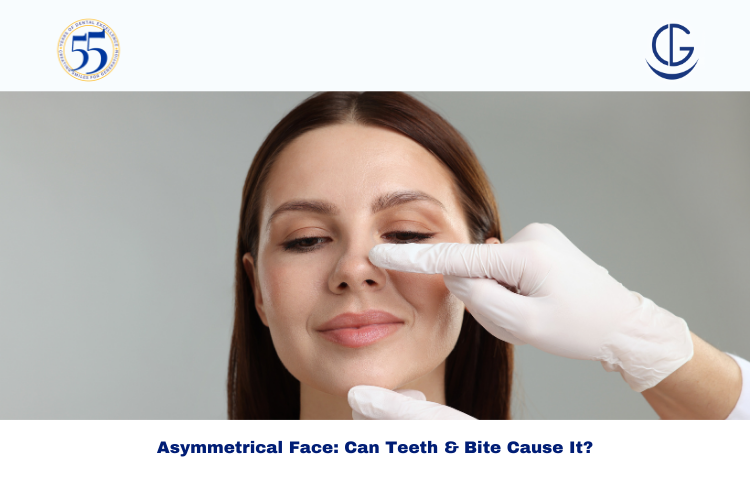
If you’ve been staring at your face wondering why one side looks different from the other, you might be surprised to learn that the answer could be sitting right inside your mouth. Dental misalignment and bite problems are among the most overlooked — and most treatable — causes of an asymmetrical face.
At Dr. Gowd’s Dental Hospital in Hyderabad, we regularly see patients whose facial asymmetry traces back directly to how their teeth fit together. Here’s everything you need to know.
Call Now for a Bite & Asymmetrical Face Consultation: 08065295050
Your teeth, jaw, and facial muscles all work as one interconnected system. When your bite is balanced, your facial muscles on both sides activate evenly — keeping your face looking proportionate. But when there’s a bite imbalance, things start to shift.
Think of it this way: if you consistently chew on the right side of your mouth because your left side is uncomfortable, the muscles on your right jaw get a constant workout while those on the left remain underused. Over months and years, this creates visible differences in muscle size, jaw position, and even bone density — all of which show up as facial asymmetry.
When your upper and lower teeth don’t align correctly — whether it’s an overbite, underbite, crossbite, or deep bite — the jaw is forced into an unnatural position. This shifts facial balance and can cause one side of the face to appear longer, flatter, or more prominent than the other.
When a back molar is lost and not replaced, the surrounding teeth gradually shift and the jawbone in that area begins to shrink. This bone loss reduces support on one side of the face, causing the cheek and jaw on that side to appear sunken — a classic sign of bite-related facial asymmetry.
Most people have a dominant chewing side — but consistently chewing only on one side creates uneven muscle development. The dominant side builds more bulk in the masseter (chewing) muscle, making that side of the jaw appear wider or more angular than the other.
The temporomandibular joint (TMJ) connects your jaw to your skull. When this joint is inflamed, damaged, or misaligned, it can shift the resting position of your jaw — leading to visible asymmetry in the lower face and chin. TMJ disorders are often accompanied by jaw clicking, pain, or difficulty opening the mouth fully.
Severely crooked teeth can push the jaw into a shifted position to compensate, creating uneven pressure across the face. Over time, this sustained misalignment manifests as facial imbalance, particularly in the lower third of the face.
Ill-fitting crowns, bridges, or dentures that alter bite height on one side of the mouth can create asymmetric muscle engagement — a problem that is surprisingly common and easily correctable with bite adjustment.
Your facial asymmetry is likely linked to teeth or bite if you notice:
• One side of your jaw appears larger or more developed
• You naturally prefer chewing on one side
• Your smile is noticeably uneven when you open your mouth
• You experience jaw clicking, popping, or pain on one side
• Your lower jaw appears shifted to the left or right
• You’ve recently lost a back tooth that was never replaced
👉 Not sure if your face is asymmetrical? Try our Asymmetrical Face Test: How to Check at Home
Orthodontic treatments are often the first line of correction for bite-related facial asymmetry. Clear aligners gradually reposition the teeth, correcting the bite and allowing the jaw muscles to engage more evenly — improving facial balance over time without surgery.
Replacing a missing molar with a dental implant restores chewing balance, prevents bone loss, and maintains the support structure of the face — stopping asymmetry from worsening.
A targeted procedure where the dentist carefully reshapes specific tooth surfaces so the bite distributes pressure evenly across both sides. This can relieve TMJ strain and reduce muscle-based asymmetry.
For patients with multiple dental causes of facial imbalance, a comprehensive rehabilitation plan — combining implants, crowns, orthodontics, and bite therapy — can restore both function and facial symmetry.
At Dr. Gowd’s Dental Hospital in Gachibowli, our specialists begin every asymmetric face consultation with a detailed 5D digital facial scan combined with a comprehensive bite analysis. This allows us to precisely identify whether your facial asymmetry originates from dental, muscular, or skeletal causes — and create a targeted, non-invasive treatment plan tailored to your face.
Our treatments range from custom clear aligners and bite equilibration to full mouth rehabilitation — all designed to restore natural facial balance without surgery wherever possible.
👉 Also helpful: How to Fix an Asymmetrical Face Without Surgery
Facial asymmetry is more common than most people realise, and in many cases, the root cause lies in something as simple as teeth alignment or bite imbalance. Issues like missing molars, uneven chewing habits, TMJ disorders, and malocclusion can gradually affect jaw muscles and facial structure over time.
The good news is that many of these problems are treatable without surgery. With modern dentistry solutions such as clear aligners, dental implants, bite adjustment, and full mouth rehabilitation, dentists can restore proper bite function and significantly improve facial balance.
If you’ve noticed one side of your face appearing more prominent, your smile looking uneven, or your jaw shifting while chewing, it’s worth getting a professional evaluation to determine the real cause.
At Dr. Gowd’s Dental Hospital, our specialists perform advanced facial and bite analysis to diagnose the exact cause of asymmetry and recommend personalised treatment options.
You can visit any of our Hyderabad branches:
Gachibowli, Madhapur, Koti, Nanakramguda
Yes. Bite misalignment, missing molars, uneven chewing habits, and TMJ disorders are all well-established dental causes of facial asymmetry. Correcting the bite often improves facial balance noticeably.
A clinical examination and 5D facial scan can distinguish between dental, muscular, and skeletal causes. Dentists at Dr. Gowd’s Dental Hospital provide this assessment as part of an asymmetric face consultation.
Yes — when the asymmetry stems from bite misalignment or uneven tooth positioning. Clear aligners gradually correct teeth and bite, allowing jaw muscles to rebalance and improving facial symmetry over time.
Replacing a missing molar with a dental implant restores chewing balance, prevents jawbone loss, and maintains facial support on that side — all of which help reduce or prevent worsening asymmetry.
Yes. Our specialists assess TMJ function as part of every asymmetric face evaluation and provide targeted bite therapy, splints, or orthodontic correction depending on the underlying cause.

 Gachibowli Branch