

Schedule Appointment


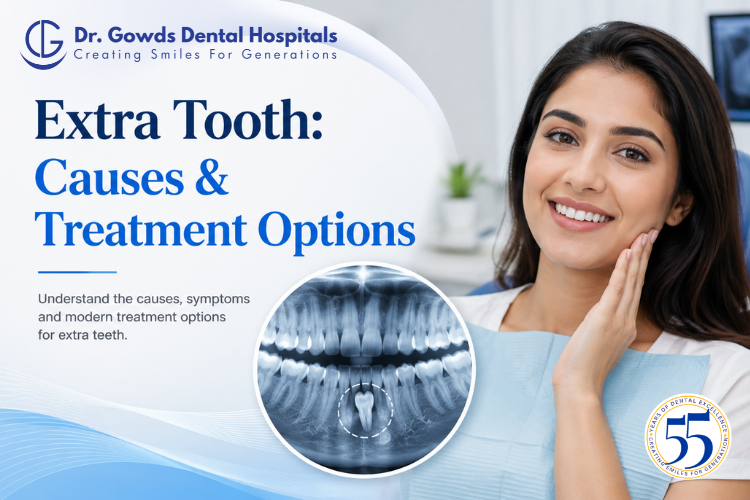
An extra tooth may seem unusual, but it is a dental condition that affects both children and adults. While some people never notice an additional tooth, others experience pain, crowding, delayed eruption of permanent teeth, or difficulty maintaining proper oral hygiene.
At Dr. Gowds Dental Hospital, we frequently diagnose and treat patients with supernumerary teeth using advanced digital imaging and personalized treatment plans. Early diagnosis is important because an extra tooth can interfere with the normal development and alignment of your teeth.
In this guide, we’ll explain what an extra tooth is, why it develops, its symptoms, complications, diagnosis, treatment options, and when removal may be necessary.
An extra tooth is a tooth that develops in addition to the normal number of teeth. Dentists refer to this condition as supernumerary teeth.
Normally, adults have:
When one or more additional teeth develop, they are called supernumerary teeth.
These teeth may erupt normally or remain impacted beneath the gums.
An extra tooth can develop almost anywhere in the mouth.
The most common locations include:
The most frequently seen type is called a mesiodens, which appears between the upper front teeth.
Dentists classify supernumerary teeth based on their location and shape.
Located between the upper front teeth.
This is the most common extra tooth.
Develops beside the molars.
Appears behind the last molar.
Often called the “fourth molar.”
Forms near the premolar region.
Extra teeth may appear as:
Some resemble natural teeth, while others have an unusual appearance.
The exact cause is not completely understood.
However, several factors may contribute.
Family history increases the likelihood of developing supernumerary teeth.
Abnormal activity of the dental lamina during tooth development can result in additional teeth.
Extra teeth are sometimes associated with conditions such as:
Many people with an extra tooth, however, have no underlying medical condition.
Some patients have no symptoms.
Others may notice:
Many impacted extra teeth are discovered only during routine dental X-rays.
Leaving an extra tooth untreated may lead to several complications.
Additional teeth occupy space needed for permanent teeth.
This often results in:
An impacted extra tooth may block normal permanent teeth from erupting.
This is particularly common in children.
The extra tooth itself may remain trapped inside the jawbone.
Impacted teeth can sometimes form cysts.
Crowded teeth are harder to clean.
Food accumulation increases the risk of:
An impacted extra tooth may press against neighbouring teeth, causing root resorption or weakening.
Extra teeth often interfere with orthodontic treatment.
Removing them may be necessary before braces.
Not always.
Treatment depends on:
If the extra tooth causes no problems, your dentist may recommend periodic observation.
However, removal is advised if it causes complications.
Treatment varies according to each patient’s needs.
Small, symptom-free extra teeth may simply be monitored during regular dental check-ups.
If crowding develops, braces or aligners may be recommended after removing the extra tooth.
Impacted supernumerary teeth often require minor oral surgery.
This is one of the most common treatment approaches.
Some patients require:
No.
Since the condition develops during tooth formation, there is no known method to prevent it.
However, regular dental check-ups help identify the problem early before complications arise.
Children should receive routine dental examinations to monitor proper tooth eruption.
An extra tooth may seem harmless initially, but it can lead to crowding, delayed tooth eruption, bite problems, and other dental complications if left untreated. Early diagnosis through routine dental examinations allows timely treatment and helps prevent more complex issues in the future.
At Dr. Gowds Dental Hospital, our experienced dental team offers comprehensive evaluation and advanced treatment for supernumerary teeth, ensuring healthy tooth development and a confident smile. If you or your child has an extra tooth or delayed tooth eruption, schedule a consultation with our specialists for an accurate diagnosis and personalized treatment plan.
Visit us at-
Dr gowds dental hospital Nanakramguda
Dr gowds dental hospital Gachibowli
Dr gowds dental hospital madhapur
An extra tooth is medically known as a supernumerary tooth.
No. Supernumerary teeth are relatively uncommon and occur in a small percentage of the population.
Yes. It may cause pain if it becomes impacted, infected, or presses against neighbouring teeth.
No. Some extra teeth only require observation, while others need surgical removal if they cause complications.
Yes. An extra tooth may interfere with orthodontic treatment and often needs to be removed before braces.
The procedure is performed under local anaesthesia, making it comfortable for most patients. Mild discomfort after surgery usually resolves within a few days.
Yes. Extra teeth commonly appear during childhood and may prevent permanent teeth from erupting properly.
 Gachibowli Branch