

Schedule Appointment


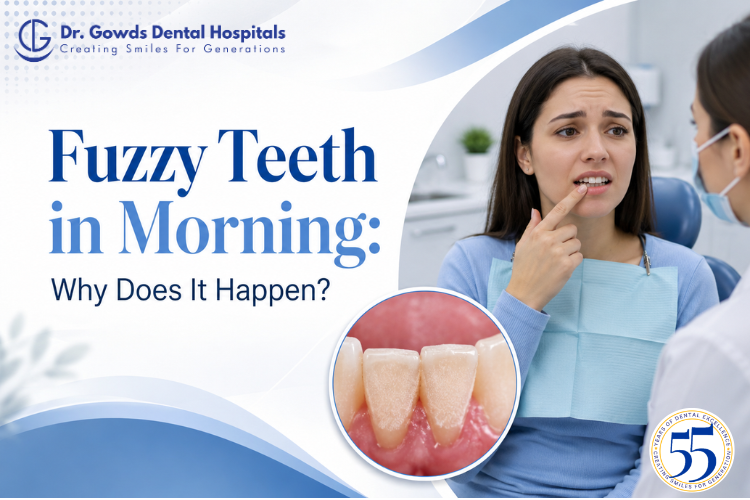
Have you ever woken up and noticed that your teeth feel fuzzy, rough, sticky, or coated even though they felt clean before going to bed?
This fuzzy teeth in morning sensation is usually related to plaque buildup and changes in saliva flow while you sleep. During the night, saliva production naturally decreases. With less saliva to wash away food particles and bacteria, a thin layer of plaque can accumulate on the teeth and make their surfaces feel less smooth.
For most people, the feeling improves after brushing and cleaning between the teeth. However, persistent fuzziness may sometimes indicate inadequate plaque removal, dry mouth, gum problems, or other oral health concerns.
At Dr. Gowds Dental Hospitals, routine dental examinations can help identify whether morning tooth fuzziness is simply related to overnight plaque or is associated with an underlying dental problem.
Several factors can contribute to that unpleasant coating on your teeth after waking.
The most common reason your teeth feel fuzzy in the morning is plaque buildup.
Plaque is a soft, sticky film containing bacteria, saliva components, and food debris. It constantly forms on teeth throughout the day.
While you sleep, you are not brushing, rinsing, or eating, so plaque can remain undisturbed on the tooth surfaces for several hours.
When you run your tongue over your teeth after waking, this buildup can feel:
Brushing removes much of this buildup and restores the smooth feeling of clean teeth.
Saliva plays an important role in oral health.
It helps:
Saliva production decreases during sleep.
As a result, bacteria and plaque can remain on the tooth surfaces for longer.
This is one reason why maintaining good oral hygiene before bedtime is particularly important.
If plaque is already present when you go to sleep, it can remain on your teeth for several hours.
Skipping nighttime brushing or rushing through brushing may leave behind:
These deposits can contribute to a stronger fuzzy sensation the following morning.
Brushing twice a day, including before bed, helps reduce overnight plaque accumulation.
A toothbrush cannot effectively clean every surface between adjacent teeth.
If you do not floss or use another suitable interdental cleaning method, plaque may remain between the teeth overnight.
This can contribute to:
Cleaning between the teeth is therefore an important part of nighttime oral hygiene.
A dry mouth can make the fuzzy feeling more noticeable.
Reduced saliva means there is less natural cleansing of the teeth and oral tissues.
Dry mouth may be associated with:
If you regularly wake up with a very dry mouth along with fuzzy teeth, discuss it with your dentist.
Sleeping with your mouth open can dry the oral tissues.
When the mouth becomes dry, plaque and bacteria may accumulate more readily.
You may wake up with:
If mouth breathing happens regularly, it may be worth discussing with a healthcare professional or dentist to determine the underlying cause.
Plaque does not always look obvious.
A thin layer can be difficult to see but easily detected with your tongue.
This explains why your teeth may feel fuzzy even when they appear relatively clean in the mirror.
The sensation often becomes more noticeable along:
These areas are particularly prone to plaque accumulation.
If plaque is not removed regularly, it can harden into dental calculus, also called tartar.
Unlike soft plaque, tartar cannot be removed effectively with ordinary brushing.
It may make the teeth feel:
If your teeth continue to feel rough even immediately after brushing, professional dental cleaning may be necessary.
An occasional fuzzy feeling after waking is common and is usually related to overnight plaque accumulation or reduced saliva flow.
However, persistent fuzziness should not simply be ignored.
If your teeth regularly feel coated despite good brushing and interdental cleaning, a dental examination can determine whether plaque, tartar, dry mouth, gum inflammation, or another issue is contributing to the sensation.
Brushing in the morning is an important part of daily oral hygiene.
It removes overnight plaque and leaves the teeth feeling smoother and cleaner.
If you prefer to eat breakfast first, ask your dentist about the best timing for brushing based on your dietary and oral health habits.
A fuzzy sensation is usually not an emergency.
However, schedule a dental examination if it is accompanied by:
These symptoms may indicate a problem requiring professional assessment.
Sometimes.
If the fuzzy feeling is frequent and accompanied by visible plaque, bad breath, or bleeding gums, it may indicate that plaque is not being removed effectively.
However, fuzzy teeth can also occur despite good oral hygiene because saliva flow naturally decreases during sleep.
The overall pattern and accompanying symptoms matter more than the sensation alone.
A consistent routine can help reduce morning plaque buildup.
Regular professional dental check-ups can also help detect plaque-related problems early.
If your teeth feel fuzzy in the morning, the most common explanation is overnight plaque accumulation combined with reduced saliva flow during sleep. In many cases, brushing, cleaning between the teeth, staying hydrated, and maintaining a consistent bedtime oral hygiene routine can reduce the sensation.
However, if your teeth continue to feel rough or coated despite good oral care—or if you also experience bleeding gums, bad breath, sensitivity, or visible tartar—it is worth having your teeth and gums professionally examined.
Good nighttime oral hygiene is one of the simplest ways to wake up with a cleaner, healthier mouth.
Visit us at-
Dr gowds dental hospital Nanakramguda
Dr gowds dental hospital Gachibowli
Dr gowds dental hospital madhapur
Your teeth may feel fuzzy because plaque and bacteria accumulate overnight while saliva production decreases during sleep. The sensation usually improves after brushing and interdental cleaning.
Some plaque formation is normal because plaque continuously develops on teeth. However, regular and effective brushing and interdental cleaning help keep its buildup under control.
Persistent fuzziness after brushing may be caused by plaque that has not been completely removed, tartar, dry mouth, or areas that are difficult to clean. A dentist can identify the cause.
Yes. Reduced saliva means less natural cleansing of the teeth, which can make plaque accumulation and the fuzzy feeling more noticeable.
Brush twice daily with fluoride toothpaste, clean between your teeth every day, maintain good hydration, clean your tongue, and have regular dental check-ups and professional cleanings when recommended.


 Gachibowli Branch