

Schedule Appointment


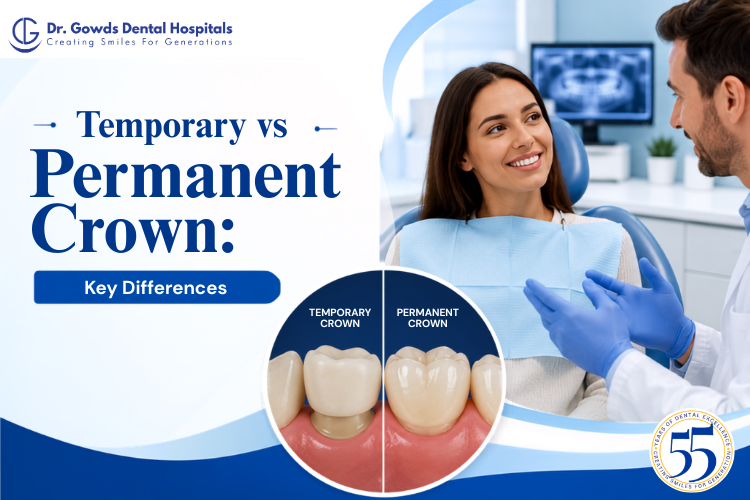
If your dentist has told you that you need a dental crown, you may first receive a temporary dental crown before the final restoration is placed. This can raise a common question: What is the difference between a temporary crown vs permanent crown?
Both crowns cover and protect the prepared tooth, but they serve different purposes.
A temporary crown is designed to protect the tooth for a limited period while the permanent crown is being fabricated. A permanent crown is the final restoration designed for long-term function, comfort, and appearance.
Understanding the difference can help you know what to expect during crown treatment and how to care for your tooth between appointments.
A temporary dental crown is a short-term restoration placed over a prepared tooth while the permanent crown is being made.
After a tooth is prepared for a crown, the natural tooth may have reduced protection from the surrounding environment. The temporary crown acts as a protective covering during this period.
It helps:
Temporary crowns are not intended to serve as the final restoration.
A permanent crown is the final dental restoration that is permanently cemented or bonded to the prepared tooth.
It is custom-made based on factors such as:
Permanent crowns are designed to withstand normal chewing forces and provide long-term restoration of the tooth.
| Feature | Temporary Dental Crown | Permanent Crown |
| Purpose | Short-term protection | Final tooth restoration |
| Duration | Used temporarily | Designed for long-term use |
| Material | Usually provisional resin or acrylic-based material | May be ceramic, porcelain-fused-to-metal, zirconia, or metal |
| Strength | Lower | Higher |
| Fit | Provisional fit | Precisely customized |
| Appearance | Usually acceptable but less refined | Designed for natural-looking aesthetics |
| Attachment | Usually temporary cement | Permanent cement or bonding |
| Fabrication | Often made quickly | Custom fabricated using detailed impressions or digital scans |
A temporary crown is important because permanent crown fabrication may require time.
It provides protection while the final restoration is being prepared.
The tooth may be sensitive after preparation.
A temporary crown helps shield it from:
A prepared tooth can sometimes become sensitive.
The temporary crown provides a protective barrier over the exposed tooth structure.
Teeth can shift slightly if a prepared tooth remains uncovered.
A temporary crown helps maintain the tooth’s position until the permanent crown is placed.
This is important because even small changes can affect the fit of the final crown.
A properly shaped temporary crown also helps the surrounding gum tissue adapt to the planned contour of the final restoration.
A temporary crown is designed for short-term use.
Although it can protect the tooth effectively, it generally does not have the same strength, precision, or long-term durability as a permanent crown.
Temporary materials may:
Therefore, a temporary crown should be replaced with the planned permanent restoration.
Temporary crowns are commonly made from provisional materials such as:
The choice depends on the tooth, expected duration, and treatment requirements.
Permanent crowns can be made from several materials.
Zirconia crowns are known for their strength and can provide a natural appearance.
These crowns can offer highly aesthetic results, particularly for visible teeth.
These combine a metal substructure with a tooth-colored outer layer.
Metal restorations are highly durable and may be suitable for selected teeth, particularly where strength is a major consideration.
Your dentist will recommend the most suitable material based on the location and condition of the tooth.
A temporary crown is generally worn until the permanent crown is ready.
The exact duration varies depending on:
Your dentist will tell you when to return for the final crown placement.
The lifespan of a permanent crown varies depending on:
A well-maintained crown can provide long-term service, but it is not considered a lifetime restoration.
You can generally eat with a temporary crown, but some precautions are important.
Avoid:
These precautions reduce the risk of loosening or breaking the temporary restoration.
Permanent crowns are generally designed with greater attention to:
Temporary crowns are primarily designed to protect the tooth and maintain function until the final restoration is ready.
Understanding the difference between a Temporary vs Permanent Crown can make the crown treatment process easier to understand. A temporary dental crown is primarily used to protect the prepared tooth, reduce sensitivity, maintain tooth position, and support function while the final restoration is being fabricated. A permanent crown is the definitive restoration, designed for long-term durability, fit, function, and appearance.
If you have been advised to receive a dental crown or are experiencing problems with an existing temporary or permanent crown, consult the dental team at Dr. Gowds Dental Hospitals for an evaluation and personalized treatment plan.
Visit us at-
Dr gowds dental hospital Nanakramguda
Dr gowds dental hospital Gachibowli
Dr gowds dental hospital madhapur
A temporary crown is a short-term protective restoration used while the final crown is being prepared. A permanent crown is the final customized restoration designed for long-term use.
Yes, but it is advisable to avoid sticky and very hard foods and to minimize heavy chewing on the temporary crown.
Yes. Continue brushing gently around the temporary crown and maintain good oral hygiene.
Contact your dentist as soon as possible. Keep the crown and avoid using household glue to reattach it.
Yes. Permanent crowns are fabricated from materials specifically selected for long-term function and are generally considerably stronger and more durable than provisional crowns.
Yes. The crown itself does not decay, but the natural tooth surrounding or underneath the crown can develop decay if oral hygiene is inadequate.
 Gachibowli Branch