

Schedule Appointment

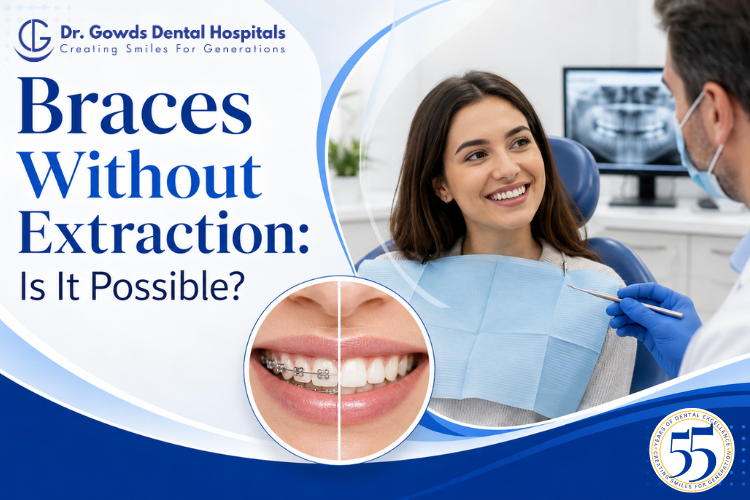
Braces Without Extraction are possible for many patients. Advances in orthodontics now allow many cases of crowded, spaced, or misaligned teeth to be treated without removing permanent teeth. Whether extractions are necessary depends on factors such as the amount of crowding, jaw size, bite alignment, facial profile, and overall oral health. Modern orthodontic techniques, including braces and clear aligners, often create space through controlled tooth movement rather than tooth removal. However, some patients with severe crowding or complex bite problems may still benefit from extractions to achieve stable and healthy results.
At Dr. Gowds Dental Hospitals, every orthodontic treatment plan is personalized after a comprehensive clinical examination and digital imaging to determine whether non-extraction treatment is appropriate.
Braces Without Extraction refers to orthodontic treatment that straightens teeth without removing any permanent teeth.
Instead of creating space by extracting teeth, orthodontists use carefully planned tooth movements and other techniques to align the teeth while preserving the natural dentition whenever appropriate.
The goal is to achieve:
In the past, tooth extractions were more frequently recommended because severe crowding often left insufficient space to align all the teeth properly.
Today, improved diagnostic tools and modern orthodontic techniques allow many patients to be treated conservatively.
However, extractions are still recommended when they provide the healthiest and most stable long-term outcome.
No.
Although many patients qualify for Braces Without Extraction, not everyone is a suitable candidate.
The decision depends on several clinical factors rather than patient preference alone.
Your orthodontist evaluates multiple aspects before preparing a treatment plan.
Mild to moderate crowding can often be corrected without removing teeth.
Severe crowding may require additional space that cannot be safely created through tooth movement alone.
The relationship between the upper and lower teeth plays an important role.
Certain bite problems may be corrected without extractions, while others may require them for optimal function.
Small jaws with limited space may increase the likelihood of needing extractions.
Patients with adequate arch space often qualify for non-extraction treatment.
Orthodontists consider how tooth movement will affect facial appearance.
Treatment is planned to support balanced facial aesthetics as well as dental alignment.
Large teeth within a relatively small jaw may create significant crowding.
This influences whether sufficient space can be created without extractions.
Healthy supporting tissues are essential before significant orthodontic tooth movement begins.
Modern orthodontics offers several methods for creating space while preserving natural teeth.
Carefully widening the dental arch may provide additional space for alignment in selected patients.
Small amounts of enamel may be reshaped between selected teeth to create minor additional space.
This is performed conservatively and only when clinically appropriate.
Braces and clear aligners can reposition teeth into more efficient alignment, utilizing available space within the dental arch.
Changing the angle of crowded teeth can sometimes improve alignment without requiring extractions.
Yes.
Many patients treated with clear aligners also undergo Braces Without Extraction principles.
Like braces, aligners can:
However, severe cases may still require extractions regardless of the orthodontic appliance used.
When clinically appropriate, non-extraction treatment may offer several advantages.
These include:
The primary goal remains achieving a healthy, functional bite rather than simply avoiding extractions.
Although preserving natural teeth is generally preferred, extractions may be necessary in situations such as:
Your orthodontist recommends extractions only when they are expected to improve long-term treatment outcomes.
Braces Without Extraction are a realistic option for many patients, thanks to advances in modern orthodontics and digital treatment planning. While preserving natural teeth is often desirable, the decision to avoid or recommend extractions should always be based on careful clinical evaluation rather than preference alone. The most successful orthodontic treatment is one that creates a healthy bite, stable alignment, and a balanced smile.
If you are considering braces or clear aligners, consult the experienced orthodontic team at Dr. Gowds Dental Hospitals. A comprehensive assessment will determine whether non-extraction orthodontic treatment is the most suitable option for your individual needs.
Visit us at-
Dr gowds dental hospital Nanakramguda
Dr gowds dental hospital Gachibowli
Dr gowds dental hospital madhapur
Yes. Many patients with mild to moderate crowding or certain bite conditions can undergo orthodontic treatment without removing permanent teeth.
No. Tooth extraction is recommended only when necessary to achieve proper alignment, bite function, and long-term stability.
Yes. Clear aligners can often treat suitable cases without extractions, although complex cases may still require tooth removal.
The decision is based on factors such as crowding, jaw size, bite alignment, facial profile, tooth size, and overall oral health.
Not necessarily. While preserving healthy teeth is preferred whenever possible, extractions may sometimes provide the safest, healthiest, and most stable orthodontic result.
 Gachibowli Branch