

Schedule Appointment

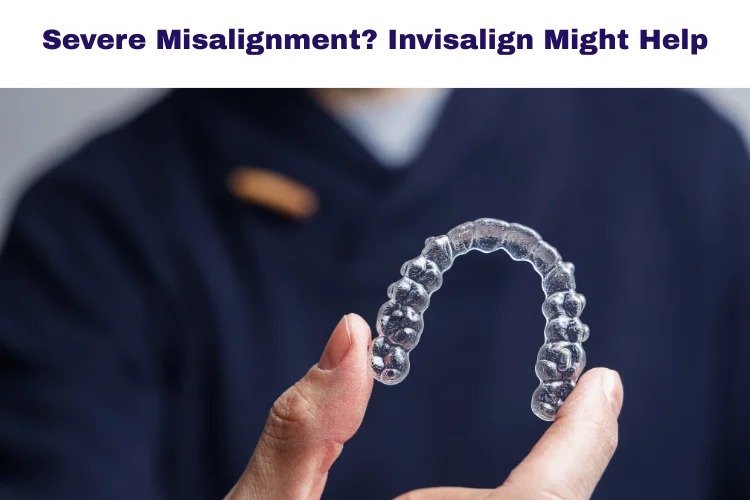
Invisalign has become a popular choice for teeth straightening due to its discreet and comfortable design. But many people wonder: Can Invisalign treat severe alignment issues?
The answer lies in understanding how invisalign for severe cases works, what it can realistically achieve, and when alternative treatments may be more effective.
Today, invisalign for severe cases can address a wider range of dental issues than before, including:
With advancements in aligner technology,it can now treat more complex cases than ever before. Attachments (small, tooth-colored bumps bonded to the teeth) and elastics (rubber bands) can be used to apply additional force and guide complex movements.
The short answer is: yes, in many situations — but not all.
Invisalign for severe cases depends heavily on the type and complexity of the problem, as well as the expertise of the orthodontist.
With proper planning, invisalign for severe cases can deliver results comparable to braces in many of these situations.
There are still limitations. Invisalign may not be the best option for:
In such scenarios, traditional braces or a combined approach may be recommended instead of relying solely on invisalign for severe cases.
Selecting the appropriate provider is crucial, particularly in cases of severe illness. An experienced orthodontist can:
For severe alignment, the effectiveness is frequently depends more on the provider’s skill than the product.
| Factor | Invisalign (Severe Cases) | Traditional Braces (Severe Cases) |
| Aesthetics during treatment | Nearly invisible — significant advantage | Visible metal or ceramic brackets |
| Compliance requirement | Critical — 22hrs/day mandatory | Fixed — works continuously without patient effort |
| Complex rotation control | Good with attachments; limitations for >30° | Excellent — 3D bracket control |
| Skeletal correction | Not possible alone | Not possible alone — surgery needed for both |
| Open bite treatment | Often excellent — better than expected | Can be effective but sometimes less predictable |
| Patient comfort | Smooth plastic, no wire emergencies | Wire irritation possible; more emergency visits |
| Treatment monitoring | Every 6–8 weeks | Every 4–6 weeks typically |
| Switching mid-treatment | Possible — Invisalign can incorporate braces phase | Can transition to aligners for finishing |
Invisalign vs Braces: Which Is Better for You?
Wearing the aligners for 20 to 22 hours a day is required. Strict adherence is even more crucial for patients with severe misalignment in order to get the intended outcomes. Failing to wear them consistently can lead to treatment delays or suboptimal outcomes.
Braces may be more effective in cases involving:
Yes, in many cases, but severe crowding may require attachments or additional tools.
It depends. Braces may be more effective for very complex or structural issues.
Treatment may take 18–24 months or longer, depending on complexity and compliance.
Only in rare cases where jaw alignment needs correction beyond its capabilities.
Often, yes. Attachments help aligners grip and move teeth more effectively.
Your provider may suggest switching to or combining with braces for better results.
Invisalign has come a long way in treating complex alignment problems. While it may not replace braces in every severe case, it’s certainly an option worth considering with the guidance of a skilled provider. A personalized consultation will help determine the best course of action for your unique dental needs.
Book a consultation to find out if this can correct your severe alignment issues.
Visit Dr. Gowds Dental Hospitals for a consultation today!
Our Branches
 Gachibowli Branch