

Schedule Appointment

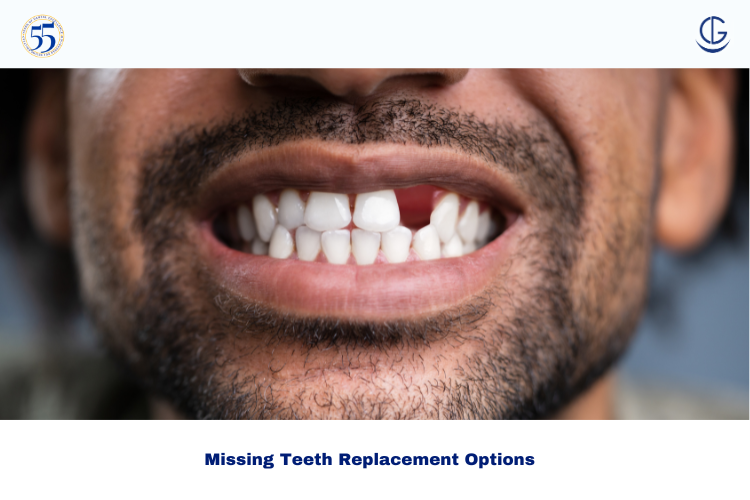
If you are researching missing teeth replacement options, you are probably wondering which solution is actually best for your long-term oral health. Should you choose a dental implant, bridge, or denture? At Dr. Gowds Dental Hospitals, one of the most common questions patients ask is which tooth replacement option looks the most natural, lasts the longest, and protects the jawbone best over time. The truth is that every treatment option has different advantages, costs, maintenance requirements, and long-term outcomes. Understanding these differences is essential before making a decision about replacing a missing tooth.
Many patients assume a single missing tooth is harmless, especially if it is not visible when smiling.
Unfortunately, the effects of tooth loss continue long after the tooth is gone.
Within the first year after tooth loss:
Over time, untreated tooth loss can lead to:
Replacing missing teeth early helps preserve both function and bone structure.
Modern dentistry offers four primary solutions:
Each option works differently and suits different situations.
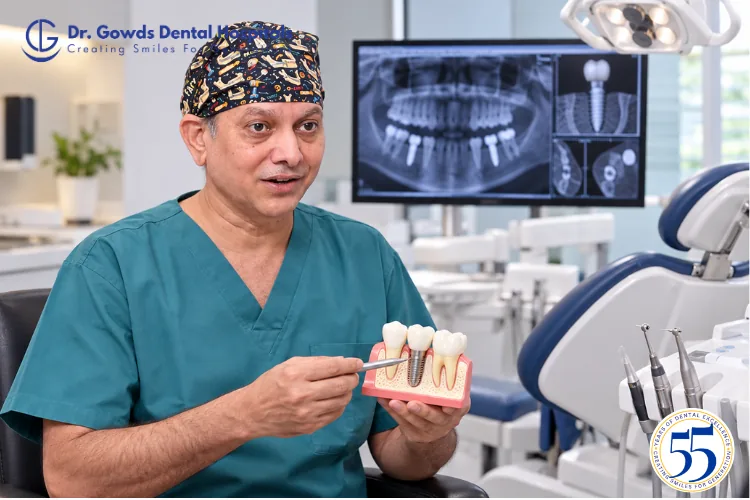
A dental implant is widely considered the most advanced and long-lasting tooth replacement option available today.
The implant consists of:
Over several months, the implant fuses with the jawbone through a process called osseointegration.
Once healed, it functions very similarly to a natural tooth root.
Dental implants are usually ideal for:
Most healthy adults qualify for implants, although some patients may require bone grafting first.
Longest Lifespan
Dental implants generally last:
This makes them the most durable missing tooth replacement option.
Prevents Bone Loss
Unlike bridges and dentures, implants stimulate the jawbone and help preserve bone density.
This is one of the biggest long-term advantages of implants.
Does Not Damage Neighbouring Teeth
An implant replaces the missing tooth independently.
Healthy adjacent teeth remain untouched.
Most Natural Look and Feel
Dental implants closely mimic natural teeth in:
Many patients eventually forget they even have an implant.
Easy to Maintain
Implants are cleaned similarly to natural teeth:
No removal or adhesives are required.
Higher Initial Cost
Implants usually cost more upfront than bridges or dentures.
However, their long lifespan often makes them more cost-effective long term.
Requires Minor Surgery
Implant placement involves a surgical procedure under local anaesthesia.
Healing typically takes:
Bone Grafting May Be Needed
Patients with significant bone loss may require additional procedures before implant placement.
Best Option for Missing Back Molar
For most patients, a dental implant is the best option for replacing a missing back molar.
Back teeth absorb the greatest chewing pressure, and implants handle this force more effectively than removable dentures or bridges.
A dental bridge replaces a missing tooth by attaching a false tooth to crowns placed on the neighbouring teeth.
The surrounding teeth act as anchors for the bridge.
Bridges have been used successfully for decades and remain a common solution.
Bridges may be suitable for:
Faster Treatment
Most bridges are completed within:
This makes bridges much faster than implants.
Lower Initial Cost Than Implants
Bridges generally cost less upfront than implants.
No Surgery Required
Many patients prefer bridges because they avoid surgical procedures.
Healthy Teeth Must Be Ground Down
The biggest disadvantage is that healthy neighbouring teeth must be permanently reduced to support the bridge.
This cannot be reversed.
Does Not Prevent Bone Loss
Because no tooth root replaces the missing tooth, the jawbone underneath continues shrinking over time.
Shorter Lifespan
Dental bridges typically last:
They usually require replacement sooner than implants.
More Difficult to Clean
Special floss threaders or water flossers are needed to clean underneath the bridge.
Poor cleaning may increase the risk of decay or gum disease around the supporting teeth.
| Factor | Dental Implant | Dental Bridge |
| Lifespan | 20–25+ years | 10–15 years |
| Bone Preservation | Yes | No |
| Surgery Required | Yes | No |
| Affects Neighbouring Teeth | No | Yes |
| Cleaning | Similar to natural teeth | More difficult |
| Long-Term Stability | Excellent | Moderate |
| Upfront Cost | Higher | Lower |
In most healthy patients, implants are usually the better long-term option because they preserve bone and avoid damaging adjacent teeth.
However, bridges may still be appropriate in select situations.
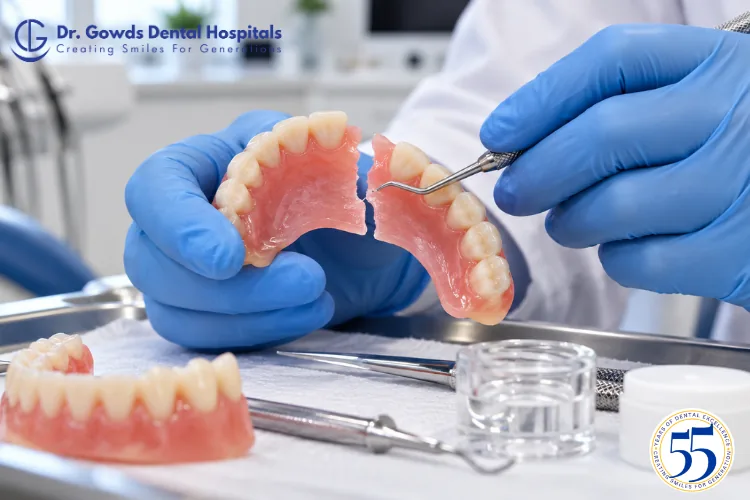
A partial denture is a removable appliance that replaces one or several missing teeth.
Artificial teeth are attached to a plate that clips onto remaining natural teeth.
Partial dentures may suit:
Lowest Initial Cost
Partial dentures are usually the most affordable tooth replacement option.
No Surgery Required
The treatment is entirely non-surgical.
Can Replace Multiple Teeth at Once
Partial dentures are useful when several teeth are missing in different areas.
Less Natural Feel
Compared to implants or bridges, dentures often feel:
Does Not Prevent Bone Loss
Bone underneath the denture continues shrinking over time.
Requires Ongoing Adjustments
As bone shape changes, dentures often require:
Shorter Lifespan
Most partial dentures last:
Full dentures replace all teeth in the upper arch, lower arch, or both.
Modern dentures look more natural than older versions, but they still rest directly on the gums.
Many denture patients experience:
This is especially common with lower dentures.
Implant-supported dentures combine implants with a full denture system.
The denture attaches securely onto 4–6 implants using systems such as:
This provides:
For patients missing all teeth, implant-supported dentures are often the closest alternative to natural teeth.
| Feature | Implant | Bridge | Partial Denture | Full Denture |
| Average Lifespan | 20–25+ yrs | 10–15 yrs | 5–10 yrs | 5–10 yrs |
| Bone Preservation | Yes | No | No | No |
| Surgery Required | Yes | No | No | No |
| Affects Other Teeth | No | Yes | Mildly | No |
| Natural Feel | Excellent | Very Good | Moderate | Moderate |
| Cleaning | Easy | Moderate | Removable | Removable |
| Stability | Excellent | Good | Variable | Variable |
| Best For | Long-term replacement | Fast fixed solution | Budget replacement | Full tooth loss |
The right choice depends on:
However, as a general rule:
Single Missing Tooth
A dental implant is usually the best long-term solution.
Missing Tooth With Damaged Neighbouring Teeth
A bridge may be practical if adjacent teeth already need crowns.
Multiple Missing Teeth on a Budget
A partial denture may work as an interim option.
Full Mouth Tooth Loss
Implant-supported dentures typically provide the best function and stability.
Without replacement:
Over time, this can affect:
Replacing missing teeth early usually provides the best long-term outcome.
If you are exploring missing teeth replacement options and want to understand which treatment is best for your long-term oral health, the specialist team at Dr. Gowds Dental Hospital can help assess your bone health, bite, and treatment goals to recommend the most suitable option for your situation.
Visit us at-
Dr gowds dental hospital Nanakramguda
Dr gowds dental hospital Gachibowli
Dr gowds dental hospital madhapur
A dental implant is usually the best long-term option because it handles chewing pressure effectively and preserves jawbone support.
Partial dentures are generally the lowest-cost option for replacing multiple missing teeth.
In many healthy patients, yes. Implants last longer, preserve bone, and do not damage neighbouring teeth.
Dental implants typically last 20–25+ years, while bridges usually last around 10–15 years.
Yes. Full-mouth implant systems such as All-on-4 and All-on-6 can replace an entire arch of missing teeth.
The jawbone shrinks, nearby teeth shift, and bite problems gradually develop over time.
 Gachibowli Branch