

Schedule Appointment


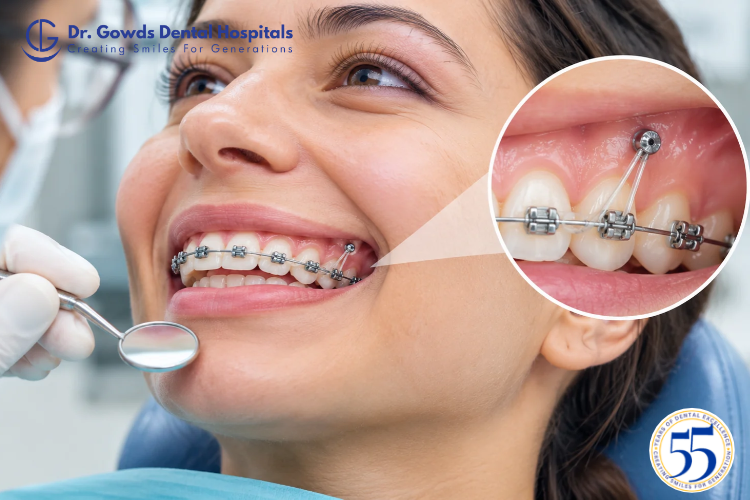
Orthodontic mini-implants are small temporary anchorage devices that can give an orthodontist a stable point of support during specific tooth movements. For patients whose treatment requires greater control over how individual teeth move, mini-implants may be considered as part of a carefully planned orthodontic approach.
Unlike conventional dental implants, orthodontic mini-implants are designed for temporary use during orthodontic treatment. Understanding how they work, why they may be used, and what the process involves can help you have a more informed discussion with your orthodontist.
At Dr Gowds Dental Hospitals, patients in Hyderabad can discuss orthodontic treatment options with the dental team at the Gachibowli, Puppalguda, Madhapur, and Koti branches.
Looking into orthodontic mini-implants?
Orthodontic mini-implants, also called temporary anchorage devices or TADs, are small devices placed in the jawbone to provide temporary anchorage during orthodontic treatment.
In conventional orthodontics, moving one tooth can sometimes create an unwanted movement in another tooth. Anchorage refers to the support used to control these forces.
A mini-implant provides an additional fixed point from which orthodontic forces can be applied. This allows the orthodontist to plan specific movements without relying entirely on other teeth for support.
The device is different from a conventional dental implant used to replace a missing tooth. Its purpose, placement, duration of use, and role in treatment are different.
The basic idea behind an orthodontic mini-implant is straightforward: it provides a temporary, stable anchorage point.
Once the orthodontic mini-implant is placed, an orthodontist can connect it to the orthodontic appliance using appropriate components. The resulting setup can help direct forces toward the teeth that need to move.
Orthodontic treatment involves applying carefully planned forces to change the position of teeth. For some movements, the orthodontist needs to control not only which tooth moves but also which teeth remain relatively stable.
Anchorage can be particularly relevant when treatment involves:
The exact use of a mini-implant depends on the patient’s tooth position, bite, bone conditions, treatment objectives, and overall orthodontic plan.
Traditional orthodontic anchorage may involve teeth, appliances, or other supporting methods. However, some treatment plans require a more independent anchorage point.
Orthodontic mini-implants can be considered when the orthodontist needs additional anchorage for a particular movement.
A mini-implant can provide a fixed reference point for applying orthodontic forces. This can be useful when the treatment requires careful control of a particular tooth or group of teeth.
Certain tooth movements are more demanding from an orthodontic planning perspective. In selected cases, mini-implants can become part of the mechanics used to achieve the planned movement.
Unlike permanent dental implants, orthodontic mini-implants are intended to be used for a specific stage of orthodontic treatment. Once they are no longer required, the orthodontist can assess and remove them as part of the treatment plan.
The process begins with an orthodontic assessment. The orthodontist evaluates the teeth, bite, available space, and overall treatment objectives before deciding whether additional anchorage is appropriate.
The orthodontist examines the teeth and surrounding structures and reviews the planned tooth movements.
If additional anchorage is required, the orthodontist determines the appropriate location and type of mini-implant for the planned movement.
The mini-implant is placed in the selected area according to the orthodontic treatment plan. The exact technique depends on the location and individual clinical requirements.
After placement, the mini-implant can be incorporated into the orthodontic mechanics. This may involve elastics, springs, wires, or other orthodontic components depending on the treatment design.
The orthodontist monitors tooth movement and the condition of the mini-implant during scheduled appointments. Adjustments can be made as treatment progresses.
When the mini-implant is no longer required, the orthodontist evaluates the treatment stage and removes the temporary device.
No single orthodontic technique is appropriate for every patient.
The decision to use orthodontic mini-implants depends on factors such as:
An orthodontist can determine whether mini-implants are appropriate after evaluating the individual treatment requirements.
Both approaches are used to provide support during orthodontic treatment, but they work differently.
Traditional anchorage may rely on existing teeth or orthodontic appliances. A mini-implant provides a temporary anchorage point that is independent of the teeth being moved.
The choice is not simply about choosing one method over another. The orthodontist considers the required tooth movement and selects the anchorage method that fits the overall treatment design.
No. Orthodontic mini-implants are not a replacement for braces.
Braces and other orthodontic appliances are responsible for applying forces to move teeth. A mini-implant may provide an additional anchorage point that supports those mechanics.
Depending on the treatment plan, mini-implants may be used alongside fixed braces or other orthodontic appliances.
If your orthodontist discusses a mini-implant, it is reasonable to ask questions about its role in your treatment.
Consider asking:
Understanding the purpose of the device can make the treatment plan easier to follow.
The use of orthodontic mini-implants is not based on one factor alone. Orthodontic treatment is planned around the patient’s individual tooth position, bite, treatment objectives, and available anchorage.
The orthodontist may also consider how different teeth need to move relative to one another.
This is why a consultation is important before deciding whether mini-implants are appropriate. A device that is useful for one orthodontic movement may not be necessary for another.
Considering mini-implants as part of your orthodontic treatment? Talk to the orthodontic team at Dr Gowds Dental Hospitals in Hyderabad to understand the options relevant to your treatment plan.
Orthodontic mini-implants are intended for temporary use. Once the planned orthodontic movement has progressed to the required stage, the orthodontist determines whether the device is still needed.
If it is no longer required, it can be removed as part of the treatment process.
The timing varies between treatment plans because different patients require different orthodontic movements and treatment mechanics.
The effectiveness of any orthodontic technique depends on how appropriately it is selected and incorporated into the overall treatment plan.
Mini-implants are not simply added to orthodontic treatment to make it more advanced. Their purpose is to provide anchorage when the treatment mechanics call for it.
A well-planned approach considers the desired tooth movement, available anchorage, appliance design, and individual patient factors before deciding whether a mini-implant is useful.
If you are exploring orthodontic treatment in Hyderabad, understanding the different anchorage options can help you participate more confidently in treatment discussions.
Dr Gowds Dental Hospitals provides orthodontic care across its Hyderabad branches in Nanakramguda, Gachibowli, Madhapur, koti. If mini-implants are being considered, the orthodontic team can evaluate your treatment requirements and explain how temporary anchorage may fit into the overall plan.
Orthodontic mini-implants are small temporary anchorage devices used to provide additional support during selected orthodontic tooth movements. They do not replace braces or conventional orthodontic appliances. Instead, they can become part of the treatment mechanics when additional anchorage is required.
The phrase “faster, more precise tooth movement” should be understood as a description of the treatment objective rather than a guaranteed timeline or result. Every orthodontic treatment plan is individual.
If you are considering orthodontic treatment and want to know whether a mini-implant could be relevant to your case, an orthodontic consultation is the appropriate starting point.
Looking for orthodontic care in Hyderabad? Contact Dr Gowds Dental Hospitals to discuss your orthodontic treatment options.
Orthodontic mini-implants are small temporary anchorage devices used during selected orthodontic treatments. They provide a stable point from which orthodontic forces can be applied to support specific tooth movements.
They provide an additional anchorage point for orthodontic mechanics. This can help the orthodontist control how selected teeth move while limiting reliance on other teeth for anchorage.
No. Orthodontic mini-implants are temporary anchorage devices used during orthodontic treatment. Conventional dental implants are designed for tooth replacement and serve a different purpose.
No. Mini-implants do not replace braces. They may be used alongside braces or other orthodontic appliances when additional anchorage is needed for specific tooth movements.
The duration depends on the individual treatment plan and the tooth movement being performed. The orthodontist determines when the device is no longer required.
Not every orthodontic patient needs a mini-implant. They may be considered when a treatment plan requires additional anchorage or greater control over particular tooth movements.
Yes. They are designed as temporary anchorage devices. Once they are no longer required for the planned orthodontic mechanics, the orthodontist can assess and remove them.
Yes, mini-implants can be incorporated into selected orthodontic treatment plans involving braces. Their use depends on the tooth movement and anchorage requirements identified during treatment planning.
 Gachibowli Branch