

Schedule Appointment


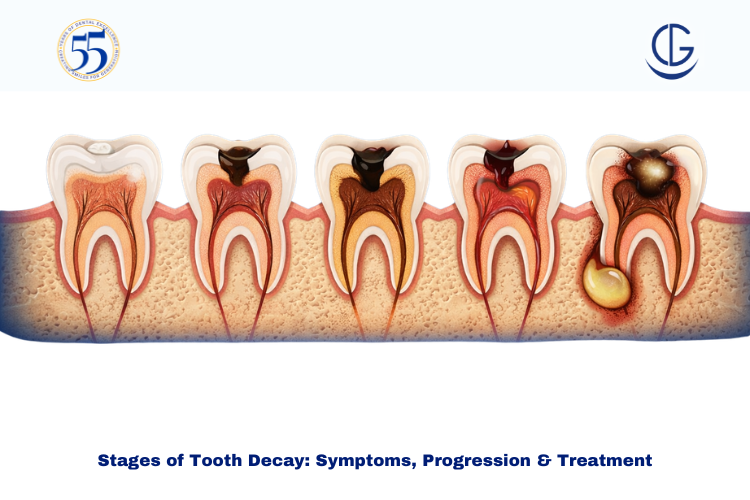
To understand the stages of tooth decay, you need to know how a small enamel spot can gradually turn into deep tooth damage if ignored. Tooth decay (also called cavities or dental caries) doesn’t happen overnight—it’s a step-by-step process influenced by diet, oral hygiene, saliva, and bacteria.
At Dr Gowds Dental Hospitals, we see many patients across Hyderabad who delay treatment because early decay often “doesn’t hurt.” But when pain starts, the decay is usually already advanced. As one of the Best Dental Hospital in Hyderabad, our goal is to help you catch tooth decay early, treat it comfortably, and protect your natural teeth for the long term.
If you’re noticing sensitivity, brown/white spots, food getting stuck, or recurring tooth pain, don’t wait.
Book a consultation at Dr Gowds Dental Hospitals.
Tooth decay starts when plaque bacteria feed on sugars and produce acid. That acid slowly dissolves the minerals in your tooth surface. Over time, the tooth weakens and breaks down.
Common Hyderabad-specific risk factors we often see:
This is the earliest stage—and the easiest to reverse.
What happens:
Acid attacks enamel minerals and leaves a chalky white spot on the tooth.
Symptoms you may notice:
What a dentist may recommend:
Key note: If you treat this stage early, you may avoid drilling completely.
If demineralization continues, a cavity forms in enamel.
What happens:
The enamel surface breaks down and creates a small hole.
Symptoms:
Treatment options:
Dentin is the layer under enamel. It’s softer than enamel, so decay spreads faster here.
What happens:
The cavity deepens and bacteria move closer to the nerve.
Symptoms:
Treatment options:
This stage often brings Hyderabad patients to the clinic because pain starts affecting daily routines.
This is when decay reaches the pulp (nerve and blood supply inside the tooth).
What happens:
The nerve becomes inflamed or infected. The tooth may develop internal pressure and severe pain.
Symptoms:
Treatment options:
This is the most serious stage of tooth decay.
What happens:
Pus forms at the root tip due to infection, and it may spread to surrounding tissue.
Symptoms:
Treatment options:
Important: Abscess is not something to “wait out.” It needs prompt professional care.
There’s no fixed timeline. Dental caries progression can take months to years depending on:
Some people develop decay faster due to dry mouth, frequent snacking, or poor cleaning around crowded teeth.
At Dr Gowds, diagnosis typically includes:
We also guide patients on prevention strategies based on lifestyle—especially helpful for working professionals and students in Hyderabad with irregular routines.
If you want to avoid the later stages of tooth decay, focus on simple habits:
Crowded teeth trap plaque and make brushing ineffective. In such cases:
Book a dental consultation if you have:
Early intervention often means simpler, faster, and more comfortable treatment.
Tooth decay is treatable at every stage—but the earlier you act, the easier and more affordable it usually is. If you suspect a cavity, sensitivity, or recurring tooth pain, book a consultation with Dr Gowds Dental Hospitals today.
Visit your nearest branch in Gachibowli, Madhapur, Koti, Nanakramguda, talk to an orthodontist if alignment is affecting cleaning, and explore aligner treatment to reduce future decay risk.
Yes. The earliest stage (white spot demineralization) can often be reversed with fluoride treatment, hygiene correction, and diet control if caught in time.
Enamel has no nerve supply. Pain usually starts when decay reaches dentin or the pulp (nerve), which is why early cavities may feel normal.
Treatments are planned to be comfortable. Most fillings are quick, and deeper treatments like root canals are done under anesthesia to reduce pain and anxiety.
It depends on the stage. A small filling may be completed in one visit, while root canal treatment and crown placement may need multiple visits.
Decay can progress deeper and faster than expected. Delays may turn a simple filling into a root canal or even tooth loss in advanced cases.

 Gachibowli Branch