

Schedule Appointment

Have you ever caught yourself wondering if your face is perfectly balanced — or is one side subtly different from the other? You’re not imagining it. Most people have some degree of facial asymmetry, and a simple at-home asymmetrical face test can help you understand what you’re seeing and whether it’s worth addressing.
At Dr. Gowds Dental Hospital in Hyderabad, we help patients understand their facial balance through detailed assessments. But before you book a consultation, here’s how you can do a basic check yourself.
Dr. Gowd’s Dental Hospital, Hyderabad, offers comprehensive facial symmetry and jaw alignment consultations. Whether your test results were mild or more significant, our team will guide you with an honest, personalised treatment plan.
An asymmetrical face test is a self-assessment technique where you compare both sides of your face to identify visible differences in structure, muscle tone, or proportions. It is not a clinical diagnosis — but it’s a great starting point to understand your facial balance.
Think of it as a personal ‘face symmetry check’ that helps you notice differences in your jawline, cheeks, eyes, or smile — before deciding whether professional evaluation is right for you.
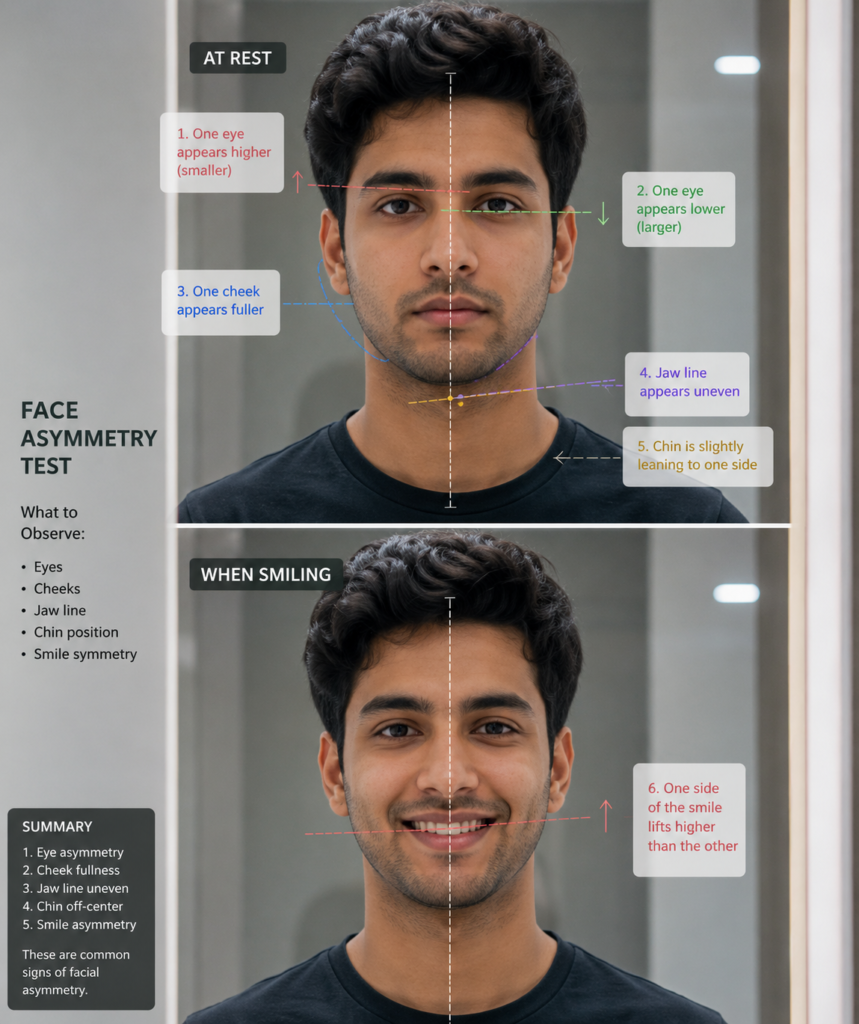
Stand in front of a well-lit mirror with your face relaxed and your hair pulled back. Look straight ahead without tilting your head. Notice:
• Is one eye higher or larger than the other?
• Does one cheek appear fuller or rounder?
• Is your chin centred, or does it lean slightly to one side?
• Is your jawline even on both sides?
• When you smile, does one side rise higher than the other?
Mild differences are completely normal. But if one or more of these feel noticeably pronounced, it may be worth exploring further.
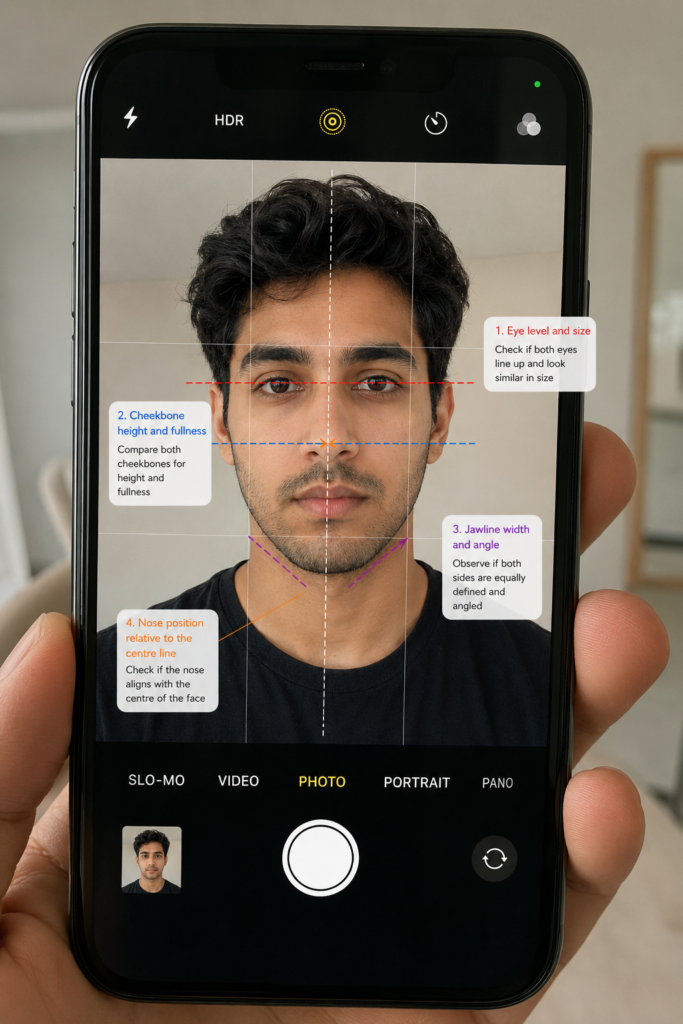
Take a straight-on photo of your face in natural light — no filters, no angles. Then use a basic editing app to draw a vertical line down the centre of your face. Compare the left and right halves. Look for differences in:
This is the same technique that many beauty professionals and dental specialists use as a starting point for facial analysis.
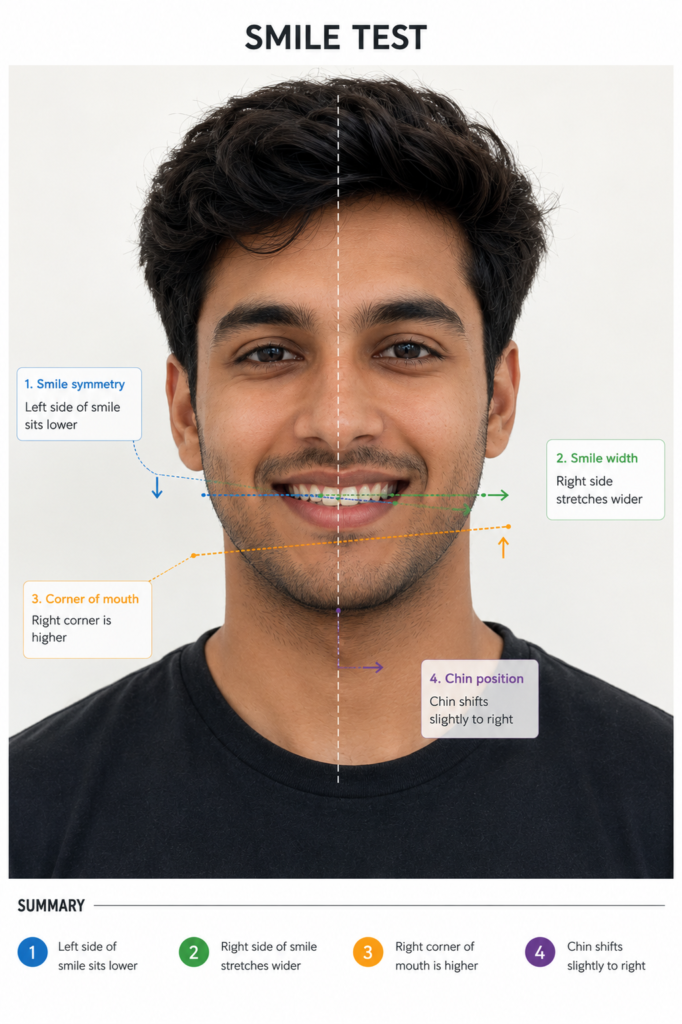
Smile naturally in the mirror. A balanced smile lifts evenly on both sides. If one corner of your mouth moves noticeably higher, stays lower, or one cheek lifts more than the other — this may indicate muscular imbalance, jaw misalignment, or a bite-related issue that a dental specialist can assess.
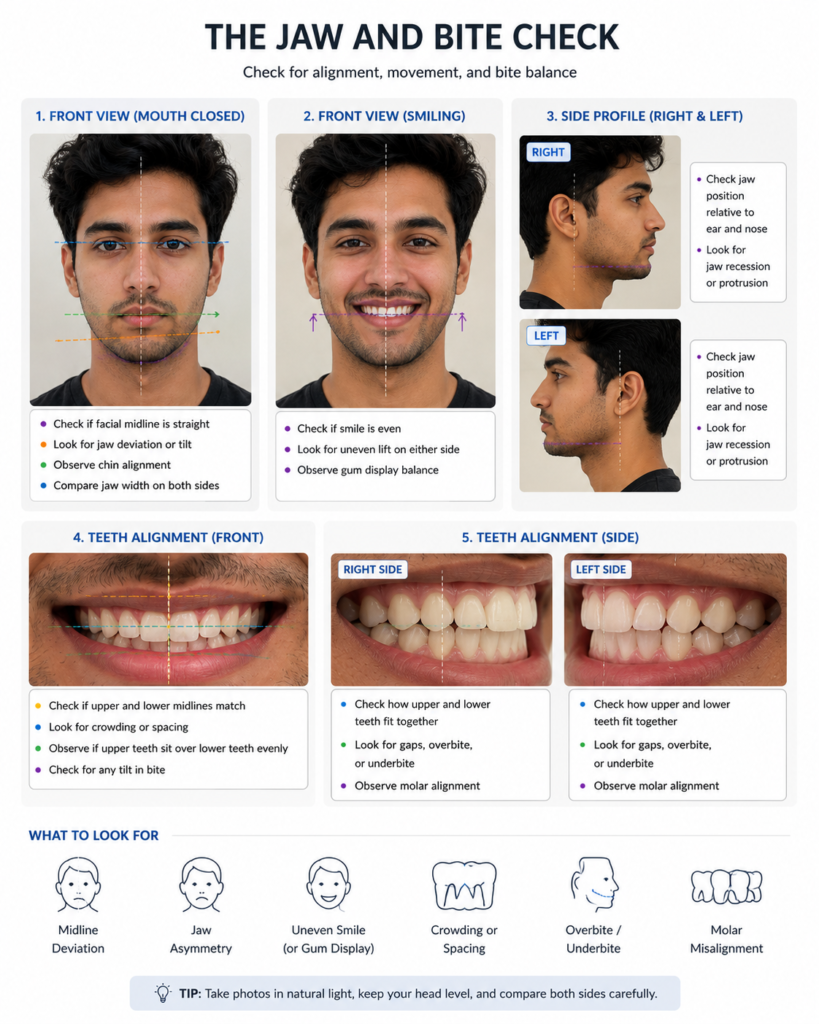
Bite down gently. Do your teeth feel evenly distributed? Does one side feel more pressure than the other? An uneven bite is one of the most common dental causes of facial asymmetry, and it’s often correctable without surgery.
The tests above help you see asymmetry. This step helps you measure it — giving you a clearer picture of how significant the difference between your two sides actually is.
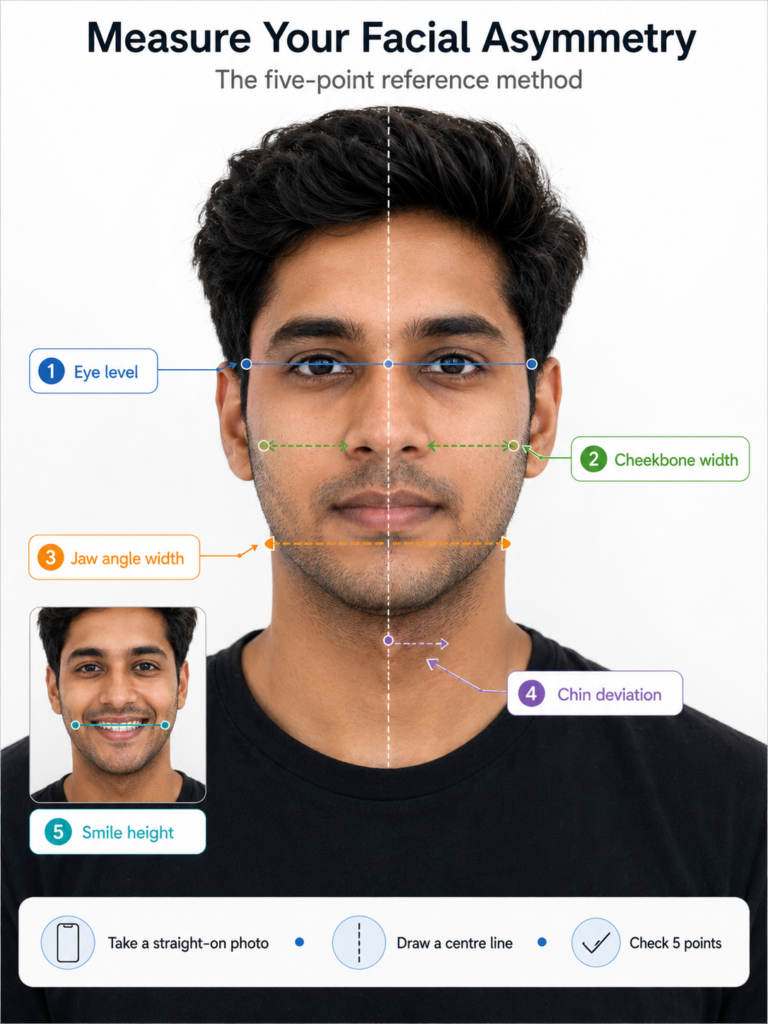
Take a straight-on photo and use any free photo editing app (Samsung Gallery, Snapseed, or even WhatsApp’s built-in editor). Draw a vertical line from the centre of your hairline through your nose tip to your chin. Then measure or visually assess five reference points:
A home facial symmetry check can help you notice visible differences, but it cannot reliably determine the medical severity of facial asymmetry.
Instead of relying on a specific millimetre cutoff, consider whether:
Small visible differences can be part of normal facial variation. If the asymmetry is pronounced, changing, or associated with functional symptoms, professional evaluation is more useful than attempting to grade it from a photograph.
Home measurement gives you a useful estimate, but a precise facial asymmetry analysis requires digital tools. At Dr. Gowds Dental Hospital, our 5D facial scan measures each facial zone to within 1mm — identifying exactly which structures are causing the imbalance and which treatment options are relevant.
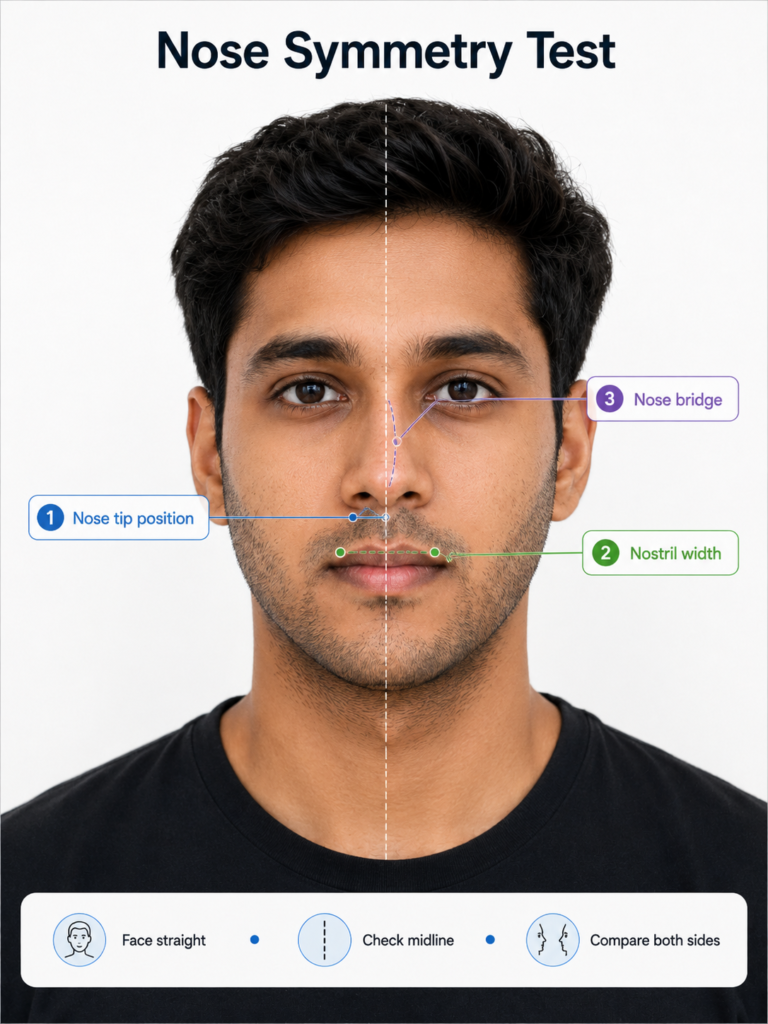
The nose is naturally asymmetrical in many people, and small differences in the bridge, tip, nostrils, or base can be normal.
Using a straight-on photo, you can look at:
These observations can help you notice facial balance, but they cannot determine the cause of the asymmetry.
Nose asymmetry may be related to natural anatomy, previous injury, soft tissue, cartilage, or underlying facial structure. A photograph alone cannot tell whether the teeth or jaws are involved.
If nose asymmetry is pronounced, changing, or accompanied by jaw, bite, breathing, or functional concerns, professional evaluation may be appropriate.
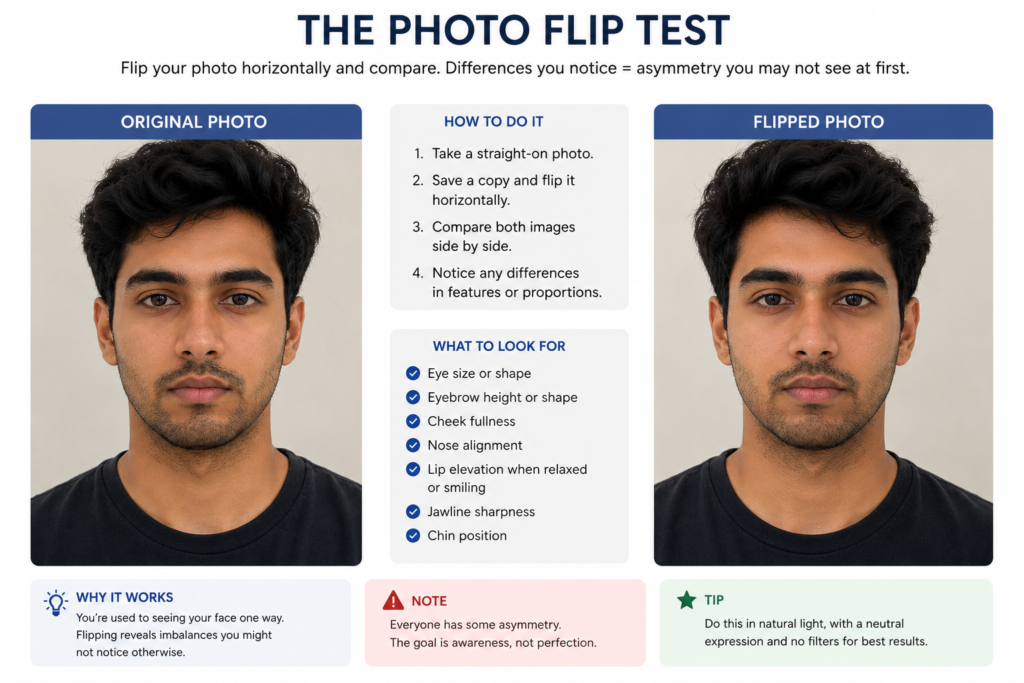
After completing the mirror and photo checks, you may notice that one side appears fuller, narrower, higher, or more prominent than the other.
Compare:
A home photo can help you notice these differences, but it cannot reliably identify a “problem side” or determine the underlying cause.
For a more detailed guide, read which side of your face is more asymmetrical.
Use this checklist to consolidate what you found across all the tests above. Check off each point that applies to you, then read the result below.
One cheek appears noticeably fuller or wider than the other
One eye sits higher than the other in photos
Smile lifts higher on one sideChin appears off-centre (leans left or right)
Jaw shifts to one side when biting down
Nose tip or base deviates from your midline
Teeth feel uneven in pressure when biting
You chew mainly on one side
Based on your tests above, use this table to understand what your results indicate and what action, if any, is appropriate.
| What You Notice | What It May Mean | Suggested Next Step |
|---|---|---|
| Small differences visible only on close inspection | Often part of normal facial variation | Usually no action is needed unless you are concerned |
| A consistent difference in smile, cheek, jaw, or chin position | May reflect natural structure, muscle differences, dental factors, or other causes | Monitor and consider professional evaluation if it bothers you |
| An uneven bite, jaw shift, clicking, or chewing difficulty | Dental or jaw-related factors may be involved | Consider a dental or orthodontic assessment |
| Asymmetry that is increasing or affecting function | May need further clinical evaluation | Arrange a professional assessment |
| Sudden facial drooping, weakness, numbness, or speech difficulty | May indicate a medical problem rather than routine facial asymmetry | Seek urgent medical care |
If your asymmetrical face test reveals noticeable imbalance — especially in your jaw, smile, or bite — it’s time to get a clinical evaluation. At Dr. Gowd’s Dental Hospital, our specialists use 5D digital facial scans to accurately map facial proportions and identify the root cause of asymmetry.
Common dental causes of facial asymmetry include misaligned teeth, uneven bite, missing molars, and jaw muscle imbalance. The good news is that many of these can be corrected non-surgically using clear aligners, orthodontic braces, or bite adjustments.
After completing the at-home check, use the result as a starting point rather than a diagnosis.
If the differences are mild and not affecting function, you may simply monitor them over time.
If you notice bite problems, jaw symptoms, or persistent asymmetry, consider a dental or orthodontic evaluation.
If you want to explore non-surgical options, see our guide to how to fix an asymmetrical face without surgery.
If you want to explore exercises or at-home approaches, see our guide to facial asymmetry exercises and natural correction.
Doing a simple asymmetrical face test at home can help you become more aware of your facial balance and identify whether the differences you see are mild, moderate, or potentially worth addressing. It’s important to remember that perfect facial symmetry is extremely rare — almost everyone has small variations between the two sides of their face.
However, if your test shows noticeable differences in your jawline, smile, or bite, it could indicate an underlying dental or structural issue. The encouraging news is that many cases can be improved through modern asymmetrical face correction treatments such as clear aligners, orthodontics, or bite correction procedures.
If you’re wondering how to fix an asymmetrical face, the best next step is a professional evaluation. At Dr. Gowd’s Dental Hospital, specialists use advanced facial analysis and digital diagnostics to identify the root cause and recommend the most suitable treatment plan.
You can visit any of our Hyderabad branches:
Gachibowli, Madhapur, Koti, Nanakramguda
Yes — the mirror test, photo split test, smile test, and jaw bite check are all reliable at-home methods to assess facial balance. However, for an accurate diagnosis, a dental or medical professional’s evaluation is recommended.
A home test gives a general idea of visible imbalances but cannot identify structural or dental causes. A clinical assessment using digital scans is far more precise.
Yes, in many cases. If the asymmetry is linked to dental misalignment, bite issues, or jaw imbalance, a dentist can recommend aligners, braces, or restorative treatments to improve facial symmetry.
An uneven smile can indicate muscular imbalance or a dental bite issue. It is one of the most common and most correctable forms of facial asymmetry.
Yes. Dr. Gowd’s Dental Hospital in Hyderabad provides detailed facial symmetry consultations, including digital facial scans and personalised treatment planning for asymmetric face correction.
 Gachibowli Branch