

Schedule Appointment

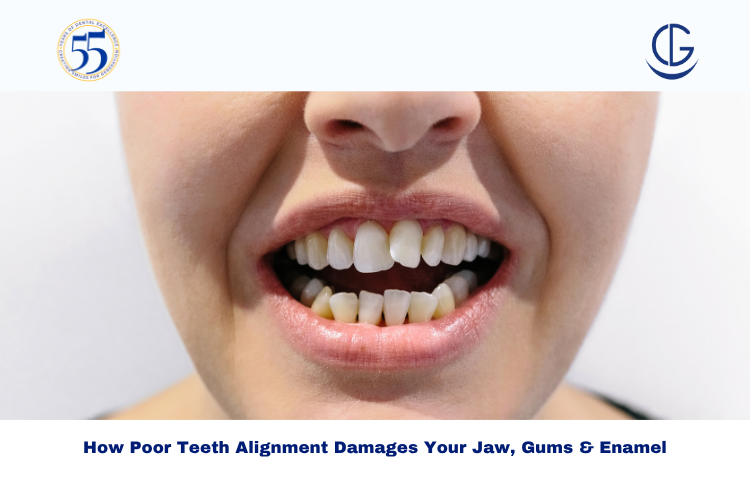
Teeth alignment is a subject most people think of in purely aesthetic terms — crooked teeth, a gapped smile, or a jawline that does not look quite right. But the clinical reality is considerably more serious than that. Poor teeth alignment is not simply a cosmetic inconvenience. It is a mechanical problem that places abnormal stress on teeth, bone, gum tissue, jaw joints, and muscles every single time you bite, chew, or swallow — which, over the course of a day, amounts to thousands of individual force events. Over months and years, misaligned teeth alignment causes accelerated enamel wear, food trapping that drives decay and gum disease, jaw pain that is frequently misdiagnosed as something else entirely, and digestive issues that begin in the mouth. At Dr Gowds Dental Hospitals, we see the full clinical spectrum of teeth alignment consequences — and this guide is designed to help you recognise when your misalignment has moved beyond a cosmetic concern into a healthy one.
| Medically Reviewed by: Prof. Dr. Snigdha Gowd, MDS (Orthodontics & Dentofacial Orthopaedics) |
| 📞 Call: 08065295050 | 📅 Book an Appointment Today |
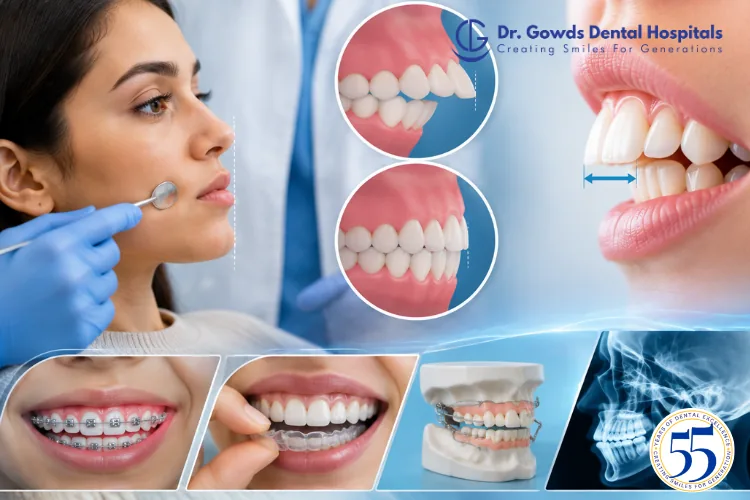
Ideal teeth alignment — the clinical standard orthodontists refer to as Class I occlusion — describes a specific relationship between the upper and lower dental arches where the teeth interdigitate properly, the bite forces are evenly distributed, and no individual tooth or joint is bearing a disproportionate load. In this ideal state, each tooth contacts its neighbours and the opposing arch in a way that distributes chewing forces along the long axis of the root — the direction the tooth is designed to handle.
Deviations from this ideal teeth alignment — whether crowding, spacing, an overbite, underbite, crossbite, or open bite — mean that forces are distributed unevenly. Some teeth bear too much load; others make no proper contact at all. The jaw has to compensate with altered movement patterns. Muscles work harder. Joints experience asymmetric loading. These compensations may be invisible to the patient in the early years, but their cumulative effects become increasingly apparent over time.
The key insight is this: poor teeth alignment is not a static problem. It is a progressive one. Left untreated, misalignment does not simply stay the same — it creates conditions that worsen over time.
Each of the following health consequences of poor teeth alignment is well-documented in peer-reviewed orthodontic and dental literature. Understanding them is not about alarming patients — it is about helping people understand that teeth alignment treatment is a health investment, not merely a cosmetic one.
Misaligned teeth create contact points that enamel was never designed to handle
When teeth alignment places opposing surfaces in contact at abnormal angles — as occurs in deep overbites, edge-to-edge bites, and certain crossbites — the enamel at those contact points erodes at a far faster rate than normal occlusal wear.
The resulting patterns are characteristic: flattened incisal edges, worn palatal surfaces on upper anterior teeth, and cupped-out occlusal surfaces on posterior teeth. Once enamel is lost, it does not regenerate. Severe cases require restorative intervention — crowns, veneers, or bonding — to restore vertical dimension.
Correcting the underlying teeth alignment problem does not restore lost enamel, but it prevents further loss and protects any restorative work placed.
Crowded teeth create persistent plaque traps that no toothbrush can fully reach
Crowding — arguably the most common teeth alignment problem — creates overlapping contact areas where toothbrush bristles and floss cannot effectively penetrate. These areas accumulate plaque and calculus continuously, and the resulting acid attack on enamel produces interproximal (between-tooth) cavities that are often advanced by the time they are detected on X-ray.
Patients with crowded teeth alignment consistently present with a higher caries burden than patients with well-spaced arches, even when oral hygiene effort is equivalent. Straightening the arch does not just improve aesthetics — it literally makes the teeth cleanable.
Misalignment creates periodontal conditions that accelerate bone loss
Gum disease (periodontitis) requires two things to progress: bacteria and a susceptible local environment. Poor teeth alignment creates the local environment by producing food traps, areas of gingival trauma from opposing teeth, and regions of the arch where the gum lacks adequate bony support.
A crossbite tooth that bites outside its normal arch, for example, creates labial gingival trauma every time the jaws close. Crowded lower anteriors create persistent interproximal plaque accumulation that drives localised bone loss. These teeth alignment-driven periodontal factors compound the general bacterial cause of gum disease — and must be addressed as part of comprehensive periodontal treatment.
Abnormal occlusal forces from misalignment load the temporomandibular joints unevenly
The temporomandibular joint (TMJ) is designed to function symmetrically — equal loading on both sides during chewing and swallowing. Poor teeth alignment disrupts this symmetry. A unilateral posterior crossbite, for example, forces the mandible to deviate laterally on closure — a movement that concentrates loading on one condyle repeatedly throughout the day.
Over time, this asymmetric loading contributes to disc displacement, condylar remodelling, and the clinical picture of TMJ dysfunction: clicking, locking, restricted opening, and pain that radiates to the ear, temple, and neck. Many TMJ disorder patients at Dr Gowd’s have a component of teeth alignment dysfunction that, when corrected, significantly reduces joint symptoms.
A malfunctioning bite means food is not properly prepared before swallowing
Proper mastication — the mechanical breakdown of food in the mouth — depends on even occlusal contact across the posterior teeth alignment. An open bite, where the posterior teeth contact but the anterior teeth do not, means front-tooth cutting function is absent. A severe underbite may make it mechanically impossible to bite into food normally.
When chewing is inefficient due to poor teeth alignment, food reaches the stomach in larger, less prepared pieces. The digestive burden increases. Patients with significant malocclusion sometimes report bloating, indigestion, and discomfort that resolves or improves after teeth alignment correction — a connection that is physiologically entirely logical.
Certain jaw alignment patterns contribute to airway restriction during sleep
Severe retrognathia — a significantly receded lower jaw, often associated with a pronounced overbite in the teeth alignment — can reduce the posterior airway space and contribute to upper airway resistance during sleep. This is a well-documented pathway to snoring and, in more significant cases, obstructive sleep apnoea.
While teeth alignment correction alone does not treat sleep apnoea, addressing the skeletal component of a severe overbite through combined orthodontic and surgical treatment can contribute meaningfully to improving the airway space and reducing sleep-disordered breathing in appropriate patients.
Not all teeth alignment problems progress to these consequences at the same rate. But the following signs suggest that your misalignment has moved beyond cosmetic concern into territory that warrants professional assessment:
| ⚠️ Signs Your Teeth Alignment Is Affecting Your Health — See a Clinician:• Consistent jaw clicking, locking, or pain on one or both sides when chewing• Headaches that concentrate in the temples or behind the eyes — particularly on waking• Visible notching or flattening at the incisal edges of your front teeth• Recurrent cavities between teeth despite good oral hygiene efforts• Gum recession on specific teeth that are outside the normal arch curvature• Difficulty biting into food cleanly, or preference for chewing only on one side• Sore, tired jaw muscles after eating — particularly in the morning after night clenching• A bite that feels uneven or has shifted noticeably compared to a few years ago |
The appropriate teeth alignment treatment depends entirely on the type and severity of the presenting malocclusion, the patient’s age, their oral health status, and their aesthetic and lifestyle preferences. At Dr Gowds Dental Hospitals, we offer the full spectrum of teeth alignment treatments:
The most popular teeth alignment treatment for adults with mild to moderate misalignment. Clear aligners are removable, near-invisible, and effective for crowding, spacing, mild bite corrections, and relapse cases. A digital ClinCheck simulation allows patients to see their projected outcome before starting.
For moderate to complex teeth alignment problems that push the limits of clear aligner capability, ceramic bracket braces offer the full mechanical range of fixed orthodontic treatment with significantly reduced aesthetic impact compared to metal brackets.
The most clinically versatile teeth alignment option — capable of managing the full range of malocclusions. Recommended for patients where clinical complexity exceeds clear aligner or ceramic bracket capability, or where cost is a primary concern.
For skeletal teeth alignment discrepancies — significant jaw size mismatches — orthognathic surgery combined with pre- and post-surgical orthodontics delivers corrections that no appliance alone can achieve.
Teeth alignment is not a vanity project. It is the structural foundation of your oral health — and by extension, a meaningful contributor to your general wellbeing. The patients who understand this tend to approach orthodontic treatment with a very different kind of commitment than those who see it as purely cosmetic. They are motivated not just by the prospect of a better smile but by the concrete health outcomes: no more TMJ pain, no more recurring cavities in the same crowded spot, no more worn incisal edges that will eventually require expensive restorations. At Dr Gowds Dental Hospitals, our teeth alignment assessments are designed to give you exactly this picture — the full clinical reality of what your misalignment is doing now and what it will do over the next ten years if left untreated. Come in for an assessment. Let us show you what is actually happening — and what we can do about it.
| Book a Teeth Alignment Assessment at Dr Gowds Dental Hospitals — Clinical Examination, Digital Imaging, and a Clear Treatment Plan in One Visit. Our Hyderabad branches: Gachibowli, Madhapur, Koti, Nanakramguda |
Yes — this is one of the most commonly reported and most commonly overlooked symptoms of poor teeth alignment. The masticatory muscles and temporomandibular joint are intimately connected to the temporal and occipital muscles. Asymmetric jaw loading from misalignment creates muscle tension that radiates as headache — particularly concentrated at the temples and behind the eyes, and often worse on waking after night clenching.
Generally, yes. Untreated misalignment does not stay static. Natural mesial drift — the tendency of teeth to move forward in the arch over time — causes crowding to worsen progressively in most adults. Enamel wear compounds with each passing year. Bone loss from gum disease, if not arrested, reduces the structural support available for eventual teeth alignment treatment. Early intervention is almost always clinically simpler and less expensive than late treatment.
In many cases, yes. Correcting the teeth alignment addresses the mechanical root cause of enamel wear, food trapping, and abnormal jaw loading. Many patients report significant improvement in TMJ symptoms, reduction in cavity frequency, and improved chewing efficiency after clear aligner treatment. However, existing damage — lost enamel, periodontal bone loss, established TMJ changes — requires separate restorative or therapeutic management.
Absolutely not — and this is one of the most important clinical misconceptions we encounter. Teeth alignment treatment is dental and medical treatment with well-documented health benefits that include reduced caries risk, improved periodontal health, better TMJ function, and in certain cases, airway improvements. Many dental insurance policies in India recognise orthodontic treatment as medically indicated when misalignment is causing measurable functional or structural damage.
The best teeth alignment treatment is always the one most appropriate for your specific clinical presentation. For mild to moderate misalignment in adults, clear aligners — particularly Invisalign at Dr Gowds — offer an excellent combination of clinical effectiveness, aesthetic discretion, and patient comfort.
Treatment duration depends on the complexity of your malocclusion and the appliance chosen. Mild cases addressed with clear aligners can complete in 6–9 months. Moderate cases typically take 12–18 months. Complex combined treatments — particularly those involving significant bite correction alongside arch alignment — may take 18–24 months.
 Gachibowli Branch