

Schedule Appointment


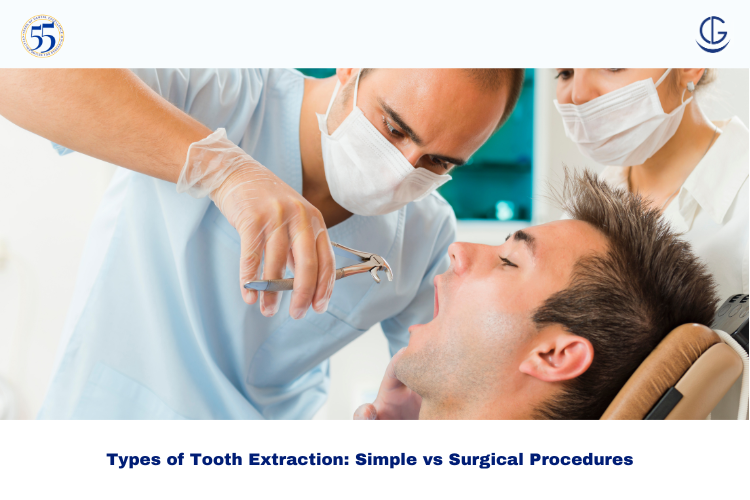
Hearing that you need a tooth extracted can feel intimidating, but modern dentistry offers safe and comfortable solutions for removing damaged, infected, or problematic teeth. Depending on the condition of the tooth and its position in the mouth, your dentist may recommend different extraction techniques.
Understanding the various types of tooth extraction can help you know what to expect and reduce anxiety before treatment.
At Dr. Gowds Dental Hospitals, experienced oral surgeons and dental specialists perform tooth extractions using advanced diagnostic technology, precise techniques, and patient-focused care to ensure a comfortable experience.
A tooth extraction is a dental procedure in which a tooth is removed from its socket in the jawbone.
Dentists may recommend extraction when a tooth cannot be saved through treatments such as fillings, root canal therapy, crowns, or periodontal treatment.
Not all extractions are the same.
Some teeth can be removed quickly in a dental chair, while others require minor oral surgery.
The two main types of tooth extraction are:
Each serves different clinical situations.
A simple extraction is performed when the tooth is fully visible above the gum line and can be removed without surgery.
Dentists may recommend simple extraction for:
The procedure typically involves:
Most simple extractions take only a short amount of time.
Recovery is generally straightforward.
Most patients experience:
Healing usually progresses quickly with proper aftercare.
A surgical extraction is a more complex procedure performed when a tooth cannot be easily accessed or removed through standard techniques.
Surgical extraction may be required for:
The procedure may involve:
After removal, the area may be closed with stitches.
Because surgical extraction is more invasive, patients may experience:
Following post-operative instructions helps ensure proper recovery.
Beyond simple and surgical methods, dentists often categorize extractions according to the tooth involved.
Wisdom teeth are among the most commonly extracted teeth.
Extraction may be necessary when wisdom teeth:
Wisdom tooth removal is often performed surgically.
In some orthodontic cases, premolars may be removed to create space for proper tooth alignment.
This is commonly recommended for:
Children occasionally require extraction of primary teeth when:
These procedures are usually simple extractions.
Molars may require extraction due to:
Depending on the condition of the tooth, the extraction may be simple or surgical.
Dentists always try to save natural teeth whenever possible.
However, extraction may become necessary when:
When decay destroys most of the tooth structure, restoration may no longer be possible.
Severe periodontal disease can loosen teeth significantly, making extraction necessary.
Untreated infections can spread into surrounding tissues and bone.
Deep cracks extending below the gum line often cannot be repaired.
Creating space for proper alignment sometimes requires strategic tooth removal.
One of the most common concerns patients have about the types of tooth extraction is pain.
Modern dentistry has made extraction procedures significantly more comfortable.
During treatment, local anesthesia prevents pain.
Patients typically feel:
But they should not experience sharp pain.
At Dr. Gowds Dental Hospitals, advanced pain management techniques help ensure patient comfort throughout the procedure.
The body immediately begins healing the extraction site.
Patients should:
Some swelling and tenderness are normal.
Applying cold compresses can help reduce discomfort.
Healing timelines vary depending on:
Simple extractions often heal faster than surgical extractions.
Although extractions are generally safe, potential complications include:
Following your dentist’s aftercare instructions significantly reduces these risks.
If a permanent tooth is removed, replacement may be recommended to maintain oral health.
Options include:
Often considered the gold standard for replacing missing teeth.
Fixed restorations that replace one or more missing teeth.
Removable appliances for replacing multiple missing teeth.
At Dr. Gowds Dental Hospitals, dentists help patients select the most appropriate replacement option based on their needs and budget.
Before recommending treatment, dentists evaluate:
This helps determine which of the types of tooth extraction is most suitable for your situation.
Understanding the different types of tooth extraction can make dental treatment feel far less intimidating. While simple extractions are used for visible and easily accessible teeth, surgical extractions are reserved for impacted, broken, or difficult-to-remove teeth. Both procedures are routinely performed using modern techniques designed to maximize comfort and safety.
At Dr. Gowds Dental Hospitals, experienced dental specialists provide comprehensive evaluation, painless extraction procedures, and personalized aftercare to support a smooth recovery. If you have been advised to undergo a tooth extraction, an early consultation can help you understand your options and protect your long-term oral health.
Visit us at-
Dr gowds dental hospital Nanakramguda
Dr gowds dental hospital Gachibowli
Dr gowds dental hospital madhapur
The two primary types of tooth extraction are simple extraction and surgical extraction. Simple extraction is used for visible teeth, while surgical extraction is performed when the tooth is impacted, broken, or difficult to access.
Most impacted wisdom teeth require surgical extraction because they are partially erupted, trapped beneath the gums, or positioned at unusual angles.
No. Surgical extraction is performed using local anesthesia and, in some cases, sedation. Patients may feel pressure during the procedure but should not feel pain.
Simple extractions often heal within one to two weeks, while surgical extractions may require a longer recovery period depending on the complexity of the case.
Yes. Missing teeth can be replaced using dental implants, bridges, or dentures to restore appearance, function, and oral health.

 Gachibowli Branch