

Schedule Appointment


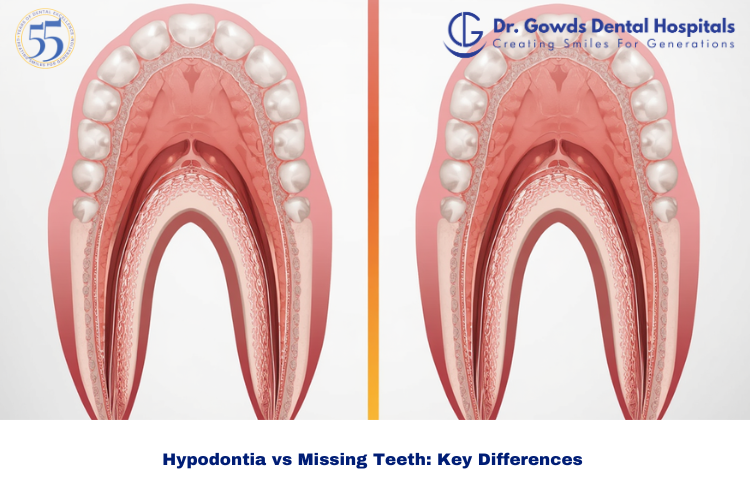
No, hypodontia and missing teeth are not the same.
Hypodontia is a developmental dental condition in which one or more permanent teeth never form. Missing teeth is a broader term that refers to any tooth that is absent from the mouth, whether due to genetics, tooth decay, gum disease, injury, extraction, or hypodontia.
In simple terms:
Understanding this distinction is important because treatment depends on why the tooth is missing in the first place.
At Dr. Gowds Dental Hospitals, specialists use advanced diagnostics and personalized treatment planning to determine the cause of missing teeth and recommend the most appropriate solution.
Many patients discover a gap in their smile and immediately assume a tooth has been lost.
However, some teeth may have never developed at all.
The difference affects:
Identifying whether a tooth is missing due to hypodontia or tooth loss helps dentists choose the most effective treatment strategy.
| Feature | Hypodontia | Missing Teeth |
| Definition | Teeth never develop | Teeth are absent for any reason |
| Present Since Birth | Yes | Not always |
| Tooth Formation | Tooth bud never forms | Tooth develops and is later lost |
| Main Cause | Genetics and developmental factors | Decay, trauma, gum disease, extraction, hypodontia |
| Preventable | Usually no | Often yes |
| Diagnosis | Missing tooth bud visible on X-rays | Cause of tooth loss must be identified |
| Treatment | Orthodontics, implants, restorations | Depends on reason for tooth loss |
Hypodontia is a congenital condition where one to five permanent teeth fail to develop.
Because the tooth bud never forms, the permanent tooth never erupts.
This condition is also known as tooth agenesis.
Unlike teeth lost later in life, hypodontia means the tooth was never present.
The teeth most commonly affected include:
Wisdom teeth are usually excluded because their absence is extremely common.
Missing teeth simply means one or more teeth are absent from the mouth.
The reason can vary significantly.
Common causes include:
This is why “missing teeth” is a broad description rather than a specific diagnosis.
This is the biggest difference.
The tooth never develops because of genetic or developmental factors.
The tooth may be absent because of:
Hypodontia is one cause of missing teeth, but many missing teeth have nothing to do with hypodontia.
The tooth is absent from the beginning because it never forms.
The tooth develops normally but is lost later due to disease, injury, or treatment.
This distinction often becomes apparent through dental imaging.
Dentists use:
The absence of a tooth bud confirms hypodontia.
The focus is on determining why the tooth was lost.
Dentists evaluate:
Since the tooth never develops, surrounding teeth may drift into empty spaces during growth.
This can affect:
The effects usually occur after tooth loss and may include:
Treatment differs because the underlying cause is different.
May involve:
May involve:
Research shows genetics plays the most significant role.
The condition often runs in families.
Potential causes include:
Inherited mutations affecting tooth development.
Certain syndromes may influence tooth formation.
Rare developmental disturbances during pregnancy may affect tooth bud formation.
Unlike hypodontia, missing teeth have many possible causes.
Untreated cavities may destroy teeth beyond repair.
Advanced periodontitis can cause tooth loss.
Sports injuries, accidents, or falls may result in tooth loss.
Some teeth are removed due to crowding, infection, or damage.
Occasionally, teeth cannot be preserved despite treatment.
Whether a tooth never develops or is lost later, the consequences can be significant.
Teeth may shift into empty spaces.
Missing teeth can reduce chewing efficiency.
Some sounds become difficult to pronounce.
The jawbone may shrink over time.
Visible gaps often affect smile aesthetics and self-esteem.
| Treatment | Hypodontia | Missing Teeth |
| Orthodontics | Commonly used | Sometimes required |
| Dental Implants | Common solution | Common solution |
| Dental Bridges | Frequently used | Frequently used |
| Dentures | Rare | Common for multiple missing teeth |
| Veneers | For aesthetic corrections | Limited use |
| Full-Mouth Rehabilitation | Severe cases | Severe cases |
Treatment is always customized based on age, oral health, bone availability, and smile goals.
Although the terms are often used interchangeably, hypodontia and missing teeth are not the same condition.
Hypodontia occurs when permanent teeth never develop, while missing teeth is a broader term that includes teeth lost because of decay, trauma, gum disease, extraction, or developmental conditions.
The most important takeaway is simple:
Hypodontia is one cause of missing teeth, but not all missing teeth are caused by hypodontia.
Understanding the difference helps ensure accurate diagnosis, effective treatment planning, and better long-term oral health outcomes.
If you suspect hypodontia or have concerns about missing teeth, an evaluation at Dr. Gowds Dental Hospitals can help determine the cause and identify the most suitable treatment solution.
Visit us at-
Dr gowds dental hospital Nanakramguda
Dr gowds dental hospital Gachibowli
Dr gowds dental hospital madhapur
Hypodontia is a congenital condition where permanent teeth never develop, while missing teeth refers to any absent tooth regardless of the cause.
Yes. Hypodontia causes missing teeth because the affected teeth never form. However, many missing teeth result from other causes such as decay, trauma, or extraction.
Yes. Missing teeth due to hypodontia can influence jaw growth, bite alignment, and overall facial development if not treated appropriately.
Treatment depends on the cause and severity. Common options include orthodontics, dental implants, bridges, veneers, and comprehensive smile rehabilitation.
 Gachibowli Branch