

Schedule Appointment


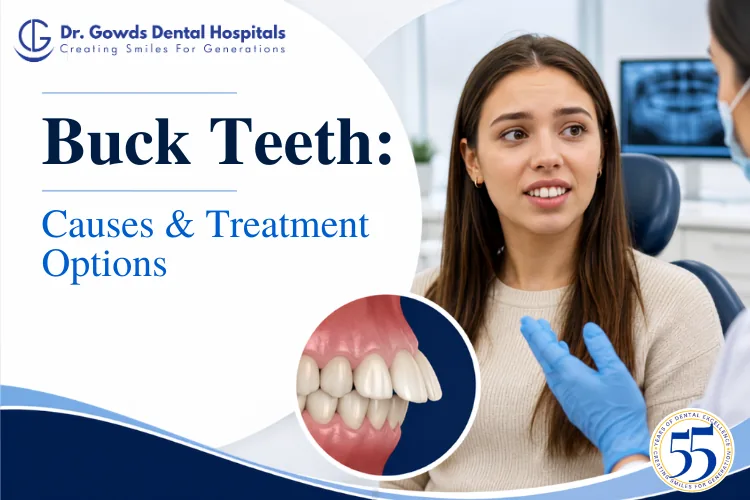
Buck teeth is a common term used to describe upper front teeth that appear more prominent or extend farther forward than expected. In dental terminology, this appearance may be associated with increased overjet, where the upper front teeth sit significantly ahead of the lower front teeth.
The appearance of protruding front teeth can vary from person to person. In some cases, the teeth themselves are positioned forward. In others, the underlying jaw relationship contributes to the appearance.
Buck teeth are not simply a cosmetic concern. Depending on their severity, protruding teeth can affect the bite, make the front teeth more vulnerable to injury, and sometimes make it harder to maintain proper oral hygiene.
The good news is that many cases can be managed with orthodontic treatment. Braces, clear aligners, and other orthodontic approaches may be considered depending on the cause, age, tooth position, and overall bite.
At Dr. Gowds Dental Hospitals, an orthodontic assessment can help identify why the front teeth protrude and determine an appropriate treatment approach.
Buck teeth is an informal term for noticeably protruding upper front teeth.
A person may have buck teeth when the upper incisors:
Dentists may describe this relationship using the term overjet.
A small amount of horizontal distance between the upper and lower front teeth is normal. The concern arises when the horizontal overlap is significantly increased or is associated with other orthodontic problems.
There is no single cause of buck teeth. Several factors can contribute to protruding front teeth.
Overjet refers to the horizontal distance between the upper and lower front teeth.
When this distance is greater than the expected range, the upper front teeth may appear prominent.
Increased overjet can result from the position of the teeth, the jaws, or a combination of both.
The relationship between the upper and lower jaws plays an important role in how the front teeth appear.
If the upper jaw is positioned farther forward relative to the lower jaw, the upper front teeth may look more prominent.
Similarly, a lower jaw that sits farther back can increase the apparent prominence of the upper front teeth.
This is why orthodontic assessment looks at both the teeth and the underlying jaw relationship.
Crowding can alter the position of individual teeth.
When there is limited space in the dental arch, front teeth may:
This can contribute to a protruding appearance.
Certain habits during childhood can influence the position of developing front teeth when they are prolonged or associated with significant pressure.
Examples include:
The effect depends on the duration, frequency, intensity, and stage of dental development.
The tongue naturally rests against structures within the mouth.
In some individuals, an abnormal tongue posture or forward tongue thrust can contribute to changes in the position of the front teeth.
An orthodontist may assess tongue function and oral habits when evaluating protruding teeth.
The timing of tooth loss during childhood can influence how neighboring teeth develop and move.
Early loss of primary teeth can affect available space for permanent teeth and may contribute to changes in alignment.
Jaw size, tooth size, facial structure, and dental alignment are influenced partly by genetics.
Children may therefore develop a similar pattern of tooth or jaw alignment to other family members.
Not necessarily.
Some people with protruding front teeth have no functional difficulties. In other cases, increased protrusion may be associated with orthodontic problems.
Potential concerns can include:
The significance depends on the individual’s dental and skeletal relationship.
Front teeth that extend significantly forward may be more exposed during falls or accidental impacts.
This can be particularly relevant in active children and adolescents.
Significant overjet may be associated with other bite irregularities.
The upper and lower teeth may not meet in an optimal relationship, which can affect chewing function.
When teeth are crowded, tilted, or positioned unusually, some surfaces may be more difficult to clean effectively.
Plaque accumulation can increase the risk of gum inflammation and tooth decay.
In many cases, yes.
The appropriate treatment depends on why the front teeth are protruding.
Treatment may involve:
Not every patient requires the same approach.
Traditional braces are commonly used to correct protruding teeth.
Brackets are attached to the teeth and connected with orthodontic wires. Controlled forces gradually move the teeth into more appropriate positions.
Braces may be particularly useful when protruding teeth occur alongside:
The treatment plan is customized to the patient’s orthodontic needs.
Clear aligners can correct protruding front teeth in many suitable cases.
A series of customized transparent trays gradually guides the teeth toward planned positions.
Clear aligners may be considered when the problem is primarily dental and the required tooth movements are suitable for aligner treatment.
However, more complex cases may require additional orthodontic techniques or traditional braces.
An orthodontist should determine whether aligners are appropriate rather than choosing treatment based only on appearance.
Children may have different treatment options depending on their stage of dental and jaw development.
Early orthodontic evaluation can help determine whether:
Early evaluation does not automatically mean that immediate treatment is necessary.
Adults can also undergo orthodontic correction for protruding front teeth.
Treatment planning may need to consider:
Depending on the case, braces or clear aligners may be suitable.
Treatment duration varies considerably.
Factors that influence treatment time include:
A mildly protruding tooth may require a different treatment period from a complex bite problem involving both jaws.
Your orthodontist can provide a more individualized estimate after examination.
Teeth can move after orthodontic treatment.
This is why retention is an important part of treatment.
Retainers help maintain the corrected position of the teeth after active orthodontic treatment has ended.
The type and duration of retention depend on the individual case.
Following your orthodontist’s retainer instructions can help maintain the treatment result.
Buck teeth are commonly associated with prominent upper front teeth or increased overjet. They can develop because of tooth position, crowding, jaw growth patterns, childhood oral habits, tongue posture, genetics, or a combination of factors.
While some cases are primarily cosmetic, significant protrusion can also affect the bite or increase the vulnerability of the front teeth to injury.
Treatment depends on the underlying cause. Braces and clear aligners can correct many dental alignment problems, while growing children may sometimes benefit from appropriately timed orthodontic treatment. More significant jaw discrepancies may require a different approach.
If your front teeth appear to stick out or you are concerned about your child’s developing bite, an orthodontic assessment can help determine the cause and identify the most appropriate treatment options.
Visit us at-
Dr gowds dental hospital Nanakramguda
Dr gowds dental hospital Gachibowli
Dr gowds dental hospital madhapur
Buck teeth is a common term for upper front teeth that appear noticeably prominent or extend farther forward than the lower front teeth. Dentists may describe the horizontal relationship between the upper and lower incisors as overjet.
Buck teeth can be associated with increased overjet, jaw growth patterns, crowding, childhood oral habits, tongue posture, genetics, or changes in tooth position.
Yes. Braces can correct many cases of protruding front teeth by gradually moving the teeth into a more appropriate position and improving the bite.
Clear aligners can correct suitable cases of protruding teeth. Their effectiveness depends on the severity of the problem, the type of tooth movement required, and the underlying jaw relationship.
No. Many cases can be treated without extraction. Whether extra space is needed depends on crowding, tooth position, facial profile, and the overall orthodontic treatment plan.
Yes. Adults can receive orthodontic treatment for protruding front teeth. Braces or clear aligners may be options depending on the condition of the teeth, gums, bone support, and bite.
Some aspects of dental alignment change as children grow and permanent teeth erupt, but significant protrusion should not be expected to correct itself. An orthodontic evaluation can determine whether monitoring or treatment is appropriate.
When upper front teeth extend significantly forward, they may be more exposed during accidental impacts or falls. This can increase their vulnerability to dental trauma, particularly in active children.
Yes. Significant protrusion may be associated with increased overjet and other bite irregularities. Orthodontic treatment can address the tooth alignment and, where possible, improve the bite relationship.
 Gachibowli Branch