

Schedule Appointment

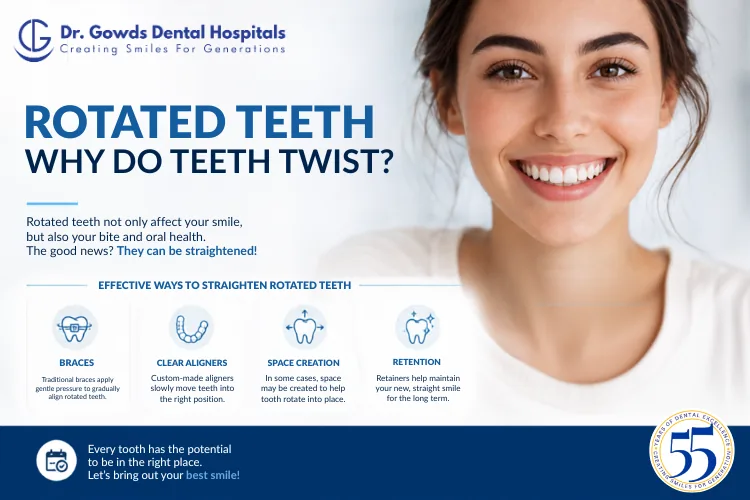
Rotated teeth are teeth that have turned or twisted around their normal vertical position instead of sitting straight within the dental arch. The degree of rotation can range from a slight change in angle to a noticeable twist that affects the appearance or position of the tooth.
Tooth rotation can occur because of crowding, limited space in the dental arch, abnormal tooth development, early loss of baby teeth, or other orthodontic factors. Some rotated teeth cause no immediate symptoms, while others can make brushing and flossing more difficult or contribute to an uneven bite.
Fortunately, many rotated teeth can be corrected with orthodontic treatment. Depending on the severity and the patient’s overall dental condition, treatment may involve traditional braces, clear aligners, or other orthodontic approaches.
At Dr. Gowds Dental Hospitals, an orthodontic evaluation can determine the cause and severity of tooth rotation and help identify the most appropriate way to improve tooth alignment.
A normally positioned tooth follows the natural shape of the dental arch.
A rotated tooth has turned around its long axis, causing part or all of the tooth to face in an unusual direction.
For example, a tooth may appear:
The amount of rotation can vary considerably from person to person.
Several factors can cause or contribute to tooth rotation.
One of the most common reasons for rotated teeth is insufficient space.
When there is not enough room for all the teeth to fit properly, teeth may:
Crowding is particularly common in the front teeth but can affect other areas of the mouth as well.
The size and shape of the dental arch influence how teeth are positioned.
If the available space is smaller than the total width of the teeth, individual teeth may rotate as they attempt to fit within the arch.
Baby teeth help maintain space for permanent teeth.
If a primary tooth is lost significantly earlier than expected, neighboring teeth may move into the available space.
This can reduce the room available for the permanent tooth and contribute to abnormal eruption or rotation.
A baby tooth that remains in place longer than expected can interfere with the normal eruption path of a permanent tooth.
The permanent tooth may erupt in an unusual position or become rotated.
Permanent teeth do not always erupt in an ideal direction.
A tooth may emerge at an angle because of:
This can result in a rotated or displaced tooth.
When a tooth is missing, surrounding teeth may gradually move into the available space.
This movement can change the alignment of neighboring teeth and sometimes cause rotation.
Supernumerary teeth, or additional teeth, can interfere with normal tooth eruption and positioning.
Depending on their location, they may contribute to crowding or rotation.
When a permanent tooth is lost, neighboring teeth may gradually drift toward the empty space.
This can change their alignment and potentially lead to rotation or tipping.
The appearance depends on which tooth is affected and how much it has rotated.
You may notice:
Sometimes rotation is subtle and is noticed only during a dental examination.
A mildly rotated tooth may not cause any significant problems.
However, more pronounced rotation can affect both oral hygiene and bite function.
Potential problems include:
Twisted teeth can create areas where toothbrush bristles and floss cannot easily reach.
This may increase plaque accumulation.
Persistent plaque around a rotated tooth can contribute to gum inflammation.
If food and plaque repeatedly collect around difficult-to-clean areas, the risk of decay may increase.
A significantly rotated tooth may contact opposing teeth differently and contribute to an uneven bite.
Rotation can make teeth appear crowded or uneven, which may affect smile aesthetics.
Not every rotated tooth necessarily requires treatment.
Treatment may be recommended when rotation:
An orthodontist can determine whether correction is appropriate based on the individual’s needs.
Yes. Braces can often correct rotated teeth by applying controlled forces that gradually turn the tooth into a more appropriate position.
Traditional braces use brackets and orthodontic wires to guide teeth through planned movements.
The exact technique depends on:
Clear aligners can correct certain types of tooth rotation.
They use a series of customized trays to gradually move teeth toward their planned positions.
However, not every rotation responds equally well to aligner treatment.
The predictability of correction depends on factors such as:
Your orthodontist can determine whether clear aligners are appropriate for your particular case.
Both approaches can be useful, but their suitability varies.
| Feature | Braces | Clear Aligners |
| Tooth rotation correction | Often effective | Effective for selected cases |
| Visibility | More noticeable | Less noticeable |
| Removable | No | Yes |
| Cleaning | Requires careful cleaning around brackets | Easier to remove for brushing |
| Compliance | Less dependent on wearing time | Requires consistent wear |
| Treatment planning | Customized | Digitally planned |
| Suitability | Broad range of cases | Depends on case complexity |
The best option is determined after an orthodontic assessment.
There is no single treatment time for every rotated tooth.
The duration depends on:
A slightly rotated tooth may require less treatment than a severely rotated tooth that is part of a larger crowding or bite problem.
Some teeth are more challenging to rotate because of their shape and root anatomy.
A tooth may also resist rotation because of:
This is why orthodontic treatment needs to be planned carefully rather than simply applying force to the visible part of the tooth.
Yes.
Adults can undergo orthodontic treatment for rotated teeth.
However, treatment planning may need to consider:
A comprehensive dental and orthodontic evaluation is important before starting treatment.
A mildly rotated tooth may remain stable for many years.
However, significant rotation can make oral hygiene more difficult and may contribute to plaque accumulation, gum inflammation, or uneven tooth contacts.
If the rotation is associated with crowding or an abnormal bite, leaving the underlying orthodontic problem untreated may allow the alignment issue to persist.
Rotated teeth are usually the result of factors such as crowding, limited space, abnormal eruption, early or delayed loss of baby teeth, or changes in the position of neighboring teeth.
Although mild rotation may not cause immediate problems, significantly rotated teeth can make cleaning more difficult, contribute to plaque accumulation, affect the bite, and alter the appearance of the smile.
The good news is that many rotated teeth can be corrected with modern orthodontic treatment. Braces and clear aligners can both be effective in suitable cases, but the appropriate option depends on the degree of rotation and the overall alignment of the teeth.
If you have a twisted or rotated tooth, an orthodontic assessment at Dr. Gowds Dental Hospitals can help determine whether treatment is needed and which approach is best suited to your dental needs.
Visit us at-
Dr gowds dental hospital Nanakramguda
Dr gowds dental hospital Gachibowli
Dr gowds dental hospital madhapur
Rotated teeth are teeth that have twisted around their normal vertical axis rather than following the natural alignment of the dental arch.
Tooth rotation can result from crowding, insufficient space, abnormal eruption, early or delayed loss of baby teeth, missing teeth, extra teeth, or changes in the position of neighboring teeth.
Some rotated teeth can be corrected using clear aligners, depending on the severity and tooth position. A dentist or orthodontist can determine whether aligners are suitable.
Yes, clear aligners can correct certain tooth rotations. More significant rotations may be more challenging and may require additional orthodontic techniques.
Not necessarily. Mild rotation may cause no problems, but significant rotation can make cleaning difficult and may contribute to plaque buildup, gum problems, bite issues, or cosmetic concerns.
Treatment time varies depending on the degree of rotation, available space, tooth position, and whether other orthodontic problems need to be corrected.
Once a permanent tooth has fully erupted, significant rotation generally does not correct itself naturally. Orthodontic treatment may be needed when correction is clinically appropriate.
 Gachibowli Branch