

Schedule Appointment


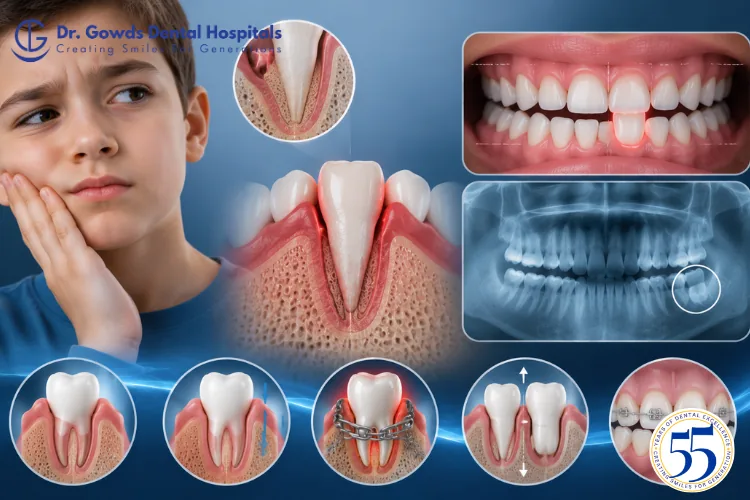
A tooth is normally supported within the jaw by a specialized structure called the periodontal ligament. This ligament provides a small amount of flexibility between the tooth root and the surrounding bone.
Sometimes that normal connection is disrupted, and the root of the tooth becomes directly fused to the surrounding bone. This condition is called dental ankylosis.
An ankylosed tooth may appear as though it has stopped growing or has become “stuck” while the surrounding teeth continue to develop and erupt. The difference can be particularly noticeable in children, where an affected primary tooth may gradually sit lower than the neighboring teeth.
Ankylosis is not simply a problem of a tooth erupting slowly. The underlying attachment between the tooth and bone is different.
At Dr Gowds Dental Hospitals, identifying the cause of an unusual eruption pattern is important before deciding whether a tooth should be monitored, restored, surgically managed, or removed.
An ankylosed tooth is a tooth whose root has become abnormally fused with the surrounding alveolar bone.
Normally, the periodontal ligament separates the root from the bone.
In ankylosis, portions of this ligament space are lost and bone becomes directly attached to the root surface.
Because the tooth no longer has the normal periodontal ligament interface, its ability to participate normally in tooth eruption can be affected.
Tooth eruption is a dynamic process.
As the jaws and surrounding teeth develop, teeth normally move into functional positions within the mouth.
An ankylosed tooth may not continue this process normally.
Meanwhile, neighboring teeth may continue erupting.
As a result, the ankylosed tooth can gradually appear lower than the teeth around it.
This is known as infraocclusion.
The tooth has not necessarily moved downward. Rather, the surrounding teeth and supporting structures may continue developing while the ankylosed tooth remains relatively stationary.
No.
Ankylosis and impaction are different conditions.
Ankylosed Tooth
The tooth becomes fused to the surrounding bone.
Impacted Tooth
The tooth fails to erupt normally because something prevents or interferes with its eruption.
An impacted tooth may be blocked by:
An ankylosed tooth may also have eruption problems, but the underlying reason is the abnormal tooth-to-bone fusion.
Dental examination and imaging can help distinguish between the two.
Ankylosis can occur in different teeth, but it is particularly recognized in primary molars.
Primary teeth are especially important because they normally maintain space and guide the development of the permanent dentition.
Ankylosis can also affect permanent teeth, although the clinical situation and treatment considerations can be different.
Children are continuously growing.
Their jaws change, neighboring teeth erupt, and the permanent dentition develops.
If a primary tooth becomes ankylosed, it may fail to maintain the same vertical position as surrounding teeth.
Over time, the tooth may appear noticeably lower.
This difference can become more obvious as the child grows.
An ankylosed tooth may show:
However, mild ankylosis may not be obvious to parents.
A dentist may detect it during a routine examination.
The exact cause is not always clear.
Several factors have been associated with dental ankylosis.
Injury to a tooth or its supporting structures may contribute to changes around the root.
Previous inflammation around a tooth may affect the periodontal ligament and surrounding tissues.
Some cases occur without an obvious history of trauma or infection.
Changes in the tissues surrounding the tooth may contribute to the loss of the normal periodontal ligament space.
Because ankylosis can occur for different reasons, the patient’s dental history and imaging findings are important.
Yes.
Primary tooth ankylosis is a recognized dental condition.
An ankylosed baby tooth may remain in the mouth while surrounding teeth continue erupting.
Parents may notice that the tooth appears “sunken” compared with neighboring teeth.
This is one reason regular dental examinations during childhood are valuable.
It can.
When a primary tooth becomes ankylosed and fails to erupt normally, neighboring teeth may continue moving.
This can alter the space available for the permanent successor.
Potential consequences include:
The effect depends on the tooth involved and the extent of ankylosis.
Usually, ankylosis itself does not necessarily cause pain.
A child may have an ankylosed tooth without experiencing any symptoms.
Pain may occur if another problem develops around the tooth, such as:
This is why an apparently painless ankylosed tooth may still require monitoring.
No.
Treatment depends on several factors.
The dentist may consider:
A mildly affected primary tooth that is not interfering with development may sometimes be monitored.
More significant cases may require intervention.
An ankylosed tooth is a tooth that becomes abnormally fused to the surrounding jawbone after the normal periodontal ligament connection is lost.
The condition is particularly noticeable in children when an ankylosed primary tooth appears lower than the surrounding teeth.
Although ankylosis itself may not cause pain, it can influence eruption, spacing, bite development, and the position of permanent teeth in certain cases.
Not every ankylosed tooth needs immediate treatment. Some can be monitored, while others may require restoration, space management, extraction, or coordination with orthodontic care.
The key is understanding what is happening beneath the visible tooth rather than assuming that a tooth is simply “not growing.”
At Dr Gowds Dental Hospitals, a detailed dental examination and appropriate imaging can help determine whether a tooth is ankylosed and whether observation or treatment is the most suitable approach.
For children in particular, early assessment allows the dental team to monitor jaw growth, permanent tooth development, and eruption patterns so that intervention can be planned when it is genuinely needed.
Visit us at-
Dr gowds dental hospital Nanakramguda
Dr gowds dental hospital Gachibowli
Dr gowds dental hospital madhapur
An ankylosed tooth is a tooth whose root becomes abnormally fused to the surrounding jawbone, replacing part of the normal periodontal ligament connection.
Possible contributing factors include dental trauma, previous inflammation or infection, developmental factors, and local changes around the tooth. In some cases, no clear cause is identified.
It may appear lower or “sunken” compared with neighboring teeth. This is called infraocclusion.
Not necessarily. Ankylosis itself may be painless. Pain can occur if the affected tooth develops decay, infection, gum inflammation, or another dental problem.
Yes. An ankylosed primary tooth may interfere with the eruption path or available space for the developing permanent tooth.
Infraocclusion means a tooth is positioned below the normal biting level of the surrounding teeth. It is commonly seen when a primary tooth becomes ankylosed.


 Gachibowli Branch