

Schedule Appointment


Choosing an orthodontic option is not only about straightening teeth. For many people, comfort, appearance, daily routine, and the overall treatment experience matter just as much. That is why the comparison between clear aligners vs ceramic braces is common among people considering orthodontic care.
Both options work differently. Clear aligners use a series of transparent, removable trays, while ceramic braces use tooth-coloured or clear brackets connected by a wire. Understanding these differences can make it easier to discuss your options with an orthodontic professional.
In this guide, Dr Gowds Dental Hospitals compares clear aligners and ceramic braces based on appearance, comfort, cleaning, eating habits, convenience, and treatment considerations. This can help you decide what questions to ask before choosing an option in Hyderabad.
Thinking about clear aligners or ceramic braces?
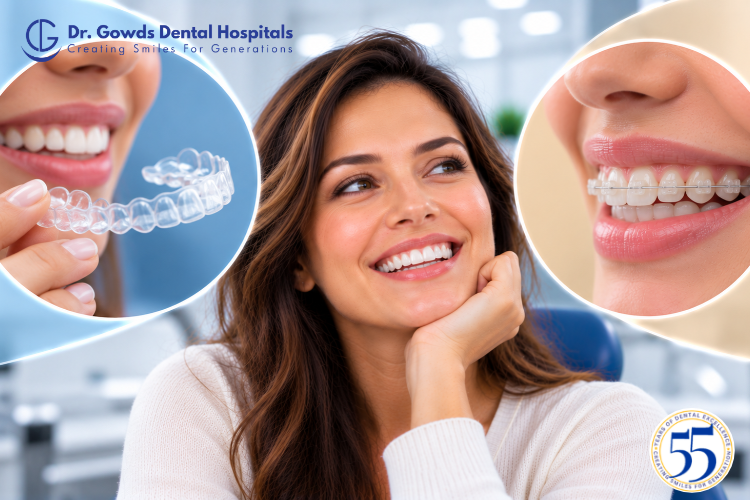
Clear aligners are a series of transparent trays designed to fit over the teeth. Each tray is used according to a planned sequence, with the aim of guiding the teeth toward planned positions.
Because the trays are removable, they can be taken out for meals and regular brushing. This can make them appealing to people who prefer an orthodontic option that fits around their daily routine.
Ceramic braces use brackets that are designed to blend more closely with the natural colour of the teeth. A wire connects the brackets and is adjusted as treatment progresses.
Unlike clear aligners, ceramic braces remain attached to the teeth during treatment. This makes them a fixed option for people who prefer not to manage removable trays.
Appearance is one of the biggest reasons people compare clear aligners vs ceramic braces.
Clear aligners are transparent and sit over the teeth, making them visually subtle in many everyday situations. They may appeal to adults and older teenagers who prefer their orthodontic appliance to be less noticeable.
Ceramic braces are also designed to be less noticeable than conventional metal braces because the brackets are tooth-coloured or clear. However, the brackets and connecting wire can still be visible.
The practical choice comes down to your preference: do you want a removable, transparent tray, or a fixed appliance designed to blend with your teeth?
Comfort is subjective, so there is no single option that feels the same for everyone.
Clear aligners have smooth tray surfaces rather than brackets and wires. You may notice pressure or tightness when moving to a new set of trays as part of the planned treatment.
Ceramic braces can feel different because brackets are attached to the teeth and connected by a wire. Getting used to the appliance can be part of the treatment experience.
Instead of asking which option is universally more comfortable, consider which appliance fits your preferences and everyday routine.
Clear aligners are removable, so they are generally taken out before eating. After meals, the teeth and trays need to be cleaned according to the recommended routine before the aligners are worn again.
Ceramic braces stay on the teeth while you eat. This means you need to pay attention to foods and eating habits that may affect the brackets or wire.
If you prefer an appliance that can be removed during meals, clear aligners may feel more convenient. If you prefer a fixed option that stays in place, ceramic braces may fit your routine better.
Both options require a consistent cleaning routine.
With clear aligners, you can remove the trays while brushing and flossing. The aligners themselves also need regular cleaning as directed during treatment.
With ceramic braces, brackets and wires remain in place, so brushing requires careful attention around these areas. Flossing can also take a little more planning.
The key difference is simple: aligners can be removed for oral hygiene, while ceramic braces require cleaning around a fixed appliance.
Clear aligners can suit people who value removability. They can be taken out for meals, brushing, photographs, or particular occasions. However, that flexibility also means you need to follow the recommended wearing routine and keep the trays safe whenever they are removed.
Ceramic braces do not require you to remember to put trays back in. They remain attached to the teeth throughout treatment, but this also means the appliance becomes part of your daily routine.
Think about your lifestyle before choosing. Travel, work, school, social events, eating habits, and your ability to manage removable trays can all influence which option feels more practical.
There is no single answer to whether clear aligners or ceramic braces are better for every person.
The suitability of an orthodontic option depends on factors such as tooth position, bite, the movements planned, treatment goals, and how consistently the recommended treatment routine is followed.
Clear aligners can be considered for certain treatment plans, while ceramic braces may be preferred when a fixed appliance is more appropriate for the planned movements.
That is why comparing the two options only by appearance or comfort can be misleading. The better starting point is understanding your orthodontic needs and then comparing the options available for your treatment plan.
Clear aligners: Transparent and generally discreet.
Ceramic braces: Tooth-coloured or clear brackets with a visible connecting wire.
Clear aligners: Removable for meals and oral hygiene.
Ceramic braces: Fixed to the teeth during treatment.
Clear aligners: Removed while eating.
Ceramic braces: Remain in place, so eating habits may need additional attention.
Clear aligners: Teeth can be cleaned without the trays in place, while the trays also need regular cleaning.
Ceramic braces: Teeth need to be cleaned carefully around brackets and wires.
Clear aligners: Require consistent use and safe storage when removed.
Ceramic braces: Stay in place, so there is no need to remember to replace an appliance after meals.
Before deciding between clear aligners vs ceramic braces, consider these questions:
A consultation can connect these lifestyle preferences with your orthodontic needs rather than choosing an option based only on appearance.
Clear aligners and ceramic braces are different approaches, and neither should be selected simply because it looks more appealing.
Clear aligners may suit people who value a discreet, removable appliance and are comfortable managing trays as part of their daily routine. Ceramic braces may suit people who prefer a tooth-coloured fixed appliance and do not want the responsibility of removing and replacing trays.
The choice depends on your teeth, bite, treatment goals, lifestyle, and the orthodontic plan recommended for you.
For patients in Hyderabad, Dr Gowds Dental Hospitals provides orthodontic consultations across Nanakramguda, Gachibowli, Madhapur, koti. Discussing both options during a consultation can help make the decision clearer and more personalized.
The clear aligners vs ceramic braces decision is less about finding one universally better option and more about finding the option that matches your orthodontic needs and everyday routine.
Clear aligners focus on removability and a discreet appearance, while ceramic braces provide a fixed, tooth-coloured approach. Comfort, cleaning, eating habits, daily responsibility, and the planned tooth movements should all be considered before making a decision.
Looking for clear aligners or ceramic braces in Hyderabad? Contact Dr Gowds Dental Hospitals and visit the branch that is convenient for you.
Clear aligners are removable transparent trays, while ceramic braces use tooth-coloured or clear brackets connected by a wire and remain fixed to the teeth during treatment.
Comfort varies from person to person. Aligners have smooth tray surfaces, while ceramic braces involve brackets and wires. Both options can feel different as treatment progresses.
Clear aligners are generally more discreet because they are transparent. Ceramic braces are also designed to blend with the teeth, although the brackets and connecting wire can still be visible.
Clear aligners are removed while eating. After a meal, the teeth and trays should be cleaned according to the recommended routine before the trays are worn again.
No. Ceramic braces are fixed to the teeth during treatment and are removed as part of the orthodontic process.
Clear aligners can be removed while brushing and flossing, giving direct access to the teeth. Ceramic braces require careful cleaning around the brackets and wires.
The choice depends on your orthodontic needs, planned tooth movements, lifestyle, appearance preferences, and ability to follow the recommended treatment routine. An orthodontic consultation can help you compare both options.
No single orthodontic option is suitable for every person or every treatment plan. An orthodontic assessment is needed to determine which options can be considered for your individual needs.

 Gachibowli Branch