

Schedule Appointment


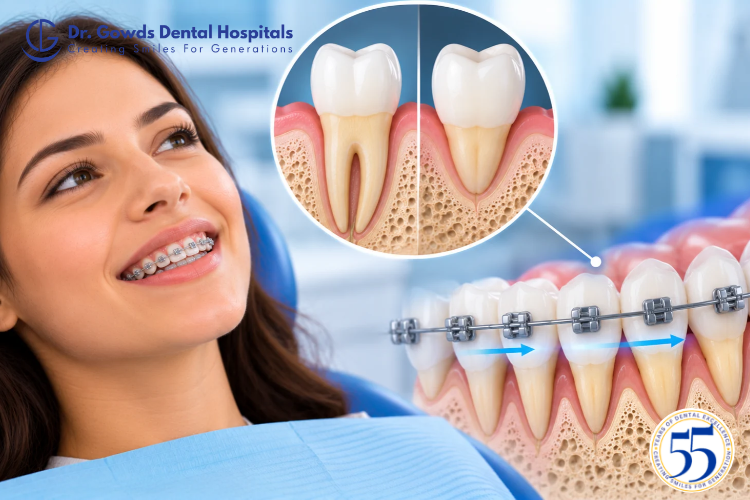
Being told that you have short tooth roots can raise an important question if you are considering braces: Can orthodontic treatment still be planned safely?
Short tooth roots can be one of the factors an orthodontist considers when assessing teeth before braces. However, the term alone does not provide the complete picture. The position of the teeth, bite, root shape and length, supporting structures and proposed tooth movements all form part of the assessment.
At Dr Gowds Dental Hospitals, an orthodontic consultation can help you understand what your dental images show and how that information may fit into your proposed treatment plan.
A tooth has a crown, which is the visible portion, and a root that sits within the supporting bone. The root is an important part of the tooth’s overall structure.
Short tooth roots are roots that appear shorter than expected when assessed through dental imaging. Root length and shape can vary between different teeth, so an orthodontist considers the individual teeth rather than relying on the phrase “short roots” alone.
The finding may be noticed during an orthodontic examination or when reviewing dental X-rays taken as part of treatment planning.
Short tooth roots are generally assessed using dental imaging alongside a clinical examination. The orthodontist may review several aspects of your teeth and bite, including:
This gives the orthodontist a broader picture rather than making a treatment decision based on one feature of an X-ray.
They can be relevant to orthodontic treatment planning.
Braces involve planned tooth movement, so the appearance and position of the roots may be considered when deciding how the teeth should be positioned.
If shorter roots are visible, the orthodontist may take that information into account when planning the direction and extent of tooth movement. The approach can vary from one person to another because orthodontic treatment is based on the individual’s dental condition.
This means two people with short-looking roots may not necessarily have the same treatment plan.
An orthodontic assessment is about more than simply looking at crooked or crowded teeth. The orthodontist also needs to understand the underlying structure and how the teeth relate to one another.
Root assessment may help the orthodontist:
The purpose is to create an orthodontic plan that reflects your individual dental situation.
This is a common question, but there is no single answer for everyone.
Whether braces are appropriate depends on the overall assessment, including the teeth involved, root appearance, bite, supporting structures and the amount and direction of movement being considered.
If you have short tooth roots, the orthodontist may discuss a treatment approach that takes the finding into account. Depending on the individual situation, aspects of the treatment plan may also need to be considered differently.
So, being told that you have short tooth roots does not by itself provide enough information to decide whether braces are suitable.
If an X-ray shows shorter roots before orthodontic treatment, ask your orthodontist to explain exactly what the finding means for your case.
Useful questions include:
Understanding these details can help you make a more informed decision about your orthodontic treatment.
If you have already received an X-ray report mentioning short roots, bring your previous dental records and images to your consultation at Dr Gowds Dental Hospitals.
An orthodontic assessment usually begins with a discussion about your dental concerns and treatment goals. The orthodontist then examines the teeth and bite and reviews the available dental images.
Crowding, spacing, rotations and the position of individual teeth may influence the proposed orthodontic approach.
The way your upper and lower teeth meet is also considered. The orthodontist looks at how the teeth relate to each other rather than assessing one tooth in isolation.
The roots may differ naturally in length and shape. If shorter roots are visible, this information becomes part of the treatment-planning discussion.
If you have had braces or other dental treatment in the past, your dental history can provide useful context during the assessment.
Your expectations are another important part of the discussion. Your orthodontist can explain what the proposed treatment is intended to address and whether there are factors that need particular consideration.
The terms short tooth roots and root resorption do not describe exactly the same thing.
Short tooth roots refer to the length or appearance of the roots. Root resorption refers to a change involving the structure of a tooth root.
If either term appears in your dental records, it is worth asking your orthodontist to explain precisely what has been observed and what it means in your individual case.
It is important to distinguish between roots that appear short before orthodontic treatment and changes that may be observed during or after treatment.
If short roots are identified before braces, that information can be included in the orthodontic assessment and treatment planning process.
If changes in root shape or length become a concern during treatment, the orthodontist can decide whether further assessment or monitoring should be considered.
This is why an individual orthodontic assessment is more useful than relying on general information about braces.
If a dentist or orthodontist has mentioned short tooth roots, start by asking for a clear explanation of what was seen on your dental images.
Before beginning braces, you may want to discuss:
Avoid making a decision based only on the phrase “short roots”. The surrounding dental information matters.
If you are considering braces and have already been told that you have short tooth roots, an orthodontic consultation can help you understand how the finding fits into your treatment plan.
The orthodontist can review your dental condition, discuss your goals and explain the factors that may influence the proposed approach.
Considering braces and concerned about short tooth roots? Consult the orthodontic team at Dr Gowds Dental Hospitals in Hyderabad.
Short tooth roots are one of the factors that may be considered during orthodontic planning. They do not provide enough information on their own to determine whether braces are suitable.
The more useful question is not simply, “Are my roots short?” but “What do my root length and shape mean for my individual orthodontic plan?”
A detailed assessment can help you understand your teeth, bite, proposed tooth movements and any factors that may need particular consideration.
If you have been told that you have short tooth roots, discuss the finding with an orthodontist before making a decision about braces.
Looking for an orthodontic consultation in Hyderabad? Dr Gowds Dental Hospitals has branches in Nanakramguda, Gachibowli, Madhapur, koti. Book a consultation to discuss your orthodontic needs.
Short tooth roots are a factor an orthodontist may consider during treatment planning. Their presence alone does not determine whether braces are suitable.
It depends on the individual dental assessment, including root appearance, tooth position, bite, supporting structures and the planned tooth movement.
They may be noticed on dental imaging taken as part of an orthodontic assessment. The orthodontist reviews the images alongside the clinical examination and treatment goals.
No. Short roots describe the length or appearance of the roots, while root resorption refers to a change involving root structure. Your orthodontist can explain which finding applies to you.
Not necessarily. A short-root finding needs to be interpreted in the context of your overall dental condition and proposed treatment plan.
They may be one of the factors considered when deciding the direction and extent of planned tooth movement and how treatment should be monitored.
Ask which teeth are affected, how the finding relates to your treatment plan, what movements are planned and whether any modifications or monitoring should be considered.
If short roots are known or suspected, discussing them during the orthodontic assessment helps the orthodontist include that information in treatment planning.
 Gachibowli Branch