

Schedule Appointment


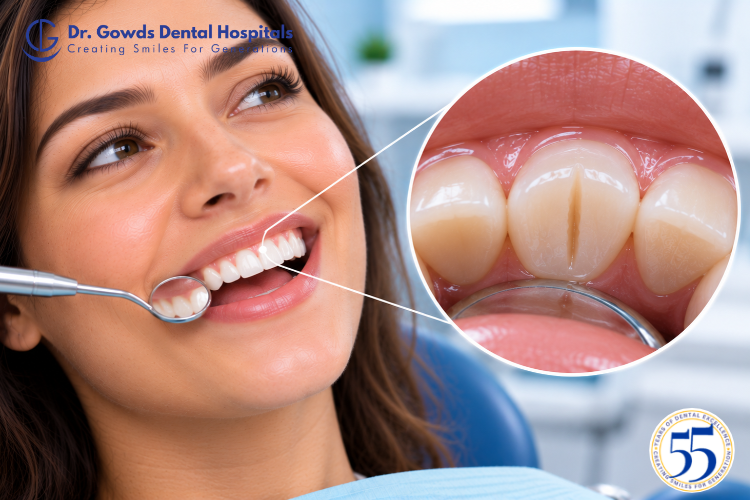
A deep groove on the back of a front tooth can be easy to overlook, especially because it is not visible when you smile. You may notice it while brushing, running your tongue over the tooth, or looking closely in a mirror.
A groove can simply be part of the tooth’s natural shape. However, when an indentation is particularly deep or difficult to keep clean, it is worth having it examined rather than ignoring it.
In dental terminology, a groove on the inner surface of a front tooth may sometimes be described as a palatal groove or developmental groove. The exact nature of the groove can only be determined by examining the tooth.
This guide explains why a groove on the back of a front tooth deserves attention, what a dentist may check, and what types of care may be considered.
The front teeth have different surfaces. The surface facing the lips is usually the one people see when they smile, while the inner surface faces the tongue and roof of the mouth.
A deep groove on the back of a front tooth is a narrow line, indentation or channel found on this inner surface.
Some grooves are shallow and simply form part of the tooth’s anatomy. Others can be more pronounced, creating a narrow area that may be difficult to see or clean properly.
The appearance of a groove can vary. It may look like:
Because several different tooth shapes can look similar, it is better not to assume the cause simply by looking at it.
A deep groove may not cause any immediate discomfort. That can make it tempting to ignore.
However, its location and shape can make the area more difficult to inspect during everyday brushing. Food particles or plaque may also be more difficult to remove from a narrow indentation.
The main reason to have a noticeable groove checked is therefore to understand what it is and whether it needs monitoring or treatment.
A dentist may consider factors such as:
Not every groove requires treatment. An examination helps determine the appropriate approach for that particular tooth.
A groove can have different explanations, and appearance alone is not enough to identify one.
Teeth are not completely flat or uniform. Small ridges, depressions and grooves can naturally occur on their surfaces.
A shallow groove that has always been present may simply be part of the tooth’s anatomy.
Some teeth develop a more pronounced groove during their formation. These grooves may be particularly noticeable on the inner surface of certain front teeth.
A developmental groove can vary considerably in depth and shape.
Changes in the tooth surface may sometimes make an existing line or indentation more noticeable.
If you have recently noticed a change in a groove, it is useful to mention it during a dental examination.
A groove that extends towards the gum may require closer inspection because its location can make it harder to see and clean.
Again, the appearance of the groove does not by itself determine whether treatment is necessary.
The first step is simple: do not try to diagnose the groove yourself.
Instead, pay attention to when you first noticed it and whether its appearance seems to have changed.
You can also maintain your normal oral hygiene routine and take care when cleaning the inner surfaces of your front teeth.
Avoid trying to scrape, cut, file or reshape the groove yourself. Attempting to change the tooth surface at home can create additional problems.
If the groove is new, appears unusually deep, is difficult to clean, or simply concerns you, arrange a dental examination.
A dental examination usually begins with a close look at the tooth and the surrounding area.
The dentist examines the shape, depth and location of the groove and looks at the surrounding tooth surface.
The area may be assessed carefully to understand whether the groove is simply an anatomical feature or whether it requires further attention.
If the groove extends close to the gum, the surrounding area may also be examined.
Depending on what the dentist observes, dental imaging may be considered to provide additional information.
The purpose of the examination is to understand the structure and condition of the tooth before deciding whether any treatment is appropriate.
There is no single treatment for every deep groove. The approach depends on the individual tooth and the characteristics of the groove.
If the groove is not causing a concern and can be maintained properly, the dentist may simply recommend keeping an eye on it during regular dental visits.
If the area is difficult to clean, professional cleaning may be recommended as part of routine dental care.
For selected grooves, a dentist may consider smoothing or sealing the area. The suitability of this approach depends on the depth, shape and condition of the tooth.
If the tooth requires more extensive attention, a restorative approach may be considered. The dentist can explain the available option after examining the tooth.
The important point is that treatment should be based on the actual condition of the tooth rather than the appearance of the groove alone.
Not sure whether the groove behind your front tooth is normal? A professional dental examination can help you understand what you are seeing and whether any care is required. Consult Dr Gowds Dental Hospitals at Nanakramguda, Gachibowli, Madhapur, koti in Hyderabad.
A deep groove on the back of a front tooth can be easy to miss during everyday brushing.
When brushing:
If a particular groove is difficult to clean, ask your dentist to demonstrate the most suitable cleaning technique for that area.
You do not need to wait until the area becomes uncomfortable before asking a dentist about it.
Consider arranging an examination if:
A dental examination can provide clarity without requiring you to guess what the groove means.
A small feature on the back of a front tooth may not seem important because it is hidden from view. But unusual or deep tooth grooves are worth discussing with a dentist when their shape, depth or condition raises questions.
The goal is not to assume that every groove represents a problem. It is to understand the tooth properly and decide whether the area needs observation, cleaning, preventive care or another form of dental treatment.
For patients in Hyderabad, Dr Gowds Dental Hospitals provides dental consultations at its Gachibowli, Puppalguda, Madhapur and Koti branches.
A groove on the back of a front tooth is a narrow line, indentation or channel on the inner surface of the tooth. It may be part of the tooth’s natural anatomy or a more pronounced developmental feature.
Some grooves are simply part of normal tooth anatomy. However, the depth, location and appearance can vary, so a dentist should examine a noticeably deep or unusual groove if you are concerned about it.
A palatal groove is a groove found on the inner surface of a tooth facing the roof of the mouth. The term may be used for certain developmental grooves, but an examination is needed to identify the exact nature of an individual tooth feature.
It may be possible to clean the area with careful brushing, but the shape and depth of a groove can make some areas harder to access. A dentist can demonstrate an appropriate cleaning technique based on the tooth’s structure.
No. Treatment is not automatically required for every groove. A dentist may recommend monitoring, cleaning, sealing, smoothing or restorative care depending on the condition and characteristics of the tooth.
Consider a dental examination if the groove is unusually deep, difficult to clean, has recently changed, or simply concerns you. A professional examination can help determine what the feature is and whether any action is appropriate.
No. Do not try to file, scrape or reshape a tooth groove yourself. Any change to the tooth surface should be assessed and carried out by a dental professional when appropriate.


 Gachibowli Branch