

Schedule Appointment


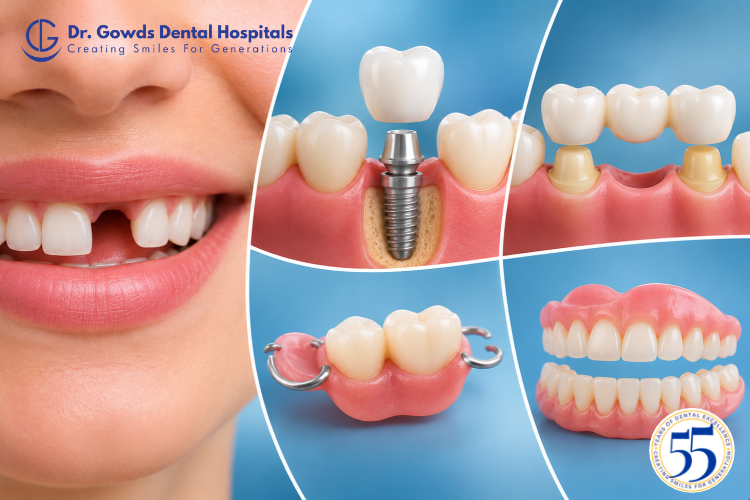
A missing tooth can be a single gap or part of a larger pattern of tooth loss. A single missing front tooth, several missing back teeth, and extensive tooth loss are different situations, so the available replacement options can differ too.
If you are looking for missing teeth treatment, understanding the available choices is a useful first step. Dr Gowds Dental Hospitals in Hyderabad can help you explore options such as dental implants, bridges and dentures based on your individual dental needs and preferences.
Looking for the right way to replace a missing tooth or several missing teeth?
Missing teeth can be grouped in several ways. Looking at the pattern of tooth loss can make it easier to understand the treatment options available.
This is when one tooth is absent while the surrounding teeth are still present. A single missing tooth may be located at the front or back of the mouth.
Common replacement options may include:
The most suitable option depends on factors such as the position of the gap, the condition of neighbouring teeth and your treatment preferences.
Sometimes two or more teeth next to each other are missing. In this situation, the treatment plan may be different from replacing one isolated tooth.
Depending on the individual case, options may include:
A dental evaluation helps determine which options are appropriate for the number and position of missing teeth.
Some people have gaps in different areas of the mouth rather than one continuous gap. For example, a person may have one missing tooth on one side and another missing tooth elsewhere.
Treatment can involve more than one type of restoration. The plan may include individual implants, bridges, partial dentures or a combination, depending on the overall dental situation.
When most or all teeth in an arch are missing, individual tooth replacement may not be the most practical approach. Options can include complete dentures, implant-supported dentures or other full-arch treatment plans.
The choice depends on factors such as the number of teeth remaining, the condition of the mouth, personal preferences and the treatment plan recommended after an examination.
There is no single treatment that is right for everyone. The main options have different designs, procedures, maintenance requirements and suitability.
Dental implants are one option for replacing missing teeth. An implant-based restoration generally involves an implant, an abutment and a dental crown or another restoration.
Implants may be considered for:
The suitability of an implant can depend on the condition of the gums and supporting bone, the location of the missing tooth and other dental factors.
A dental bridge is a fixed restoration designed to fill a gap between teeth. It uses neighbouring teeth or other supporting structures as part of the restoration design.
Bridges may be considered when:
Your dentist can assess the surrounding teeth before recommending a bridge.
A partial denture is a removable appliance used to replace several missing teeth. It can be designed for different patterns of tooth loss.
This option may be discussed when:
The design and fit of a partial denture depend on the individual mouth and the location of the missing teeth.
Complete dentures are removable appliances used when all teeth in an upper or lower arch are missing.
They are designed as a full-arch replacement rather than as individual tooth replacements.
Implant-supported dentures combine implants with a removable or fixed full-arch restoration, depending on the treatment plan.
This approach may be considered for people who need replacement of many or all teeth in an arch and are suitable for implant treatment.
The right missing teeth treatment is not determined by the number of teeth alone. A dental professional will consider several factors before suggesting an option.
A single front tooth, several back teeth and an entire arch require different planning. The location of the gap also affects the design of the replacement.
The teeth next to a gap may be relevant when considering a bridge or other restoration. Their condition and position can influence the available choices.
For implant-based treatment, the condition of the gums and supporting bone is an important part of treatment planning. An examination can help determine whether further assessment is needed.
Some people prefer fixed tooth replacement, while others may be comfortable with a removable option. Appearance, convenience, maintenance and personal priorities can all be part of the discussion.
If you have several dental concerns, your dentist may consider the wider picture rather than planning each missing tooth separately. This can help create a more organised treatment plan.
A consultation is the best way to move from general information to a treatment option that fits your situation.
Your dentist may:
Depending on the case, dental imaging may also be discussed as part of treatment planning.
Yes. People with several missing teeth do not necessarily need the same restoration throughout the mouth.
For example, a treatment plan may involve a dental implant in one area and a bridge or partial denture in another. The appropriate combination depends on the pattern of missing teeth and the condition of the surrounding structures.
This is why comparing treatment options after a dental examination is more useful than choosing a replacement based only on online information.
If you have a missing tooth and are unsure whether you need a replacement, a dental consultation can help you understand your options.
It is especially useful to seek professional advice when:
Choosing a dental hospital is an important part of planning tooth replacement. Dr Gowds Dental Hospitals provides dental care across Hyderabad, with branches in Nanakramguda, Gachibowli, Madhapur, koti.
If you are comparing dental implants, bridges, dentures or other tooth replacement options, a consultation can help you understand which choices are relevant to your specific pattern of missing teeth.
Considering treatment for missing teeth? Speak with the dental team at Dr Gowds Dental Hospitals to discuss your options and plan the next step based on your dental needs.
Missing teeth can be grouped as a single missing tooth, multiple adjacent missing teeth, multiple non-adjacent missing teeth, or extensive tooth loss involving most or all teeth in an arch.
There is no single treatment that is suitable for everyone. Dental implants, bridges, partial dentures, complete dentures and implant-supported dentures may be considered depending on the number and location of missing teeth and the condition of the surrounding structures.
Options for a single missing tooth can include a dental implant with a crown, a fixed dental bridge or a removable partial denture. A dental consultation can help determine which options are relevant to the individual case.
Dental implants may be considered for several missing teeth. The number and placement of implants depend on the individual treatment plan and the condition of the supporting structures.
Yes. Partial dentures can be used for certain patterns of multiple missing teeth, while complete dentures are designed for an entire upper or lower arch where all teeth are missing.
A dental implant is used as part of an implant-based tooth replacement. A bridge is a fixed restoration designed to fill a gap, while a denture is a removable appliance that can replace one or multiple missing teeth depending on its design.
The choice depends on factors such as the number and location of missing teeth, surrounding teeth, gums and supporting structures, treatment preferences and overall dental needs. A dental examination is the appropriate starting point for comparing options.
 Gachibowli Branch