

Schedule Appointment

If your dentures have started feeling loose, you may be wondering whether you need to replace them, adjust them, or consider a completely different option. One treatment format that may come up during a dental consultation is an implant-supported overdenture.
An implant-supported overdenture is a removable denture designed to connect to dental implants. It sits between the traditional removable denture approach and fixed implant-supported restorations in terms of how the restoration is designed and used.
For people exploring options for loose dentures, understanding how this approach differs from conventional dentures and fixed implant restorations can make the treatment discussion much easier.
At Dr Gowds Dental Hospitals in Hyderabad, patients can discuss denture and implant-related treatment options with the dental team and understand which approach is appropriate for their individual situation.
Considering an alternative to loose dentures?
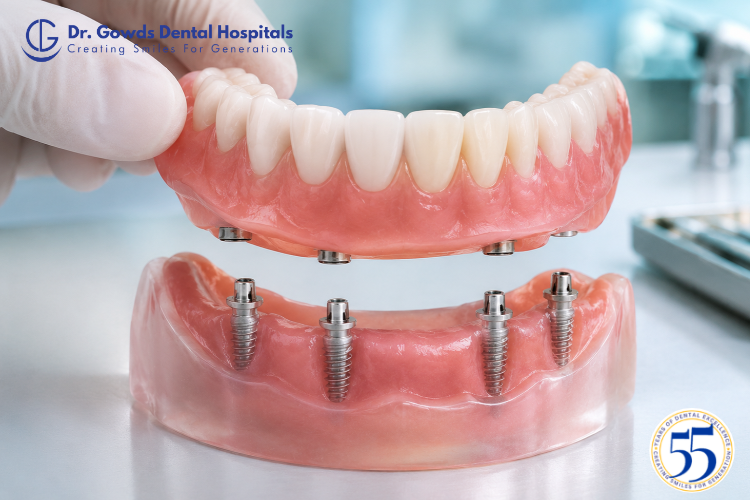
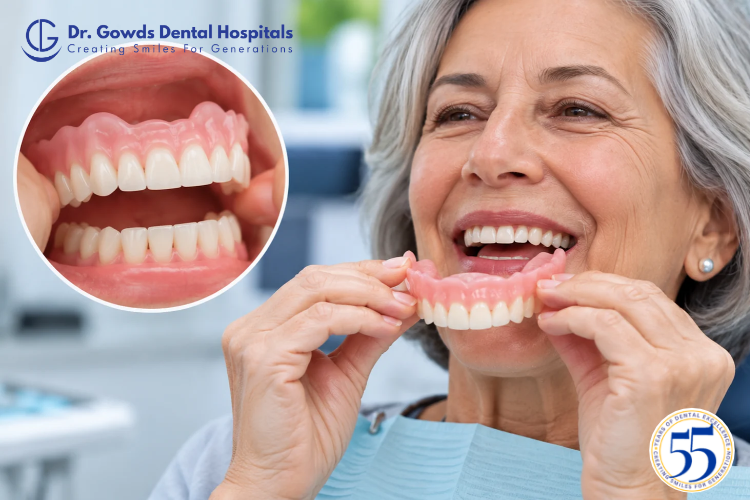
An implant-supported overdenture is a removable dental restoration that connects to dental implants placed in the jaw.
Unlike a conventional denture, which is designed to rest directly on the oral tissues, an implant-supported overdenture incorporates a connection between the denture and the implants.
The patient can remove the overdenture for cleaning and routine care, depending on the treatment design.
The exact design, attachment system, number and position of implants, and type of denture can vary from one treatment plan to another.
A conventional denture is removable and is designed to sit in the mouth without being connected to dental implants.
An implant-supported overdenture is also removable, but it includes an implant-based attachment system.
This means the two options differ mainly in how the denture is supported and retained.
If your main concern is that your current denture feels loose, a dental consultation can help determine whether an adjustment, replacement, or implant-supported option should be discussed.
A loose denture can make everyday activities feel less predictable. You may notice that the denture moves when speaking, eating, or opening your mouth.
However, looseness does not automatically mean that implants are required.
Several factors can affect how a denture fits, including:
Because there can be different reasons for a loose denture, an examination is important before deciding on a replacement or implant-supported option.
Both options are removable, but their design is different.
Traditional dentures are removable restorations designed to replace missing teeth and surrounding structures. They do not use dental implants as part of their retention system.
They can be an option for people who want a removable restoration without implant placement.
An implant-supported overdenture uses dental implants as part of the attachment system.
The denture remains removable, while the implant component is incorporated into the overall treatment design.
The choice between the two is not simply about choosing the more advanced option. It involves looking at the condition of the mouth, the existing denture, treatment preferences, and the restoration being planned.
Another common question is whether an implant-supported overdenture is the same as fixed implant teeth.
They are not the same type of restoration.
An implant-supported overdenture is designed to be removable by the patient.
A fixed implant-supported restoration is designed differently and is not intended to be routinely removed by the patient.
The two options can therefore provide very different experiences in terms of cleaning, maintenance, restoration design, and daily use.
A dentist can explain the differences between these options after evaluating your dental situation.
The treatment process depends on the individual treatment plan, but a consultation generally involves several stages.
The dentist reviews your oral condition, existing dentures, dental history, and treatment expectations.
If you already have dentures, the existing restoration can also be evaluated.
If an implant-supported option is being considered, the dentist plans the implant and overdenture design together.
The position of the implants and the type of attachment system are important parts of this planning.
When the treatment plan includes implants, they are placed according to the planned positions.
The timing and subsequent stages depend on the individual treatment plan.
The denture is designed to work with the planned implant attachment system.
In some situations, an existing denture may be evaluated for possible modification. In others, a new overdenture may be planned.
Follow-up appointments allow the dental team to assess the restoration and make any necessary adjustments to the treatment.
Regular cleaning and maintenance are also part of caring for a removable dental restoration.
Before making a decision, ask your dentist clear questions about the proposed treatment.
Useful questions include:
Understanding these details can help you compare options rather than choosing a restoration based on one feature alone.
For people comparing conventional dentures with fixed implant restorations, an implant-supported overdenture can be viewed as a middle treatment format.
It combines a removable denture design with an implant-based attachment system.
That does not mean it is automatically the right choice for everyone. The appropriate option depends on factors that can only be assessed during a dental evaluation.
The most useful comparison is therefore not simply “Which option is best?” but rather “Which restoration design fits my dental situation, preferences, and treatment plan?”
If you are comparing conventional dentures, implant-supported overdentures, and fixed implant restorations, speak with a dental team to understand how the options differ and what each treatment involves.
Once an overdenture is provided, maintaining the restoration becomes part of your regular oral-care routine.
General care may include:
Your dental team can provide specific cleaning instructions based on the type of overdenture and attachment system used.
Consider arranging a dental consultation if your dentures have become noticeably loose or if you are finding them difficult to manage during everyday activities.
A consultation does not necessarily mean that you will need implants.
The purpose is to understand why the denture is not working as expected and discuss the available options. Depending on the situation, the discussion may include denture adjustment, denture replacement, conventional dentures, implant-supported overdentures, or other restoration options.
The important step is getting the denture evaluated before deciding what to do next.
Implant-supported overdenture treatment involves more than selecting a denture. The implant placement, attachment system, denture design, fit, maintenance, and follow-up all form part of the overall treatment plan.
When comparing dental hospitals in Hyderabad, consider whether the team can explain the available options clearly and answer questions about the complete treatment process.
Dr Gowds Dental Hospitals provides dental care in Hyderabad through its branches in Gachibowli, Puppalguda, Madhapur, and Koti.
An implant-supported overdenture is a removable restoration that connects with dental implants. For someone dealing with loose dentures, it can be one of the treatment formats worth discussing alongside conventional dentures and fixed implant restorations.
The key is to understand how each option differs rather than assuming that one treatment is suitable for everyone.
If your current dentures feel loose, uncomfortable, or difficult to manage, start with a dental evaluation. From there, you can discuss whether adjustment, replacement, an implant-supported overdenture, or another restoration should be considered.
Looking for implant and denture consultation in Hyderabad? Dr Gowds Dental Hospitals offers dental consultations across Nanakramguda, Gachibowli, Madhapur, koti. Contact the team to discuss your loose-denture concerns and available treatment options.
Yes. An implant-supported overdenture is designed as a removable restoration. The specific method of removing and caring for it depends on the treatment design.
No. An implant-supported overdenture is removable, while a fixed implant-supported restoration is designed to remain in place rather than being routinely removed by the patient.
It can be discussed as one option when a person is experiencing problems with a removable denture. A dentist needs to evaluate the mouth, existing denture, and treatment requirements before determining whether this approach is appropriate.
The number and position of implants depend on the planned restoration and individual treatment requirements. Your dentist can explain the proposed implant configuration during treatment planning.
Not necessarily. The existing denture may be evaluated to determine whether it can be modified, while some treatment plans may involve creating a new overdenture. The decision depends on the denture and the planned restoration.
The overdenture should be cleaned according to the instructions provided by your dental team. Cleaning the removable restoration and caring for the areas around the implants and attachments are both important parts of routine maintenance.
The timeline varies because treatment can involve evaluation, planning, implant placement, healing or other intermediate stages, and restoration fitting. Your dentist can provide a treatment timeline based on your individual plan.
There is no single option that applies to everyone. The decision depends on factors such as your existing denture, oral condition, treatment preferences, and the restoration being planned. A dental consultation can help you compare the options.
 Gachibowli Branch