

Schedule Appointment


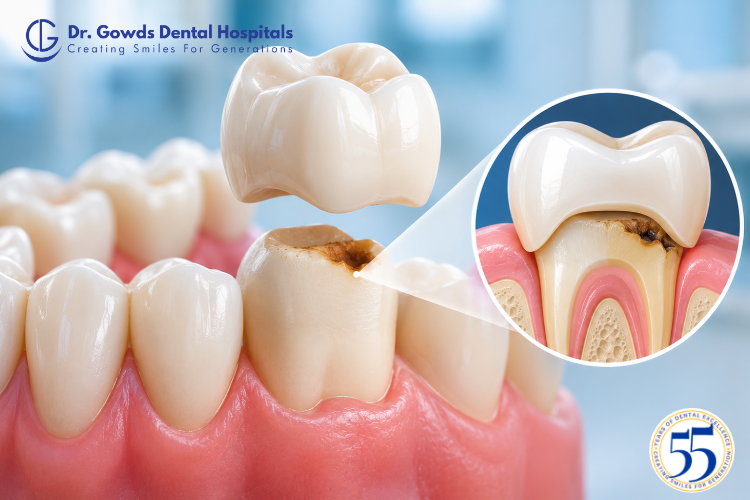
Yes, a tooth with a dental crown can still develop decay in the natural tooth structure around or beneath the crown. A crown covers part of a tooth, but it does not make the entire tooth and surrounding areas immune to cavities.
If you have a crown and notice sensitivity, discomfort, a change around the crown edge, or food repeatedly getting trapped in one area, it is worth having the tooth checked. Dr Gowds Dental Hospitals provides dental care across Hyderabad, with branches in Nanakramguda, Gachibowli, Madhapur, koti.
A crown may look completely intact while the natural tooth underneath or around its edges needs attention. Understanding how this can happen can help you know what to watch for and when to arrange a dental examination.
Have a concern about a tooth under a crown?
A dental crown is designed to cover and protect a prepared tooth. However, the crown does not replace every part of the natural tooth.
The natural tooth remains underneath and around the crown margins. Areas where the crown meets the natural tooth can also require regular cleaning and attention.
This means a cavity under a crown is possible, particularly when decay affects exposed natural tooth structure near the crown margin or an area that cannot be cleaned properly.
It is also important to remember that a change around a crowned tooth does not automatically mean there is a cavity. Sensitivity or discomfort can have different causes, which is why an examination is useful before assuming what is happening.
Several factors can make the area around a crown difficult to keep clean.
The crown has an edge where it meets the natural tooth. This area needs the same attention as the rest of the tooth.
If plaque and food debris repeatedly remain around the margin, the natural tooth structure in that area may require closer evaluation.
A crown is not the same as replacing the entire tooth. Much of the original tooth may remain underneath the restoration.
If the natural tooth develops a problem beneath or around the crown, the crown itself may continue to look normal from the outside.
Flossing and cleaning between teeth are particularly important around crowned teeth. When an area is difficult to reach, plaque may remain around the crown margin or between neighbouring teeth.
Dental crowns are not necessarily permanent for every person or situation. Over time, changes can occur around a crown, and an older restoration may need to be assessed.
The age of a crown alone does not mean that it has failed or that the tooth underneath has decay. An examination is needed to determine what is actually happening.
A cavity under a crown may not always cause an obvious symptom. In some cases, a person may notice a change around the tooth before experiencing significant discomfort.
Possible signs that deserve a dental check include:
These signs do not confirm that there is a cavity. Similar symptoms can occur for other dental reasons. A dentist can examine the tooth and determine what needs attention.
Yes, a crowned tooth can require examination even when it does not hurt.
The absence of pain does not provide enough information to determine whether the tooth is healthy. Some dental changes may be noticed during a routine examination before a person experiences obvious discomfort.
This is one reason regular dental check-ups can be useful for people with crowns, bridges, fillings, or other dental restorations.
If you have had a crown for some time but have not had the tooth assessed recently, consider arranging a dental examination rather than waiting for pain to appear.
A dentist may assess several areas when examining a crowned tooth.
The crown, its margins, nearby gums, and visible natural tooth structure can be examined for changes.
The area where the crown meets the natural tooth is particularly relevant. The dentist may check whether the margin can be cleaned properly and whether there are visible changes around it.
Some parts of a crowned tooth may not be fully visible during a routine visual examination. Depending on the situation, dental X-rays may be considered to obtain additional information.
The dentist may also look at the crown itself, how it fits, and whether there are changes that could affect the tooth underneath or around it.
The exact assessment depends on the individual tooth and the findings during the examination.
The next step depends on where the problem is located and how much natural tooth structure is involved.
Depending on the findings, a dentist may consider options such as:
There is no single solution for every crown-related problem. The appropriate approach depends on the condition of the tooth, the crown, and the surrounding structures.
If the area of concern cannot be properly assessed or treated while the crown remains in place, the dentist may discuss whether the crown needs to be removed.
This is not something that should be decided based only on symptoms. The condition of the tooth needs to be evaluated first.
Good everyday cleaning remains important after getting a crown.
Brush the crowned tooth and the surrounding teeth as part of your normal oral hygiene routine.
Use an appropriate interdental cleaning method to remove debris from areas that a toothbrush cannot reach easily.
Do not ignore persistent sensitivity, discomfort, food trapping, or a change in how a crown feels.
A crowned tooth can look normal while the surrounding natural tooth structure still needs attention. Routine examinations allow the crown and the tooth underneath to be assessed together.
No. A dark line around a crown does not automatically mean that there is a cavity.
The appearance of the area can be influenced by the crown, the natural tooth, the gumline, or other factors. A visual change should not be used to diagnose decay on your own.
If you notice a new or changing dark area around a crown, a dental examination can help determine what it represents.
That depends on the condition of both the crown and the tooth.
If the crown is otherwise suitable but the underlying tooth requires attention, the dentist will assess whether the existing restoration can remain or whether another option is needed.
The decision depends on factors such as the condition of the crown, the crown margin, the amount of natural tooth structure remaining, and the location of the problem.
Consider arranging a dental examination if you notice:
You do not have to wait for severe discomfort before asking a dentist to examine the tooth.
A dental crown covers and protects part of a natural tooth, but it does not make the remaining tooth structure completely free from dental problems.
A cavity can develop around or beneath a crown, particularly in areas where natural tooth structure remains exposed or where cleaning is difficult. At the same time, symptoms such as sensitivity, discomfort, or a dark line do not automatically mean that a cavity is present.
The most useful step is to have the crowned tooth examined when you notice a change. Early assessment can help identify what is happening and what options may be appropriate for that particular tooth.
Have a crowned tooth that feels different or concerns you? Contact Dr Gowds Dental Hospitals and arrange a dental evaluation.
Yes. The natural tooth underneath and around a crown can still require attention. A crown covers part of the tooth, but it does not eliminate the need for regular cleaning and dental examinations.
Possible signs include sensitivity, discomfort when chewing, food getting trapped, changes around the crown margin, or a change in how the crown feels. These signs can have different causes, so they should not be used to diagnose a cavity.
Yes. A crowned tooth may need assessment even when there is no noticeable pain. Regular dental examinations can help evaluate areas that may not be easy to assess at home.
It depends on where the affected area is and how accessible it is. A dentist needs to examine the tooth and crown before determining whether the existing crown can remain in place.
Not necessarily. A dark line can have different causes and does not by itself confirm tooth decay. A dentist can examine the crown margin and surrounding tooth to determine what the change represents.
The age of a crown alone does not mean that a cavity will develop. However, an older crown may need to be assessed as part of an examination of the tooth and surrounding area.
Keep the crowned tooth clean, pay attention to the areas between teeth and around the crown margin, and arrange dental examinations when recommended for your individual situation. If you notice a change around the crown, have it checked rather than trying to diagnose it yourself.
 Gachibowli Branch