

Schedule Appointment

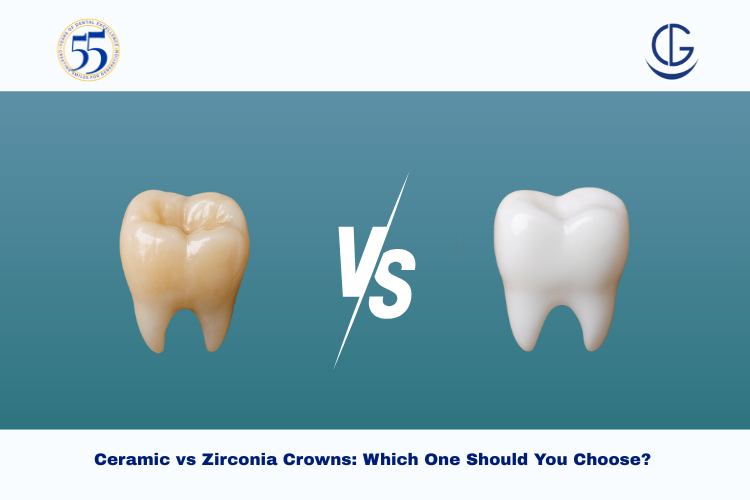
Many patients often find themselves torn between ceramic vs zirconia crowns and are not entirely sure which material may best serve their dental needs. Both types are commonly used in restorative and cosmetic dentistry, but the strengths, aesthetics, durability, and other differences may influence your decision. Here at Dr. Gowds Dental Hospitals, best Hospital for Dental care in Hyderabad, one of the best dentists will evaluate how the needs of each patient’s case are uniquely different and help you determine which is the most suitable crown material.
Choose ceramic crowns for superior aesthetics on front teeth. Choose zirconia crowns for strength and durability on back teeth. The best option depends on tooth location, bite force, and cosmetic goals.
Medically Reviewed by: Prof. Dr. Snigdha Gowd, MDS (Orthodontics & Dentofacial Orthopaedics)
Dental crowns are personalized caps that cover a damaged or compromised tooth, restoring that tooth’s shape, function, and appearance. Dentists commonly recommend dental crowns in the following situations:
Dental crowns are made from a variety of materials, but the two most popular tooth-colored crown materials are ceramic and zirconia.
Ceramic crowns, often referred to as porcelain crowns, are made entirely from dental ceramics. These crowns are widely chosen for their natural tooth-like appearance, especially when used for front teeth.
Ceramic crowns exhibit a color and translucency similar to natural teeth. Therefore, it is a great option for front teeth where aesthetics are essential.
As they are completely metal-free, ceramic crowns are safe for patients who have metal allergies or metal sensitivities.
Ceramic has excellent biocompatibility with the surrounding gum tissue and has a low potential for causing inflammation or irritation.
When it comes to common stains from food and beverages, ceramic crowns are resistant, which helps them maintain their color over time.
Ceramic is more likely to chip or break under bite pressure, especially when you are using posterior teeth or molars.
In order to account for the thickness of the crown, dentists may remove more of the natural tooth than with zirconia crowns.
Ceramic crowns suffer from fragility, so they are not indicated for teeth that are functionally high force bearing.
Zirconia crowns are made from zirconium dioxide, a highly durable, white crystalline oxide. Zirconia is a newer and more advanced material in restorative dentistry, combining strength and acceptable aesthetics. In simple terms, a zirconia crown is a tooth-colored cap milled from a single block of zirconia ceramic — one of the strongest materials used in modern dentistry, most often recommended for molars, root canal-treated teeth, and patients who grind their teeth.
Zirconia crowns are incredibly strong and resistant to fracture, making them ideal for molars and high-pressure areas in the mouth.
Zirconia crowns can often be placed with less removal of the natural tooth, preserving more of your original structure.
Like ceramic, zirconia is hypoallergenic and does not irritate surrounding tissues.
Zirconia crowns tend to last longer than ceramic crowns, sometimes exceeding 10-15 years with proper care.
Advancements in zirconia technology have improved their appearance, offering better translucency and natural shading.
While modern zirconia looks quite realistic, it may not match the translucent look of ceramics, especially for front teeth in strong natural light.
Due to their hardness, monolithic zirconia crowns can gradually wear down the natural tooth they bite against, particularly in patients who grind their teeth without a night guard.
Zirconia crowns are generally more expensive than ceramic crowns due to their advanced material and fabrication process — typically ₹12,000–₹30,000 per tooth versus ₹8,000–₹18,000 for ceramic.
| Feature | Ceramic Crowns | Zirconia Crowns |
| Aesthetics | Very high, best for front teeth | Good to excellent with newer types |
| Durability | Moderate, may chip under pressure | Extremely high, ideal for molars |
| Biocompatibility | Excellent | Excellent |
| Tooth Preparation | More enamel removal required | Minimal tooth removal |
| Cost | Lower to moderate | Higher |
| Best Use | Front teeth or low-pressure areas | Back teeth or high-pressure zones |
| Stain Resistance | High | Very high |
The strength of a dental crown is measured in megapascals (MPa) — the amount of pressure the material can withstand before fracturing. This number matters enormously for back teeth, where molar bite forces can reach 600–800 Newtons.
Zirconia (monolithic/solid zirconia) has a flexural strength of 1,000–1,200 MPa. High-translucency gradient zirconia — designed for better aesthetics — comes in at 800–1,000 MPa. Either way, it far exceeds what back teeth experience during normal chewing, grinding, or even bruxism (teeth clenching).
All-ceramic / e.max crowns have a flexural strength of approximately 400 MPa. This is significantly stronger than older feldspathic porcelain (~100 MPa), which is why modern ceramic crowns still hold up reasonably well for front teeth — but it also explains why they remain unsuitable for molars under heavy occlusal load.
Practical implication: If you grind your teeth at night, have a history of cracking crowns, or are getting a crown on a molar or premolar, zirconia is the clinically safer choice. A ceramic crown in a high-pressure zone is not just a cosmetic risk — it is a restoration risk that may require re-treatment within 5 years.
Front teeth are highly visible when you smile, speak, or laugh, so appearance usually matters just as much as strength. The best crown for front teeth depends on your cosmetic goals, bite pattern, and the condition of the tooth.
Ceramic crowns are often a preferred choice for front teeth because they offer:
This makes ceramic crowns a common option when appearance is the top priority.
Modern zirconia crowns have improved significantly and may also be suitable for front teeth in some cases, especially when extra strength is needed.
They may be recommended when:
In many cosmetic cases, ceramic crowns are often chosen for front teeth because of their natural look. However, zirconia crowns may be better when strength and durability are equally important.
The ideal choice should always be based on a professional dental evaluation, including bite analysis, tooth condition, and smile design planning.
Cost is one of the first questions patients ask, and the honest answer is: it depends — but here are realistic ranges to help you plan.
In India, ceramic (all-ceramic/e.max) crowns generally range from ₹8,000 to ₹18,000 per tooth, while zirconia crowns typically range from ₹12,000 to ₹30,000 per tooth, depending on the type of zirconia used (monolithic vs. layered), the lab, and the digital workflow involved.
Zirconia is milled from a solid block using CAD/CAM technology and requires specialized milling equipment and sintering furnaces. The raw material cost, lab time, and technical precision are all higher than for traditional ceramic crowns. High-translucency or multi-layered gradient zirconia — the kind used for front teeth where aesthetics matter — commands a premium even within the zirconia category.
Often, yes. Zirconia crowns have published survival rates of 90–95% at 10 years with good maintenance. A ceramic crown that chips at year 5 and needs replacement ultimately costs more than a zirconia crown that lasts 15 years. When you factor in replacement risk, chairtime, and retreatment, zirconia frequently offers better long-term value — especially for back teeth under high bite pressure.
At Dr. Gowds Dental Hospitals in Hyderabad, we use digital impressions and in-house CAD/CAM workflows to minimize lab turnaround costs without compromising quality. Our team will give you a clear cost breakdown during your consultation — with no hidden fees.
Step 1: Identify the tooth location
Step 2: Assess your functional risk
Step 3: Align with your aesthetic goal
If you fit neatly into one category, the answer is clear. If you’re in the middle — a visible premolar with a moderate bite — that’s exactly when a professional evaluation with digital bite analysis and shade mapping makes the difference. This is the kind of consultation Dr. Gowds Dental Hospitals specializes in.
While understanding the pros and cons of ceramic vs zirconia crowns is helpful, self-diagnosis is never recommended. Only a qualified dentist can evaluate your oral health, tooth condition, bite pattern, and aesthetic expectations to make an informed recommendation.
You should visit a dental professional if:
At Dr. Gowds Dental Hospitals, our team of experienced dental specialists will guide you every step of the way to ensure a successful outcome.
The conversation surrounding ceramic vs zirconia crowns is not about which one is a better or superior material. The right material for you will depend on your situation. Ceramic crowns can provide the best aesthetics for your smile in terms of visible teeth, while zirconia crowns can be a better option for strength and longevity in the posterior molars or occlusal area.
Ultimately, the decision of which crown to choose will depend on a variety of factors, including tooth location, functional requirements, cosmetic or design aims, and your budget. At Dr. Gowds Dental Hospitals we are up to date with the latest in dental technology and accentuate personalized treatment planning and materials when providing your bespoke crown solutions that restore form and function.
If you are looking for a crown or looking to replace your crown, book a consultation with one of our talented dentists at our Dental Hospital in Hyderabad, and let us help you achieve a stunning, confident, and dignified smile.
Ceramic crowns look natural and are usually used on front teeth; zirconia crowns are stronger and preferred on back teeth that are subjected to greater bite force. Both types of crowns generally have good biocompatibility.
Yes, zirconia crowns are much stronger, they are more crack-resistant and chip-resistant and so are used more often for molars or individuals who grind their teeth.
Ceramic crowns are more beneficial for front teeth; they have more translucency and look more natural than zirconia crowns.
Dr. Gowds Dental Hospitals, Hyderabad has an excellent history of having accurate diagnosis and accurate equipment, and providing individualized treatment in our materials and dental impressions (crowns), therefore we are the best choice when it comes to ceramic or zirconia crowns.
Yes — zirconia is one of the most recommended crown materials after a root canal, especially for back teeth. Root canal treatment removes the pulp and nerves from inside the tooth, which weakens the remaining tooth structure and makes it more prone to cracking under chewing pressure.
Zirconia crowns are highly durable, with a 90–95% survival rate at 10 years and many lasting 15+ years with proper care. Their lifespan depends on oral hygiene, regular dental visits, teeth grinding (bruxism), and avoiding hard objects like ice. Using a night guard can help extend their longevity.
A zirconia crown is considered a permanent dental restoration because it is fixed onto your tooth and not meant to be removed routinely. However, it may eventually need replacement after 10–15+ years due to wear, gum recession, weakening cement, or decay under the crown. With good oral hygiene and regular dental care, many zirconia crowns last for many years without issues.
No — nano ceramic and zirconia are different dental materials. Nano ceramic is a resin-ceramic blend mainly used for temporary crowns, veneers, or chairside restorations, but it is less durable under heavy chewing forces. Zirconia is a high-strength ceramic specifically designed for permanent crowns and is much stronger and longer-lasting, especially for back teeth. For permanent molar or premolar crowns, zirconia or all-ceramic (e.max) is generally the better choice.
Zirconia is highly resistant to staining from food and beverages. However, the cement used to bond the crown can stain at the margins over time, particularly in patients who smoke or consume a lot of coffee and tea. This is why regular dental cleaning and polishing is important even with zirconia crowns.
 Gachibowli Branch