

Schedule Appointment


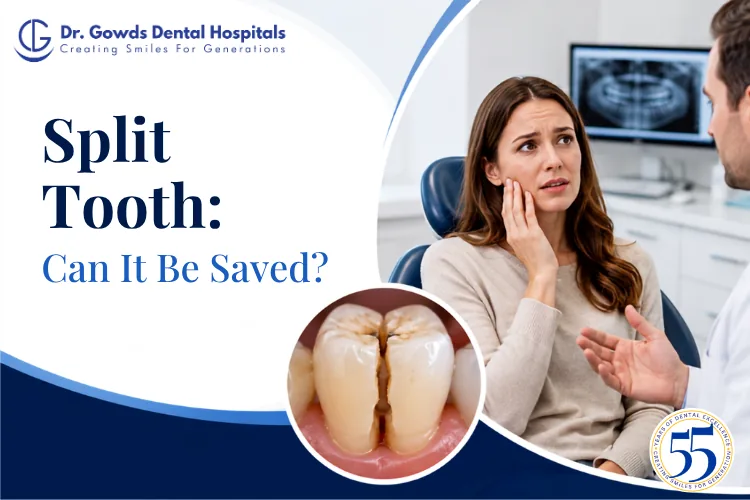
A tooth that suddenly hurts when you bite down may have several possible causes. Sometimes the problem is a cavity, loose filling, or sensitivity. In other cases, a deeper fracture may have developed within the tooth.
When a crack extends through a substantial portion of the tooth and separates it into distinct segments, it may be described as a split tooth.
A split tooth is more serious than a small crack in the enamel because the fracture can extend deeper into the tooth and sometimes toward the root. Whether the tooth can be saved depends largely on the location and extent of the fracture and how much healthy tooth structure remains.
The important question is therefore not simply whether a tooth is cracked, but where the crack is located and whether the tooth can be predictably restored.
At Dr. Gowds Dental Hospitals, a suspected split tooth can be evaluated through a clinical examination, bite assessment, and appropriate dental investigations to determine the condition of the tooth and the most suitable treatment approach.
A split tooth is a tooth in which a deep fracture has progressed far enough to separate the tooth into distinct portions.
The fracture may extend from the chewing surface toward the root.
Unlike a superficial enamel line, a split can affect deeper tooth structures and compromise the stability of the remaining tooth.
A split tooth can occur in:
The exact appearance varies depending on the direction and extent of the fracture.
No.
The terms can sometimes be used interchangeably in everyday conversation, but they describe different stages or patterns of tooth damage.
A cracked tooth may have a fracture that has not completely separated the tooth into segments.
A split tooth, on the other hand, has a fracture that has progressed to the point where the tooth is divided into separate portions.
This distinction is clinically important because treatment possibilities can be very different.
A tooth with a limited crack may sometimes be protected and restored.
A tooth that has become significantly split may have less predictable treatment options.
Yes, a tooth can develop a fracture that separates substantial portions of its structure.
However, “split in half” does not necessarily mean that the tooth has physically fallen into two completely separate pieces.
The fracture may run through part of the crown and continue toward the root, creating segments that move slightly under biting pressure.
A dentist needs to determine exactly how far the fracture extends.
A split tooth usually develops when a tooth has been subjected to forces or structural weakening that exceed its ability to withstand them.
Common contributing factors include:
A tooth with a large restoration may have less remaining natural tooth structure.
Over time, chewing forces can place stress on the remaining walls.
Extensive decay can weaken the internal structure of a tooth.
A tooth that has lost substantial structure may become more vulnerable to fracture.
Repeated excessive forces from grinding or clenching can place significant stress on teeth.
Over time, this may contribute to cracks or fractures.
Chewing on very hard foods or non-food objects can produce excessive forces.
Examples include:
Teeth that have undergone extensive restorative procedures may have reduced natural tooth structure.
This does not mean dental treatment itself causes a split tooth, but a heavily restored tooth may have different structural characteristics from an intact tooth.
A strong impact to the mouth can fracture a tooth.
Sports injuries, falls, accidents, and other trauma can damage tooth structure.
Symptoms can vary considerably.
Some people experience significant pain, while others have intermittent symptoms that are difficult to identify.
Possible symptoms include:
A split tooth does not always cause constant pain.
This is one reason some people delay dental evaluation.
When you bite down, pressure is transmitted through the tooth.
If a fracture has created separate segments, those portions may move slightly under pressure.
This movement can irritate the tissues inside the tooth or surrounding structures.
Some patients experience pain particularly when they release the bite rather than when they initially bite down.
This pattern can be an important clue during dental assessment, although it does not by itself confirm a split tooth.
A fractured tooth may not hurt continuously.
The symptoms can depend on:
This can create a frustrating pattern in which the tooth feels normal at certain times and suddenly hurts during chewing.
Intermittent pain should not automatically be dismissed simply because it disappears.
Sometimes, but not always.
The possibility of saving the tooth depends primarily on the location and extent of the fracture.
A dentist may consider:
A split tooth that can be separated into a healthy, stable portion and a non-restorable portion may sometimes have a tooth-preserving treatment option.
However, when the fracture compromises the entire tooth or extends in an unfavorable direction, extraction may be the more predictable option.
A crown can protect and restore certain damaged teeth, but a crown cannot automatically repair every split tooth.
A crown surrounds the remaining tooth structure and can help protect a tooth when enough healthy structure remains.
However, if the underlying tooth is divided by a deep fracture, simply placing a crown over it may not eliminate the problem.
The dentist first needs to determine whether the tooth is structurally suitable for restoration.
This is why a suspected split tooth should be examined before assuming that a crown will solve the problem.
Treatment depends entirely on whether the tooth or a portion of it can be predictably preserved.
If the fracture is limited and enough healthy tooth structure remains, restorative treatment may be possible.
The objective is to protect the remaining tooth and restore its function.
If the fracture has affected the pulp but the tooth remains structurally restorable, root canal treatment may be considered.
This removes infected or irreversibly inflamed pulp tissue from inside the tooth.
A suitable restoration is then required to protect the remaining tooth structure.
Root canal treatment is not a way to repair a fracture itself. It addresses problems involving the pulp when the tooth can otherwise be preserved.
In selected cases, if the tooth has separated into distinct portions and one part is healthy enough to retain, a dentist may consider a treatment designed to preserve the restorable portion.
The feasibility depends on the individual tooth and the location of the fracture.
If the tooth cannot be predictably restored, extraction may be recommended.
This can be necessary when the fracture extends extensively through the tooth or root and leaves insufficient healthy structure for long-term restoration.
Extraction is not necessarily the first choice.
It is considered when preserving the tooth would have an unfavorable prognosis.
A split tooth is more than a superficial crack. It occurs when a fracture progresses far enough to divide substantial portions of the tooth, potentially compromising its ability to function normally.
Whether a split tooth can be saved depends on the location and extent of the fracture and the amount of healthy tooth structure that remains.
Some damaged teeth can be restored, while others may require removal when the fracture makes long-term preservation unpredictable.
If you experience pain when biting, intermittent tooth sensitivity, or a recurring sensation that a particular tooth is not functioning normally, do not repeatedly test the tooth and wait for the symptoms to disappear.
An early dental examination can help determine whether the problem is a minor fracture or something more significant.
At Dr. Gowds Dental Hospitals, a suspected split tooth can be evaluated to determine the condition of the tooth and discuss the most appropriate treatment options based on its individual prognosis.
Visit us at-
Dr gowds dental hospital Nanakramguda
Dr gowds dental hospital Gachibowli
Dr gowds dental hospital madhapur
A split tooth is a tooth with a deep fracture that has progressed enough to separate the tooth into distinct portions or segments.
Sometimes. The possibility of saving the tooth depends on the location and extent of the fracture, the condition of the pulp and supporting tissues, and how much healthy tooth structure remains.
A split tooth may cause pain when biting or releasing a bite, sensitivity to hot or cold foods, intermittent toothache, or discomfort while chewing.
A deep fracture can divide substantial portions of a tooth. However, the tooth does not necessarily separate into two completely detached pieces.
A crown can protect certain damaged teeth, but it cannot repair every split tooth. The dentist must first determine whether sufficient healthy tooth structure remains and whether the fracture allows predictable restoration.
No. Extraction is generally considered when the tooth or the remaining portion cannot be predictably restored.
The fracture may become more extensive, and the tooth may develop increasing pain, pulp damage, or infection. Early evaluation can help determine whether the tooth can still be preserved.
 Gachibowli Branch