

Schedule Appointment


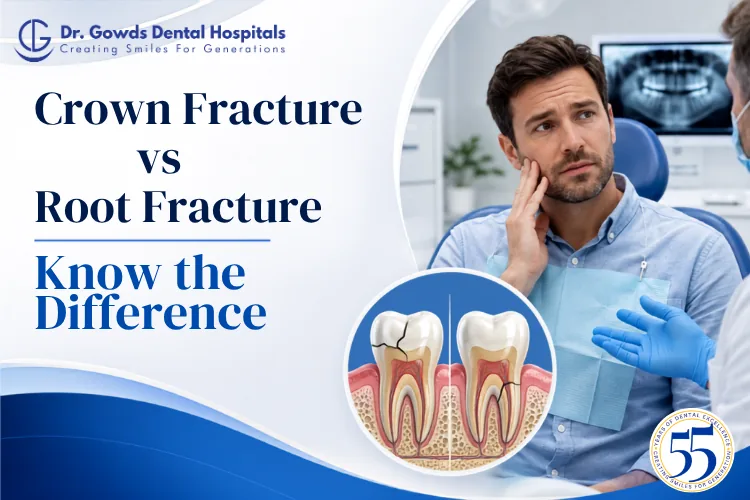
A tooth can fracture in different ways, and where the fracture occurs can significantly influence its symptoms, diagnosis, treatment, and prognosis.
A fracture involving the visible portion of the tooth is generally described as a crown fracture, while a fracture involving the root occurs below the gum line. Although both are forms of dental trauma or structural damage, they are not managed in exactly the same way.
A crown fracture may be immediately noticeable because a piece of the tooth has broken away. A root fracture can be more difficult to identify because the damaged area may be hidden beneath the gum.
Understanding the difference between a crown fracture vs root fracture can help you recognize why dental assessment is important after an injury, particularly when pain, sensitivity, tooth mobility, or changes in the bite develop.
At Dr. Gowds Dental Hospitals, a fractured tooth can be evaluated based on the location and extent of the fracture, the condition of the pulp and supporting tissues, and the amount of healthy tooth structure that remains.
A crown fracture occurs when a portion of the crown, the visible part of the tooth above the gum line, breaks.
The severity can vary considerably.
A small fracture may involve only the enamel, while a deeper fracture can extend through the dentin and potentially involve the pulp.
Depending on the extent of the injury, a crown fracture may appear as:
The treatment depends on how much of the tooth has been damaged.
A root fracture occurs within the root portion of the tooth, which is normally located below the gum line.
Because the root is not easily visible, a root fracture may not be obvious when you look in the mirror.
Root fractures can occur in different directions. A fracture may run across the root, or in some situations the fracture may have a more complex orientation.
The position of the fracture is important because it can influence:
The most important difference is where the tooth has fractured.
| Feature | Crown Fracture | Root Fracture |
| Location | Visible crown of the tooth | Root beneath the gum |
| Usually visible? | Often | Often not |
| Common symptoms | Chipping, sensitivity, pain | Tenderness, mobility, pain on biting |
| Diagnosis | Clinical examination and imaging when required | Clinical examination and dental imaging |
| Treatment | May include restoration, bonding, crown, or pulp treatment | Depends on location, stability, pulp condition, and extent |
| Prognosis | Often depends on depth of crown damage | Strongly influenced by fracture location and stability |
This comparison is useful, but individual fractures can behave differently. A dentist needs to examine the specific tooth before determining its prognosis.
A crown fracture can occur because of sudden trauma or weakening of the tooth.
Common causes include:
Children and adults can fracture teeth during falls, sports injuries, road accidents, or other impacts.
A direct blow to the mouth can damage the front teeth.
Very hard foods or objects can place excessive forces on weakened teeth.
Decay can remove significant amounts of tooth structure, making the remaining crown more vulnerable to fracture.
A heavily restored tooth may have less remaining natural structure to withstand certain forces.
Repeated clenching or grinding can place excessive forces on teeth over time.
Root fractures are often associated with trauma, although the exact cause can vary.
Possible factors include:
Root fractures can also occur in teeth that have undergone previous dental treatment, depending on the circumstances and remaining tooth structure.
Symptoms depend on how deep the fracture is.
A minor enamel fracture may cause little or no pain.
A deeper crown fracture can cause:
If the fracture reaches the pulp, symptoms may become more significant.
Root fracture symptoms can be less obvious.
Possible signs include:
Some root fractures may initially produce limited symptoms.
This is one reason dental evaluation after significant trauma can be important even when the tooth appears relatively normal.
The root is positioned below the gum, so a fracture cannot always be seen by simply looking at the tooth.
Additionally, a root fracture may not always appear clearly on an initial dental X-ray depending on the orientation of the fracture and the angle of the image.
The dentist may therefore consider several pieces of information, including:
Additional imaging may be considered when clinically appropriate
Treatment depends on the depth and size of the fracture.
A very small chip may only require smoothing or minor reshaping.
A chipped or fractured portion may sometimes be rebuilt using a tooth-coloured restorative material.
This can restore the tooth’s shape and function.
For selected minor to moderate crown fractures, bonding can restore missing tooth structure.
The suitability depends on the location and extent of the damage.
A more extensively damaged tooth may require a crown to protect the remaining structure.
However, a crown is appropriate only when sufficient healthy tooth structure remains.
If the fracture has exposed or significantly affected the pulp but the tooth remains restorable, root canal treatment may be considered.
Root canal treatment addresses the condition of the pulp; it does not physically repair a fracture.
Treatment for a root fracture depends heavily on the location and characteristics of the fracture.
Important factors include:
In selected cases, the tooth may be monitored and managed conservatively.
If the fractured portion remains stable and the tooth can be maintained, the dentist may recommend follow-up examinations.
More extensive or unfavorably positioned fractures may have a less predictable prognosis and could require removal of the affected portion or extraction, depending on the individual circumstances.
The consequences depend on the type and severity of the fracture.
A crown fracture can leave dentin exposed, increasing sensitivity and making the tooth more vulnerable to further damage.
A deeper fracture involving the pulp can result in inflammation or infection.
A root fracture may lead to mobility, localized inflammation, or other complications depending on the fracture pattern.
A damaged tooth may also become progressively weaker when exposed to continued chewing forces.
There is no universal answer.
A small enamel crown fracture may be relatively minor.
However, a crown fracture that extends into the pulp can be serious.
Likewise, some root fractures can be managed successfully, while others can significantly compromise the tooth.
The location, depth, direction, stability, pulp condition, and surrounding tissues are more important than simply labeling a fracture as a crown or root fracture.
Understanding crown fracture vs root fracture starts with recognizing that the location of the fracture matters.
A crown fracture affects the visible part of the tooth and may range from a small enamel chip to a deeper injury involving the pulp.
A root fracture occurs below the gum and can be more difficult to detect. Its prognosis depends on factors such as the location of the fracture, stability of the tooth, pulp condition, and surrounding tissues.
Neither type of fracture should be evaluated solely by how much pain it causes. A tooth can have a significant structural injury with relatively mild symptoms.
If you have experienced dental trauma, notice a broken tooth, or develop unexplained pain when biting, professional evaluation can help identify the problem and determine whether the tooth can be preserved.
At Dr. Gowds Dental Hospitals, a detailed examination can help distinguish the type of fracture and guide an appropriate treatment plan.
Visit us at-
Dr gowds dental hospital Nanakramguda
Dr gowds dental hospital Gachibowli
Dr gowds dental hospital madhapur
A crown fracture affects the visible part of the tooth above the gum, while a root fracture occurs within the root below the gum line.
Neither is automatically more serious. Severity depends on the depth, location, extent, pulp involvement, tooth stability, and surrounding tissue condition.
Symptoms can include a visible chip, sensitivity, pain when biting, sensitivity to temperature, and irritation from a sharp tooth edge.
Root fractures may cause pain when biting, tooth mobility, localized tenderness, gum changes, or sensitivity. Some can have limited symptoms initially.
Many crown fractures can be restored, depending on how much healthy tooth structure remains and whether the pulp is affected.
Some root fractures can be managed and monitored, particularly when the tooth remains stable and the fracture has favorable characteristics. The prognosis varies by case.
No. Extraction is not automatically required. Treatment depends on the fracture’s location, stability, pulp condition, surrounding tissues, and overall prognosis.
Yes. Deeper fractures can compromise the pulp or create conditions that allow infection to develop.


 Gachibowli Branch