

Schedule Appointment


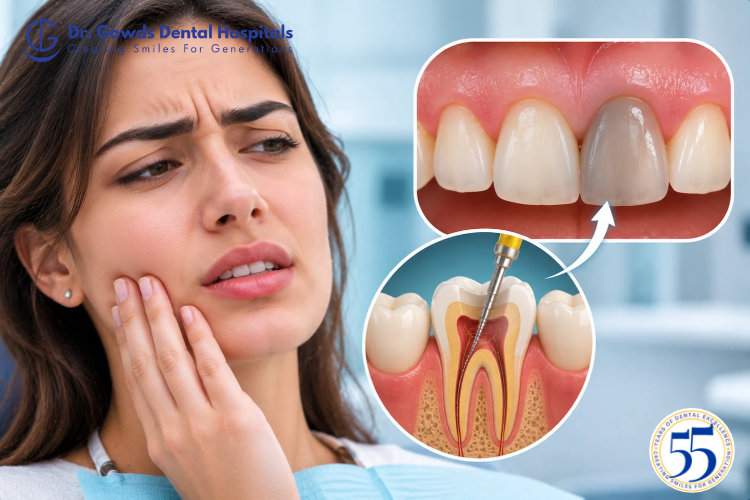
A tooth that looks darker after root canal treatment can be surprising, especially when the tooth was treated to preserve it. A dark tooth after root canal may be related to changes within the tooth, previous damage, or materials associated with earlier treatment. The important point is that the right cosmetic option depends on why the tooth changed colour and what condition the tooth and restoration are in.
At Dr Gowds Dental Hospitals, Hyderabad, a dental evaluation can help identify the likely reason for the colour change and discuss suitable options for improving the appearance.
A tooth can become grey, brown, yellowish, or darker after root canal treatment. The change may not happen immediately. In some cases, it becomes more noticeable over time.
Root canal treatment involves cleaning the internal space of the tooth. Changes within this space can sometimes affect the way the tooth looks from the outside.
This is one reason a tooth that once matched the surrounding teeth may later appear different in colour.
A tooth that needed a root canal may have had decay, an injury, or another form of damage before treatment.
Previous changes within the tooth can contribute to later discolouration, which means the colour change is not necessarily caused by the root canal procedure alone.
Materials used during earlier dental treatment can sometimes be associated with a change in the visible shade of a tooth.
The exact reason cannot be confirmed simply by looking at the tooth. A dental examination can help determine what may be contributing to the darker appearance.
The tooth itself may not be the only reason for a darker appearance. An older filling, crown, or other restoration can also affect how the tooth looks compared with neighbouring teeth.
If the restoration and natural tooth no longer match in shade, the difference may become more noticeable when you smile.
A darker colour does not, by itself, explain what is happening inside the tooth. Some people notice only a cosmetic difference, while others may have an issue with the tooth, filling, or restoration that needs assessment.
If the colour change is new or accompanied by pain, swelling, tenderness, a damaged filling, or another unusual change, it is worth arranging a dental examination rather than assuming that whitening is the only answer.
In many situations, a tooth that has darkened after root canal treatment can be considered for cosmetic colour improvement.
The method depends on the tooth’s condition, the depth and type of discolouration, the existing restoration, and the shade you want to achieve.
For some root canal-treated teeth, a dentist may discuss internal whitening, also called internal bleaching.
This approach focuses on the inside of the discoloured tooth rather than treating all teeth in the mouth. Whether it is suitable needs to be decided after examining the tooth and reviewing its existing treatment.
Regular external whitening is designed to lighten the visible surfaces of teeth.
It may be discussed when the surrounding teeth also need shade improvement, but it may not address deeper internal discolouration in a root canal-treated tooth.
This is why a dark root canal tooth may require a different approach from ordinary teeth whitening.
If whitening is not suitable or does not provide the desired appearance, a tooth-coloured restoration may be considered.
Depending on the tooth and its structure, options can include bonding, a veneer, or a crown.
A crown should not be chosen simply because a tooth is dark. The dentist should first assess whether that type of restoration is appropriate for the tooth.
Before choosing a whitening or cosmetic treatment, a dentist may look at several factors.
Is the entire tooth darker, or is the colour change limited to one area? Is it grey, brown, yellowish, or another shade?
These details can help guide the discussion about possible treatment options.
The visible tooth structure and existing restoration need to be considered.
If there is a filling or crown, its condition and appearance may also influence which cosmetic approach is discussed.
The shade of nearby teeth provides a useful reference when discussing the final appearance.
A treatment designed to make the tooth blend with the surrounding smile may be more suitable than simply trying to make one tooth as white as possible.
Some people want the tooth to blend into their smile, while others may be considering a wider smile-whitening treatment.
Discussing the desired result with your dentist can help determine the most appropriate approach.
The exact process varies from person to person.
A dentist may first confirm that the tooth is suitable for the selected cosmetic approach and then plan the treatment based on the tooth’s shade and condition.
After the colour improves, the tooth may be reviewed again to see how well it blends with neighbouring teeth. If the shade is still different, another cosmetic option may be discussed.
The aim is not simply to make one tooth white. It is to create a natural-looking match with the rest of the smile.
If one tooth looks noticeably darker after a root canal, do not choose a whitening product based only on the tooth’s colour. Speak with a dentist at Dr Gowds Dental Hospitals to understand which option fits your tooth and your cosmetic goal.
It is better not to experiment with DIY whitening methods on a root canal-treated tooth.
Home remedies, abrasive products, acids, or attempts to place whitening substances inside the tooth can cause unnecessary damage.
Internal whitening is a dental procedure and should not be attempted at home.
If you already use a home whitening product for your other teeth, ask your dentist whether it is appropriate for the treated tooth as well.
Consider a dental consultation if:
A consultation can help distinguish a cosmetic concern from a dental issue that may need attention.
Good daily oral care remains important for the treated tooth and the surrounding teeth.
Regular dental check-ups can also help identify changes in fillings, crowns, or other restorations.
If you are considering professional whitening, discuss the colour of the root canal-treated tooth before starting. Treating all teeth in the same way may not produce the same shade change in every tooth.
The most suitable approach depends on the individual tooth, the surrounding smile, and the type of restoration already present.
A dark tooth can have more than one possible cause, so treatment should begin with an examination rather than a one-size-fits-all whitening solution.
At Dr Gowds Dental Hospitals, the dental team can assess the tooth, review its existing treatment and restoration, and discuss cosmetic options based on your needs.
With branches in Nanakramguda, Gachibowli, Madhapur, koti, you can choose the Hyderabad location that is most convenient for you.
Noticed a dark tooth after root canal treatment? Book a consultation at Dr Gowds Dental Hospitals in Hyderabad and discuss the right option for a more even-looking smile.
A tooth may sometimes become darker following root canal treatment. The reason can vary, so a dental examination is useful when the colour change becomes noticeable.
A root canal-treated tooth may be considered for whitening, depending on its condition and the reason for the discolouration. Internal whitening is one option a dentist may discuss.
A grey appearance can be associated with changes within a previously treated tooth or earlier damage. The exact reason cannot be determined from colour alone.
Regular external whitening may not address deeper internal discolouration in a root canal-treated tooth. A dentist can discuss whether internal whitening or another cosmetic option is more suitable.
Internal bleaching is a cosmetic whitening approach that focuses on the inside of a discoloured root canal-treated tooth. Its suitability depends on the individual tooth.
A crown may be considered in some situations, but a dark colour alone does not automatically mean a crown is needed. The tooth’s structure and existing restoration should be assessed first.
A colour change may be purely cosmetic, but new or changing discolouration, particularly when accompanied by other symptoms, is worth discussing with a dentist.
 Gachibowli Branch