

Schedule Appointment

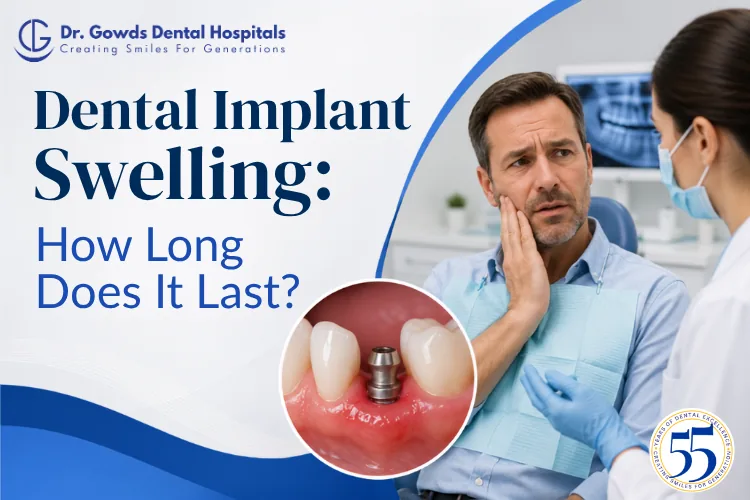
Swelling is one of the common concerns patients have after dental implant surgery. Seeing a swollen cheek or feeling tenderness around the surgical area can understandably make patients wonder whether something has gone wrong.
In many cases, dental implant swelling is a normal part of the body’s healing response after surgery. The amount and duration of swelling can vary depending on the complexity of the procedure, the number of implants placed, the location of surgery, and the individual’s healing response.
Swelling does not necessarily mean that an implant is failing or that an infection has developed.
However, knowing what is expected during implant recovery and recognizing signs that require professional attention can make the healing period easier to manage.
At Dr. Gowds Dental Hospitals, patients undergoing implant treatment receive postoperative guidance based on the specific procedure performed and their individual healing needs.
Dental implant placement involves surgery involving the gum and, in some cases, the underlying bone.
The body’s natural response to surgical injury includes inflammation.
Inflammation helps initiate the healing process by increasing blood flow and bringing immune cells and other healing components to the affected area.
As a result, patients may experience:
The swelling may be more noticeable externally around the cheek or jaw depending on where the implant was placed.
For many patients, swelling is most noticeable during the first few days after surgery.
It may increase during the initial postoperative period before gradually reducing.
A typical pattern can be:
Mild swelling may begin developing after the procedure.
Some patients may initially notice little swelling immediately after surgery.
Swelling can become more noticeable during this period.
This does not necessarily indicate a complication.
The swelling should gradually begin to decrease.
Bruising, if present, may take longer to disappear.
Most routine postoperative swelling continues improving as the tissues heal.
The exact duration varies from person to person.
The important point is the direction of change: swelling should generally begin improving rather than continuing to become progressively worse.
Yes.
Some degree of swelling can be expected after implant surgery.
However, the amount of swelling differs considerably between patients.
A straightforward implant procedure involving a single tooth may produce relatively limited swelling, while more extensive procedures can result in more noticeable postoperative inflammation.
Swelling may be greater when treatment involves:
Therefore, comparing your swelling with another patient’s recovery is not always useful.
Several factors can influence the severity and duration of swelling.
More extensive surgery generally produces a greater inflammatory response.
Multiple implant placements may involve more surgical sites than a single implant.
If bone augmentation is performed at the same time, additional tissue manipulation can contribute to postoperative swelling.
The area being treated can influence how swelling appears externally.
People heal differently.
Two patients undergoing similar procedures may experience different levels of swelling.
Following the dentist’s instructions can support a smoother recovery.
Not necessarily.
Swelling immediately following surgery is usually a response to the procedure itself and does not automatically indicate implant failure.
Implant success cannot be determined simply by looking at the amount of swelling.
The dentist evaluates other factors, including:
A patient should therefore avoid assuming that swelling means the implant has failed.
Normal postoperative swelling generally follows a pattern of developing after surgery and gradually improving.
It may be accompanied by:
The exact experience depends on the procedure.
Following the postoperative instructions provided by your dental team is important because your dentist knows the details of the surgery you underwent.
Swelling should be evaluated if it does not follow the expected healing pattern or is accompanied by concerning symptoms.
Contact your dentist if you notice:
Difficulty breathing or severe difficulty swallowing requires urgent medical attention.
Yes.
Although postoperative inflammation is common, infection can also cause swelling.
Signs that may raise concern for infection include:
These symptoms should not be ignored.
The presence of swelling alone does not establish that an infection is present. A dentist needs to evaluate the area to determine the cause.
Your dentist will provide postoperative instructions based on the procedure.
Several general measures may help support recovery.
A cold compress can help reduce discomfort and swelling during the early postoperative period.
Place it against the outside of the cheek rather than directly against the surgical area.
Use it according to the instructions provided by your dental team.
Allow your body time to recover.
Avoid unnecessary physical exertion immediately after surgery unless your dental team advises otherwise.
Keeping your head slightly elevated while resting may help reduce discomfort and swelling.
If your dentist has prescribed medication, take it exactly as instructed.
Do not alter prescribed medication or take additional medicines without appropriate medical or dental advice.
Keeping the mouth clean is important during healing.
However, the surgical site may need to be treated differently from the rest of the mouth.
Follow your dentist’s specific instructions regarding brushing, rinsing, and cleaning around the implant.
The swelling generally occurs in the surrounding soft tissues rather than meaning that the implant itself has swollen.
The implant is a solid structure placed into the jawbone.
The tissues around the surgical area respond to the procedure with inflammation, which produces the visible swelling.
As healing progresses, this inflammatory response should settle.
Contact your dental team if:
Do not wait for symptoms to become severe before contacting your dentist.
Dental implant swelling is a common part of the body’s response to surgery. It may become more noticeable during the first few days before gradually improving.
The amount of swelling depends on factors such as the extent of surgery, number of implants, bone grafting, treatment location, and individual healing response.
What matters most is the overall recovery pattern.
Swelling that gradually improves is generally less concerning than swelling that continues to increase or occurs alongside severe pain, fever, pus, or other signs of infection.
Remember that the disappearance of swelling does not mean the implant has completely healed. The implant still needs time to integrate with the surrounding bone before the final restoration process is completed.
If you are concerned about swelling after dental implant surgery, contact your dental team rather than trying to diagnose the problem yourself.
At Dr. Gowds Dental Hospitals, patients can receive individualized guidance throughout the implant recovery process.
Visit us at-
Dr gowds dental hospital Nanakramguda
Dr gowds dental hospital Gachibowli
Dr gowds dental hospital madhapur
Swelling is commonly most noticeable during the first few days after surgery and should gradually decrease afterward. The exact duration varies depending on the procedure and individual healing response.
Yes. Some swelling is a normal inflammatory response to surgery. The amount varies between patients and procedures.
Swelling should be evaluated if it continues to increase, becomes associated with severe pain, fever, pus, significant redness, or other unusual symptoms.
No. Postoperative swelling alone does not indicate implant failure. Implant success is evaluated through clinical examination and, when appropriate, imaging and follow-up.
Following your dentist’s postoperative instructions, using a cold compress when recommended, resting, keeping your head elevated, taking prescribed medication correctly, and maintaining appropriate oral hygiene can support recovery.
Recovery occurs in stages. Soft tissues begin healing relatively quickly, while the implant requires additional time to integrate with the surrounding jawbone.
 Gachibowli Branch