

Schedule Appointment


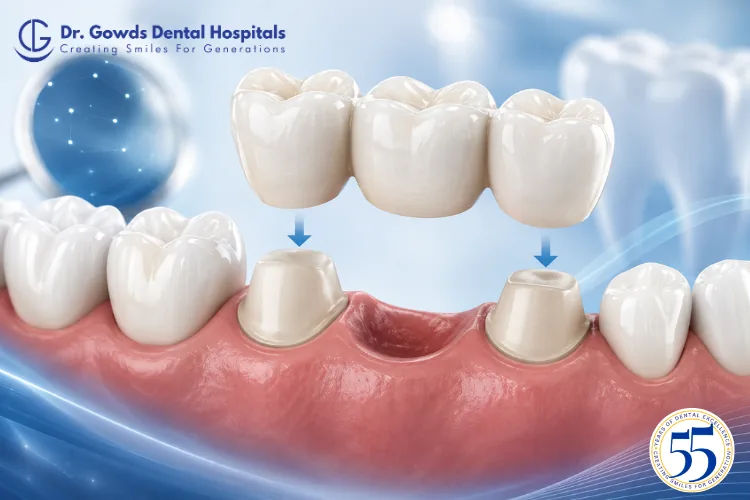
Losing a tooth can affect more than the appearance of your smile. A missing tooth may change the way you chew, influence the movement of neighboring teeth, and create a gap that can make everyday oral hygiene more difficult.
A dental bridge is one option dentists use to replace a missing tooth or several missing teeth. Unlike a removable denture, a conventional bridge is fixed in place and supported by adjacent teeth or, in some cases, dental implants.
But a dental bridge is not automatically suitable for everyone.
The health and strength of the teeth or implants supporting the bridge, the location of the missing tooth, the condition of the gums, the bite, and the amount of available space all need to be considered.
At Dr. Gowds Dental Hospitals, dental bridge treatment can be planned after assessing the missing tooth and the surrounding oral structures to determine whether a bridge is an appropriate replacement option.
A dental bridge is a fixed dental restoration designed to replace one or more missing teeth.
It typically consists of:
The replacement tooth fills the gap left by the missing natural tooth.
Depending on the type of bridge, it may be supported by natural teeth on one or both sides of the gap or by dental implants.
The bridge is designed to restore the appearance and function of the missing tooth while remaining fixed rather than being removed by the patient during normal use.
Imagine a missing tooth between two healthy teeth.
A traditional bridge can use the teeth on either side of the gap as supporting teeth. These teeth are prepared to receive crowns, which are connected to the replacement tooth.
The resulting restoration spans the space and replaces the missing tooth.
The exact design depends on:
A dentist selects the design that provides appropriate support while preserving as much healthy tooth structure as possible.
A dental bridge may be considered for patients who have:
However, having a missing tooth does not automatically mean a bridge is the best option.
A dentist needs to evaluate the surrounding teeth and oral tissues before recommending treatment.
Replacing a missing tooth can help restore several aspects of oral function.
A dental bridge may help:
A missing tooth can make chewing less comfortable or efficient.
Replacing the tooth can help restore the chewing surface.
A bridge can fill a visible gap and provide a more complete-looking smile.
Teeth contribute to the positioning of the tongue and airflow during speech. Depending on the location of the missing tooth, replacement may help restore normal oral function.
When a tooth is missing, neighboring teeth may shift into the empty space.
Replacing the missing tooth can help maintain the dental arch.
Several types of bridges are available.
The most suitable option depends on the location of the missing tooth and the condition of the surrounding structures.
A traditional bridge uses crowns placed over supporting teeth on either side of the missing tooth.
The replacement tooth is connected between these supporting crowns.
This type is commonly considered when suitable natural teeth are present on both sides of the gap.
A cantilever bridge is supported from only one side.
It may be considered in selected situations where there is only one suitable supporting tooth.
However, the location of the missing tooth and the forces placed on the restoration are important considerations.
Cantilever bridges are not appropriate for every part of the mouth.
A Maryland bridge uses a replacement tooth supported by a framework or wings attached to the back surfaces of neighboring teeth.
Unlike a traditional bridge, the adjacent teeth generally do not require the same type of extensive preparation for crowns.
Maryland bridges may be considered for certain missing front teeth.
Their suitability depends on factors such as bite, tooth position, and available support.
An implant-supported bridge uses dental implants rather than natural teeth as its primary support.
This can be useful when several adjacent teeth are missing.
The implants provide support for the bridge without requiring neighboring natural teeth to serve as bridge abutments.
Implant-supported bridges require appropriate bone, gum health, and overall suitability for implant treatment.
Both treatments can replace missing teeth, but they work differently.
A dental bridge replaces the visible tooth portion and is supported by adjacent teeth or implants.
A dental implant replaces the tooth root with an implant placed into the jawbone and is then restored with a crown or another prosthetic restoration.
A bridge may be suitable when:
An implant may be considered when:
There is no universally better option. The appropriate choice depends on the individual dental situation.
The dentist may evaluate several factors before recommending a bridge.
For a traditional bridge, the supporting teeth need to have sufficient strength and structural integrity.
Gum disease can compromise the tissues around supporting teeth.
Active gum problems may need to be addressed before bridge treatment.
The space created by the missing tooth must be appropriate for the planned restoration.
The way the upper and lower teeth meet can affect the forces placed on the bridge.
Cavities, infections, or other untreated dental problems may need to be managed before the bridge is placed.
The exact process varies according to the type of bridge.
For a traditional bridge, the process may include several stages.
The dentist examines the missing tooth area and surrounding teeth.
X-rays or other imaging may be recommended when necessary.
The dentist determines:
For a traditional bridge, the supporting teeth may be reshaped to create space for the crowns.
Local anesthesia can be used when required.
The dentist records the shape of the prepared teeth and surrounding tissues.
Depending on the clinic and treatment approach, this may be done using conventional impressions or digital scanning.
A temporary restoration may be placed while the permanent bridge is being prepared.
It protects the prepared area and allows the patient to function during the laboratory stage.
The final bridge is checked for:
Once the dentist is satisfied with the restoration, it is securely fixed in place.
The procedure itself is generally performed with appropriate local anesthesia when tooth preparation is required.
Some patients may experience temporary sensitivity or gum tenderness afterward.
The level of discomfort depends on:
If discomfort is severe or persists, the dentist should be contacted.
A dental bridge is designed to be a long-term restoration, but its lifespan varies between patients.
Factors that influence longevity include:
A bridge does not make the supporting teeth immune to cavities or gum disease.
The natural teeth underneath and around the bridge still require careful maintenance.
A well-planned bridge is designed to function with its supporting teeth.
However, preparing natural teeth for a traditional bridge involves removing some tooth structure.
The supporting teeth can also develop problems later if they are exposed to decay, gum disease, fracture, or excessive forces.
This is one reason the condition of the abutment teeth must be carefully assessed before treatment.
A dental bridge is fixed, but that does not mean it will last forever.
The bridge and the supporting teeth need ongoing maintenance.
Over time, a bridge may require repair or replacement due to:
Regular dental examinations can help identify problems early.
A dental bridge can offer several advantages when appropriately selected.
Unlike a removable denture, a conventional bridge stays in place.
It can fill a visible gap and improve smile continuity.
The replacement tooth restores part of the missing chewing surface.
Replacing a missing tooth can help reduce unwanted movement into the gap.
Depending on the type, bridge treatment may not require the same surgical process associated with dental implant placement.
A dental bridge can be an effective fixed option for replacing missing teeth when the surrounding conditions are suitable.
The success of a bridge depends on more than simply filling the empty space. The health and strength of supporting teeth, gum condition, bite, bridge design, and daily oral hygiene all play important roles.
Traditional bridges rely on natural teeth for support, while implant-supported bridges use dental implants. Other designs, such as cantilever and Maryland bridges, may be appropriate in selected cases.
If you have a missing tooth, a dental consultation can help you understand whether a bridge is suitable for your situation or whether another replacement option may be more appropriate.
At Dr. Gowds Dental Hospitals, individualized evaluation and treatment planning can help determine the right approach for restoring a missing tooth and maintaining your oral health.
Visit us at-
Dr gowds dental hospital Nanakramguda
Dr gowds dental hospital Gachibowli
Dr gowds dental hospital madhapur
A dental bridge is a fixed dental restoration used to replace one or more missing teeth. It is supported by natural teeth or dental implants, depending on the bridge design.
A dental bridge is designed for long-term use, but its lifespan varies. Oral hygiene, supporting tooth health, gum condition, bite forces, and regular dental care all influence how long it remains functional.
Neither is universally better. A bridge and implant use different treatment approaches. The appropriate choice depends on the condition of the neighboring teeth, bone, gums, bite, and the patient’s individual needs.
Yes. A single missing tooth can often be replaced with a suitable bridge when adequate supporting structures are available.
Once you have adapted to the restoration, you can generally eat normally. However, extremely hard or sticky foods may place unnecessary stress on the bridge.
A dental bridge is fixed rather than removable by the patient, but it is not necessarily permanent for life. It can require maintenance, repair, or replacement over time.
 Gachibowli Branch