

Schedule Appointment


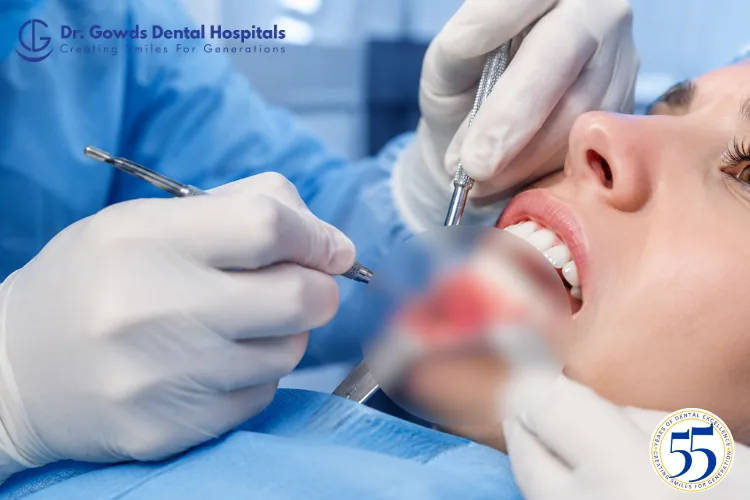
When gum disease progresses beyond the early stages, bacteria and hardened deposits can accumulate deep below the gum line. At this stage, routine brushing and conventional dental cleaning may not be enough to access and clean all affected areas.
Dental flap surgery, also known as periodontal flap surgery, is a procedure used to provide direct access to deeper areas around the teeth. During the procedure, the gum tissue is carefully lifted so the dentist or periodontist can access the tooth roots and surrounding tissues, remove deposits and diseased tissue, and address periodontal pockets.
Flap surgery is not usually the first treatment for gum disease. In many cases, dentists initially recommend professional cleaning, improved oral hygiene, and scaling and root planing. Surgery may be considered when deeper periodontal pockets or persistent disease cannot be adequately managed with non-surgical treatment.
At Dr. Gowds Dental Hospitals, periodontal treatment is planned according to the severity of gum disease, pocket depth, gum and bone condition, and the patient’s overall oral health.
Dental flap surgery is a type of periodontal surgery used to treat certain forms of gum disease.
The procedure involves carefully lifting a section of gum tissue away from the tooth and underlying structures.
This creates access to areas that may be difficult to reach with conventional instruments.
Once the area is accessible, the dental professional can:
After treatment, the gum tissue is repositioned and secured with sutures.
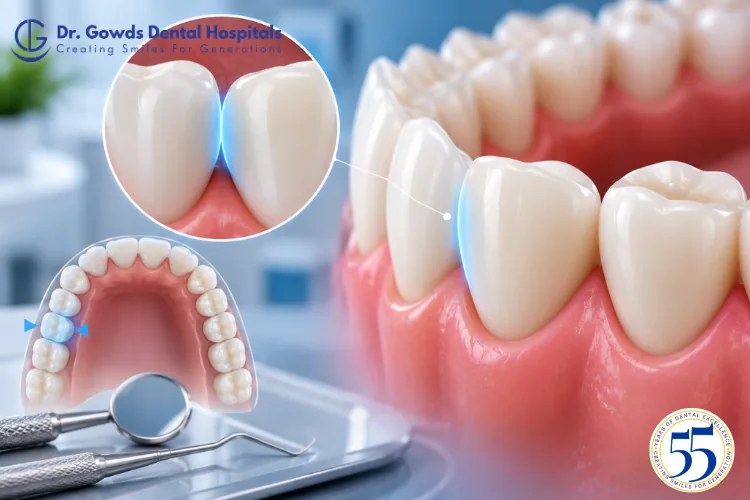
Healthy gums fit closely around the teeth.
With periodontal disease, bacterial plaque can trigger inflammation and gradually cause the gum tissue to pull away from the tooth.
This can create periodontal pockets.
As gum disease progresses, these pockets can become deeper, making it increasingly difficult to clean the affected areas thoroughly.
Bacteria and calculus can remain beneath the gum line, continuing to contribute to inflammation and tissue destruction.
When non-surgical treatment cannot adequately control the disease in certain areas, flap surgery may be considered.
Usually, no.
Treatment for gum disease is generally based on its severity.
Early gum disease may often be managed through:
For more advanced periodontal disease, scaling and root planing may be recommended.
If deep periodontal pockets or persistent disease remain after appropriate non-surgical treatment, periodontal surgery may be considered.
Therefore, flap surgery is generally part of a broader periodontal treatment plan rather than an automatic first-line procedure.
Routine dental cleaning removes plaque and calculus from surfaces that can be accessed without surgically lifting the gums.
It is commonly used to maintain oral health and manage early gum problems.
Flap surgery is different because the gum tissue is temporarily lifted to provide direct access to deeper areas.
| Routine Cleaning | Dental Flap Surgery |
| Non-surgical | Surgical procedure |
| Removes accessible plaque and calculus | Provides access to deeper periodontal areas |
| Used for preventive care and early gum problems | May be used for persistent or advanced periodontal disease |
| Does not involve lifting gum tissue | Gum tissue is temporarily lifted |
| Usually requires minimal recovery | Requires postoperative healing |
Scaling and root planing is a non-surgical periodontal treatment.
During scaling and root planing, dental professionals clean plaque and calculus from above and below the gum line using specialized instruments.
The roots may also be carefully cleaned to remove bacterial deposits.
Flap surgery differs because the gum tissue is lifted, allowing direct visualization and access to deeper areas.
A dentist may recommend one or both approaches depending on how the gums respond to treatment.
A dentist or periodontist may consider flap surgery when periodontal disease remains difficult to control despite appropriate non-surgical treatment.
Possible indications include:
The decision is based on a clinical examination rather than simply the presence of bleeding gums.
The exact procedure depends on the patient’s condition and the area being treated.
A typical periodontal flap procedure may involve several stages.
The dentist assesses:
Dental X-rays or other imaging may be used to evaluate supporting bone.
Local anesthesia is administered to numb the treatment area.
This helps make the surgical procedure more comfortable.
The dentist makes carefully planned incisions in the gum tissue around the affected teeth.
The purpose is to gain access to the areas requiring treatment while preserving as much healthy tissue as possible.
The gum tissue is gently lifted away from the tooth.
This provides access to the tooth roots and deeper periodontal areas.
Plaque and calculus are removed from the exposed tooth surfaces.
Inflamed or unhealthy tissue may also be treated as clinically appropriate.
The root surfaces may be carefully cleaned and smoothed.
Depending on the individual case, additional periodontal procedures may sometimes be performed.
For example, certain bone defects may be considered for regenerative procedures when clinically appropriate.
Not every patient undergoing flap surgery requires additional procedures.
Once the area has been cleaned and treated, the gum tissue is repositioned.
Sutures may be used to secure the tissue during healing.
The procedure is performed under local anesthesia, so the treatment area is numbed during surgery.
Patients may experience some soreness, tenderness, or sensitivity after the anesthesia wears off.
The level of postoperative discomfort varies depending on:
Your dental team can provide specific instructions for managing postoperative discomfort.
There is no single recovery period that applies to every patient.
Soft tissues begin healing after surgery, but complete periodontal healing takes longer.
Factors that can influence recovery include:
Your dentist can provide a more specific expectation based on your procedure.
No.
Although both involve gum tissue, they are different procedures.
Periodontal flap surgery involves temporarily lifting gum tissue to access deeper periodontal structures.
Gingivectomy involves removing a portion of gum tissue.
The procedures may have different indications and treatment goals.
A dentist selects the appropriate procedure based on the underlying dental or periodontal condition.
Dental flap surgery is a periodontal procedure used to access and treat areas beneath the gum line that may be difficult to manage with non-surgical treatment alone.
It is generally not the first treatment for gum disease. Depending on the severity of the condition, dentists may initially recommend professional cleaning, improved oral hygiene, or scaling and root planing.
When deep periodontal pockets or persistent disease remain, flap surgery can provide direct access to the affected areas. The procedure may allow thorough removal of deposits and treatment of diseased tissues, while selected cases may also benefit from additional periodontal procedures.
Recovery involves protecting the surgical area, maintaining appropriate oral hygiene, following dietary and medication instructions, and attending follow-up appointments.
Most importantly, successful periodontal treatment requires long-term maintenance. Flap surgery can help control active periodontal disease, but daily plaque control and regular professional care remain essential for protecting the gums and supporting teeth.
If you have persistent bleeding gums, deep periodontal pockets, gum recession, or loose teeth, a periodontal evaluation can help determine whether non-surgical or surgical treatment is appropriate.
Visit us at-
Dr gowds dental hospital Nanakramguda
Dr gowds dental hospital Gachibowli
Dr gowds dental hospital madhapur
Dental flap surgery is a periodontal procedure in which gum tissue is temporarily lifted to provide access to deeper areas around the teeth. This allows the dentist or periodontist to clean and treat areas affected by periodontal disease.
No. Many cases of gum disease can be managed with professional cleaning, improved oral hygiene, and non-surgical periodontal treatment. Flap surgery may be considered when deeper disease persists despite appropriate non-surgical care.
The procedure is performed under local anesthesia. Some soreness, tenderness, or sensitivity may occur after the anesthesia wears off.
Healing varies according to the extent of surgery and the individual patient. The soft tissues begin healing after the procedure, while complete periodontal healing takes longer.
Flap surgery can help control periodontal disease in appropriately selected areas, but ongoing oral hygiene and professional periodontal maintenance are still necessary.
Gum recession may become more noticeable after periodontal treatment as inflamed gum tissue heals. Your dentist can explain the expected changes based on your individual condition.

 Gachibowli Branch