

Schedule Appointment


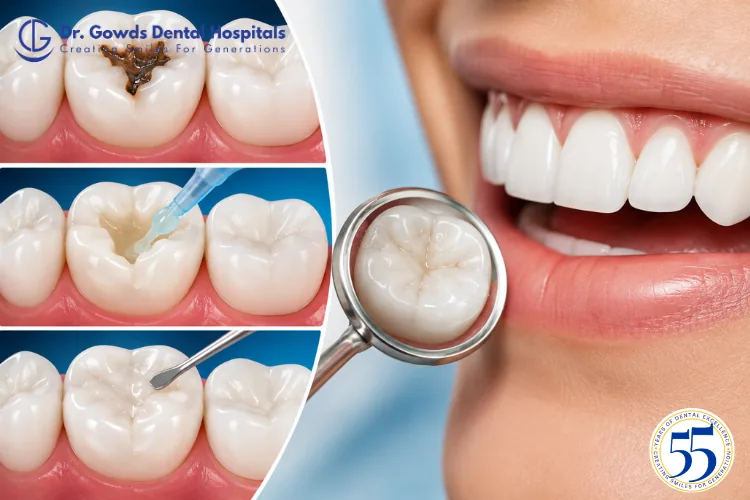
A cavity does more than create a hole in a tooth. If decay continues to progress, it can weaken the tooth structure and eventually lead to pain, infection, or the need for more extensive dental treatment.
A composite tooth filling is one of the commonly used ways to restore a tooth affected by decay or certain types of minor damage. Made from a tooth-colored composite resin, it can be shaped and bonded to the tooth to restore its form while blending with the surrounding enamel.
The appeal of composite fillings is not limited to their appearance. The material can be bonded to the tooth, allowing the dentist to restore the damaged area while preserving healthy tooth structure where clinically possible.
However, composite fillings are not the right solution for every damaged tooth. The size and location of the restoration, remaining tooth structure, bite forces, oral hygiene, and overall condition of the tooth all influence the choice of treatment.
At Dr. Gowds Dental Hospitals, composite restoration is planned according to the condition of the individual tooth rather than treating every cavity in the same way.
A composite tooth filling is a restoration made from composite resin, a tooth-colored dental material.
It can be used to restore teeth affected by:
The dentist removes the damaged or decayed portion when necessary and places the composite material into the prepared area.
The material is then shaped to recreate the tooth’s anatomy and hardened using a dental curing light.
The final restoration is adjusted so that it works comfortably with the patient’s bite.
Composite resin can be matched to the natural shade of the tooth.
Natural teeth are not simply one uniform white color. Their appearance can vary depending on enamel thickness, dentin color, lighting, and individual tooth characteristics.
During a composite restoration, the dentist can select a suitable shade and shape the material to blend with the surrounding tooth structure.
This makes composite fillings particularly useful when appearance is an important consideration, especially for visible teeth.
One of the major differences is the appearance.
Traditional amalgam fillings have a metallic or silver-colored appearance, while composite restorations are designed to resemble natural tooth structure.
Composite fillings also use an adhesive bonding technique.
Instead of simply placing filling material into a prepared cavity, the tooth is treated with bonding materials that help the composite adhere to the tooth.
This allows the restoration to become closely integrated with the prepared tooth surface.
A dentist may recommend a composite filling when a tooth has a localized area of damage that can be predictably restored with resin.
Common situations include:
Composite resin can be used to restore many cavities, particularly when sufficient healthy tooth structure remains.
A minor chip may sometimes be repaired using composite material.
In selected cases, composite can restore areas affected by localized wear.
Composite may sometimes be used to make minor changes to tooth shape.
The appropriate treatment depends on the amount of tooth structure involved.
Yes.
Composite fillings can be used to restore many teeth affected by dental decay.
The dentist first evaluates how extensive the decay is.
If the cavity is suitable for a filling, the damaged tooth structure is removed and the resulting area is restored with composite resin.
However, a very deep cavity may require a different treatment if the decay has affected the pulp or significantly weakened the tooth.
A filling is therefore not automatically appropriate for every cavity.
They can be useful for certain small chips.
For example, if a small portion of an otherwise healthy front tooth has fractured, composite resin may sometimes be bonded to the remaining tooth and shaped to restore its appearance.
The dentist must first determine:
If a tooth has a major structural fracture, a filling may not provide sufficient protection.
The procedure itself is generally performed with local anesthesia when needed.
You may feel pressure or vibration during treatment, but the area should be adequately numbed.
After treatment, some patients experience temporary sensitivity.
If the tooth remains significantly painful or sensitive, particularly when biting, it should be evaluated by the dentist.
Temporary sensitivity can occur after a filling.
This may be related to:
Mild sensitivity may settle as the tooth recovers.
However, persistent, worsening, or severe sensitivity should not simply be ignored.
It may indicate that the tooth needs further evaluation.
The treatment time depends on:
A small restoration may be completed relatively quickly, while a larger or more complex restoration can require more time.
Your dentist can provide a more accurate estimate after examining the tooth.
Composite fillings are designed to provide long-term restoration, but they do not last forever.
Their longevity depends on:
A small composite restoration in a low-stress area may behave differently from a large restoration on a heavily loaded back tooth.
Regular dental examinations allow the dentist to monitor the condition of the filling.
A filling restores a localized area of lost tooth structure.
A crown covers a much larger portion of the tooth.
A dentist may consider a crown when a tooth is significantly weakened or has lost substantial structure.
The decision depends on how much healthy tooth remains and whether the tooth needs additional protection against fracture.
At Dr. Gowds Dental Hospitals, composite restorations are planned around the condition and needs of the individual tooth.
The dental team can assess:
For suitable cases, tooth-colored composite can restore the damaged area while maintaining a natural-looking appearance.
When a cavity is too extensive for a conventional filling, alternative restorative options can also be considered.
The goal is not simply to fill a cavity but to select a restoration that supports the tooth’s function and long-term health.
A composite tooth filling can restore many teeth affected by cavities or minor structural damage while providing a natural-looking result.
Its tooth-colored appearance makes it particularly useful when aesthetics matter, while its bonding ability allows the restoration to adhere closely to the prepared tooth.
However, composite fillings are not suitable for every situation. The size of the cavity, amount of remaining tooth structure, location of the tooth, bite forces, and overall oral health all influence whether a composite restoration is appropriate.
After treatment, good brushing, daily interdental cleaning, regular dental examinations, and attention to habits such as teeth grinding can help protect both the filling and the surrounding tooth.
If you notice sensitivity, pain while biting, a rough edge, staining, or a filling that feels loose, have the tooth examined rather than assuming the problem will resolve on its own.
A timely evaluation can help determine whether the restoration simply needs monitoring, adjustment, repair, or replacement.
Visit us at-
Dr gowds dental hospital Nanakramguda
Dr gowds dental hospital Gachibowli
Dr gowds dental hospital madhapur
A composite tooth filling is a tooth-colored restoration made from composite resin. It can be used to repair many cavities and certain minor chips or areas of tooth damage.
The terms are often used interchangeably. Composite fillings are tooth-colored restorations made from composite resin.
Its lifespan varies according to the size and location of the restoration, chewing forces, oral hygiene, teeth grinding, and the condition of the surrounding tooth.
The tooth can be numbed with local anesthesia when necessary. Some temporary sensitivity may occur after treatment.
Temporary sensitivity can occur after restoration, particularly when the cavity was relatively deep. Persistent or worsening sensitivity should be evaluated by your dentist.
The composite material itself does not develop decay, but the natural tooth surrounding the restoration can develop new or recurrent decay.
Composite restorations generally do not whiten in the same way as natural teeth. If you plan to whiten your teeth, discuss the timing with your dentist.
Yes. A restoration can become loose or fracture due to factors such as heavy biting forces, decay, tooth fracture, grinding, or wear.
Not always. If a tooth has lost substantial structure, an inlay, onlay, or crown may provide more appropriate protection.
 Gachibowli Branch