
Schedule Appointment

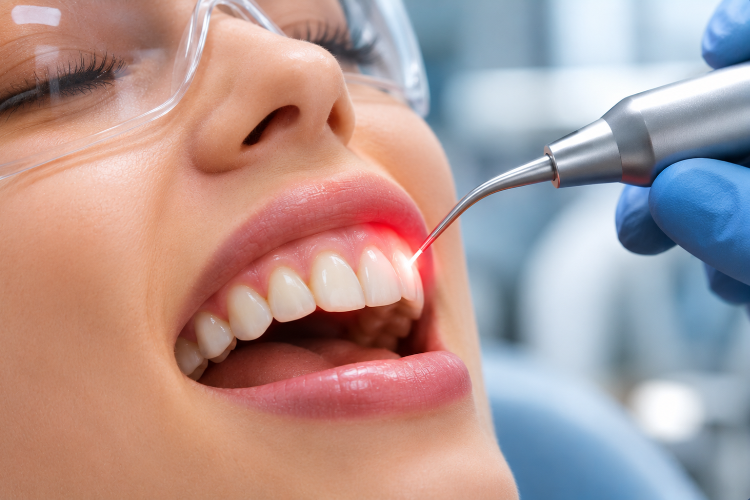
The word “laser” can make dental treatment sound more complicated than it really is. In practice, dental lasers are tools used by dentists to direct concentrated light energy at a specific area of the mouth. Depending on the type of laser and the procedure, they can be used for selected soft-tissue or hard-tissue dental applications.
That is where dental laser treatment comes in. It is best understood as another technique a dentist may consider when planning certain procedures, rather than as a completely different kind of dentistry.
At Dr Gowds Dental Hospitals, patients in Hyderabad can discuss whether laser dentistry is relevant to their dental needs and what the proposed procedure involves.
Want to understand whether laser dentistry is suitable for your dental concern?
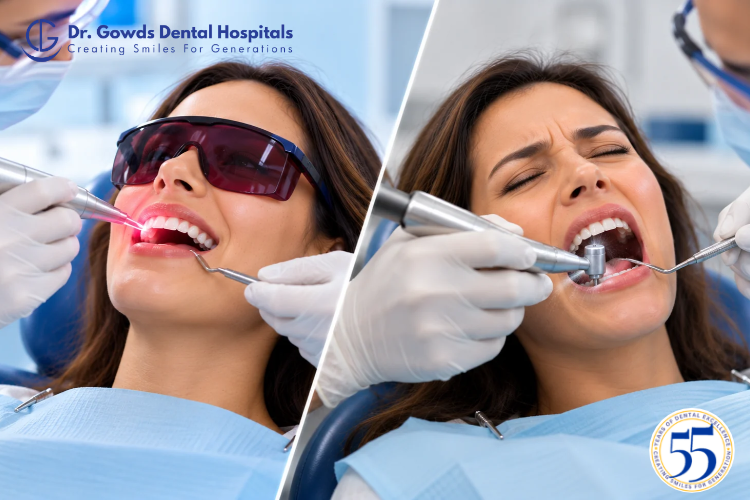
Dental laser treatment uses a dental laser device to deliver concentrated light energy to a selected area. The laser is controlled by the dentist according to the procedure being performed.
There is no single “dental laser treatment” that works the same way for every patient. Different laser systems are designed for different applications, and the choice depends on the tissue involved, the procedure, and the dentist’s treatment plan.
This is also why the phrase “no drill” needs some context. A laser may be used instead of a conventional dental instrument for certain procedures, but it does not mean that every dental treatment can be performed without a drill or other instruments.
At a basic level, the laser produces a focused beam of light. When directed at dental tissue, that energy interacts with the targeted area.
The exact interaction depends on factors such as:
The dentist controls these settings as part of the treatment process. The laser is therefore not a one-size-fits-all tool. Its use is planned around the specific dental procedure.
Soft-tissue lasers are designed for applications involving tissues such as the gums. The dentist directs the laser at the selected area and controls its movement and settings according to the procedure.
Some dental laser systems are designed for applications involving hard tissues, including parts of the tooth. Whether a laser is appropriate depends on the particular procedure and the dental assessment.
The important point is that laser dentistry is a technique, not a single treatment.
The use of lasers varies from one dental practice and procedure to another. Depending on the equipment available and the dentist’s training, laser technology may be considered for selected applications involving:
The exact use should always be explained before treatment. If a dentist recommends a laser-assisted procedure, ask what the laser will be used for and whether conventional instruments will also be required.
Not necessarily.
This is one of the most important things to understand when searching for no-drill dental treatment. The term is often used to describe procedures where a laser may replace a conventional dental instrument for a particular step.
However, dentistry involves many different procedures. A laser is not a universal replacement for every dental instrument.
A more accurate way to think about it is:
So, if you are specifically looking for “dental laser treatment without drilling,” ask your dentist whether the procedure you need can actually be performed using laser technology.
The process depends on the treatment, but a typical consultation begins with an assessment of the dental concern.
The dentist examines the area and discusses the reason for treatment. Additional examination methods may be used when needed.
If laser dentistry is being considered, the dentist determines whether a laser is appropriate for the planned procedure.
The dental team prepares the treatment area and equipment. Protective measures are used according to the laser system and procedure.
The dentist directs the laser at the selected area using settings appropriate for the procedure.
Once the procedure is complete, the dentist explains any relevant aftercare instructions and what to expect next.
The duration and steps can vary considerably. There is no single standard timeline for every dental laser procedure.
CTA: If you are curious about laser dentistry but unsure whether it applies to your treatment, speak with the dental team at Dr Gowds Dental Hospitals. A consultation can help you understand the proposed procedure before you decide.
Rather than assuming that a laser is automatically better, patients should focus on whether it is appropriate for their specific dental need.
Understanding the technology can help you:
Laser and conventional dental techniques are not necessarily competing choices. In some cases, a dentist may use one approach; in others, different tools may be used during different stages of the same procedure.
| Laser Dentistry | Conventional Approach |
| Uses focused laser energy | Uses conventional dental instruments |
| May be used for selected soft- or hard-tissue applications | Used across a wide range of dental procedures |
| Requires specific laser equipment and settings | Uses established dental instruments |
| Suitability depends on the procedure | Suitability depends on the procedure |
| May be used alone or alongside other instruments | May also be combined with other techniques |
The right comparison is not simply “laser versus drill.” It is “which technique is appropriate for this particular dental procedure?”
Before agreeing to any dental procedure, it is reasonable to ask for a clear explanation.
Consider asking:
These questions can make the consultation more useful and help you understand the treatment plan rather than focusing only on the technology.
Laser dentistry is not a separate category of dental care that everyone automatically needs. It is a technique that may be considered for selected procedures after a dental assessment.
If you are searching for dental laser treatment in Hyderabad, the best starting point is a consultation. The dentist can assess your dental concern, explain the available options, and tell you whether laser technology has a role in your treatment plan.
A consultation should be about more than simply asking whether a laser is available.
A useful discussion can cover:
This gives you a clearer picture of the procedure before treatment begins.
Dental laser treatment is not a universal replacement for every dental instrument. It is a technology that dentists may use for specific procedures involving selected dental tissues.
If the idea of laser dentistry interests you, start with the procedure you actually need rather than the technology alone. Ask what the dentist plans to use, why it is appropriate, and what the appointment will involve.
Looking for dental laser treatment in Hyderabad? Visit Dr Gowds Dental Hospitals at Nanakramguda, Gachibowli, Madhapur, koti to discuss your dental concern and understand whether laser dentistry is appropriate for your treatment plan.
Dental laser treatment uses a dental laser device to direct concentrated light energy at a selected area of the mouth. Depending on the procedure and laser system, it may be used for selected soft-tissue or hard-tissue applications.
A dental laser produces a focused beam of light that interacts with the targeted dental tissue. The dentist selects the laser type and settings according to the procedure being performed.
Not always. A laser may replace a conventional instrument during certain parts of some procedures, but it is not a universal replacement for dental drills or other instruments.
Some dental laser systems are designed for applications involving soft tissue such as gums, while other systems can be used for selected hard-tissue applications. The appropriate technology depends on the procedure being considered.
No. Whether a drill is required depends on the specific dental procedure. Some treatments may involve laser technology, conventional instruments, or a combination of both.
The process generally starts with a dental assessment and treatment planning. If laser technology is selected, the dentist prepares the treatment area, applies the laser according to the planned procedure, and provides relevant aftercare instructions.
The suitability of laser dentistry depends on the dental concern and the procedure being considered. A dental consultation is the appropriate starting point for understanding whether laser technology has a role in your treatment plan.
 Gachibowli Branch