

Schedule Appointment

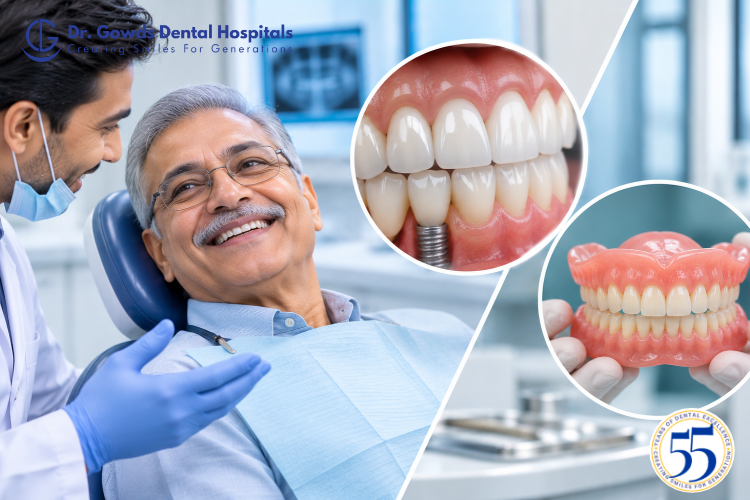
When several teeth are damaged, missing, heavily restored, or difficult to maintain, choosing the right full-mouth treatment can feel overwhelming. Two options that often come up are full mouth rehabilitation and full mouth dentures.
But which one lasts longer?
The answer is not as simple as choosing one treatment over the other. Full mouth rehabilitation is a comprehensive treatment approach that may involve different types of restorations, while full mouth dentures are removable appliances designed to replace a complete set of teeth. Their longevity depends on several factors, including the condition of the mouth, the materials used, daily care, bite forces, maintenance, and the treatment plan.
At Dr Gowds Dental Hospitals, patients can discuss their individual restoration options based on their dental condition, functional needs, and treatment goals across the Hyderabad branches in Nanakramguda, Gachibowli, Madhapur, koti.
Looking for the right option for full mouth restoration?
Full mouth rehabilitation is a coordinated approach to restoring multiple dental concerns at the same time. Instead of focusing on one tooth in isolation, the treatment plan considers the condition and relationship of the teeth across the mouth.
Depending on the individual case, a full mouth rehabilitation plan may involve restorations such as:
The exact combination is determined after evaluating the teeth, existing restorations, bite, gums, and overall oral condition.
The goal is to create a coordinated treatment plan rather than simply replacing individual teeth without considering how the different restorations work together.
The terms are sometimes used interchangeably, but full mouth rehabilitation generally refers to a comprehensive restorative treatment plan involving multiple areas of the mouth.
It is not a single procedure or a single type of dental restoration.
That distinction is important when comparing it with dentures.
Full mouth dentures, commonly referred to as complete dentures, are removable dental appliances designed to replace a complete set of teeth in an arch.
They generally consist of artificial teeth attached to a base that is designed to sit over the oral tissues.
Full dentures can be considered when a person has lost all teeth in an arch or when the remaining teeth are not suitable for the planned treatment approach.
One of the main differences from full mouth rehabilitation is that dentures are removable, whereas full mouth rehabilitation can involve restorations that are fixed, removable, or a combination depending on the treatment plan.
The biggest difference is that these are not really two identical treatment types.
| Factor | Full Mouth Rehabilitation | Full Mouth Dentures |
| Treatment type | Comprehensive restorative approach | Removable dental appliance |
| Teeth involved | May restore existing teeth and replace missing teeth | Replaces a complete set of teeth in an arch |
| Restorations | Can involve multiple restorative options | Uses an artificial tooth-and-base appliance |
| Removable | Depends on the treatment plan | Yes |
| Treatment planning | Usually highly individualised | Based on denture design and oral conditions |
| Maintenance | Depends on the restorations used | Requires regular cleaning and maintenance |
| Longevity | Depends on each restoration and oral conditions | Depends on fit, materials, care and ongoing changes |
The comparison therefore should not be based only on the question, “Which one lasts longer?”
A more useful question is:
Which option is appropriate for my current dental condition, and what maintenance will it require over time?
There is no universal number of years that can be applied to either option.
A full mouth rehabilitation may include several different restorations, and each component can have its own maintenance and replacement considerations. The overall longevity of the treatment therefore depends on factors such as:
Full dentures also require ongoing care. Their fit and comfort can change over time, and maintenance or adjustment may become necessary.
This means that full mouth rehabilitation is not automatically longer-lasting than dentures, and dentures are not automatically shorter-lasting than every rehabilitation option.
The actual answer depends on the individual treatment plan.
If you are considering full mouth rehabilitation, the treatment itself is only one part of the equation.
If some natural teeth can be incorporated into a restorative plan, their condition becomes an important part of treatment planning.
The amount of remaining tooth structure, previous restorations, and overall dental condition can influence which restoration is considered.
A full mouth rehabilitation can involve different restorations.
A crown, bridge, veneer, or implant-supported restoration does not have identical maintenance requirements. Therefore, it is better to assess the individual components rather than assign one lifespan to the entire rehabilitation.
The way the upper and lower teeth come together can affect restorations over time.
This is one reason bite evaluation can be an important part of comprehensive treatment planning.
Regular brushing, cleaning between teeth where appropriate, and maintaining good oral hygiene can help keep the mouth and restorations clean.
The exact home-care routine depends on the type of restoration used.
Full mouth treatment should not necessarily be viewed as a one-time event with no future maintenance.
Periodic dental evaluations allow the condition of restorations and surrounding oral structures to be assessed.
Dentures are also influenced by several practical factors.
A well-designed denture should be assessed for fit and comfort. Changes in the mouth over time can affect how the denture sits and functions.
The materials and construction of a denture can influence its durability and maintenance requirements.
Dentures require regular cleaning according to the instructions provided by the dental professional.
Because dentures are removable, careful handling can help reduce unnecessary damage.
A denture should not simply be used indefinitely without evaluation. Regular dental visits can help determine whether the denture continues to fit appropriately and whether any adjustments are needed.
There is no single answer that applies to everyone.
Full mouth rehabilitation may be worth discussing when:
Full mouth dentures may be worth discussing when:
The important point is that the decision should be based on an individual dental assessment rather than longevity alone.
Considering full mouth rehabilitation or dentures in Hyderabad? Dr Gowds Dental Hospitals can help you understand the available restoration options and what each involves before you make a decision.
Before selecting a treatment, ask the dental team questions such as:
These questions can make the consultation more useful and help you compare options based on your individual circumstances.
If you are comparing full mouth rehabilitation vs full mouth dentures, there is no universal winner when it comes to longevity.
Full mouth rehabilitation is a broader treatment approach that can involve several types of restorations. Full mouth dentures are removable appliances designed to replace a complete set of teeth in an arch.
The durability of either option depends on the treatment design, materials, oral condition, daily care, bite, habits, and maintenance.
Instead of choosing an option simply because you expect it to last longer, consider the bigger picture: your current dental condition, the type of restoration being proposed, maintenance requirements, and your long-term treatment goals.
Book a consultation with Dr Gowds Dental Hospitals in Hyderabad to discuss full mouth rehabilitation, dentures, and other appropriate restoration options for your dental needs.
There is no fixed answer. The longevity of either option depends on the treatment design, materials, oral condition, bite, daily care, habits, and ongoing maintenance.
Neither option is automatically better for every patient. Full mouth rehabilitation and full mouth dentures are different approaches, and the appropriate choice depends on the individual’s dental condition and treatment goals.
There is no single lifespan that applies to every denture. Fit, materials, oral conditions, daily care, handling, and regular dental evaluation can all influence how long a denture remains suitable.
A full mouth rehabilitation is a comprehensive treatment plan and may involve different types of restorations. Whether dentures are appropriate depends on the individual’s dental condition and the proposed treatment plan.
Full mouth rehabilitation should not be viewed as a treatment that requires no future maintenance. Different restorations can have different maintenance and replacement requirements.
Full mouth rehabilitation is a comprehensive restorative approach that can involve multiple types of dental restorations. Complete dentures are removable appliances designed to replace a complete set of teeth in an arch.
The decision requires an assessment of the current teeth, existing restorations, bite, oral condition, and treatment goals. A dental consultation can help you understand which options are relevant to your situation.
 Gachibowli Branch